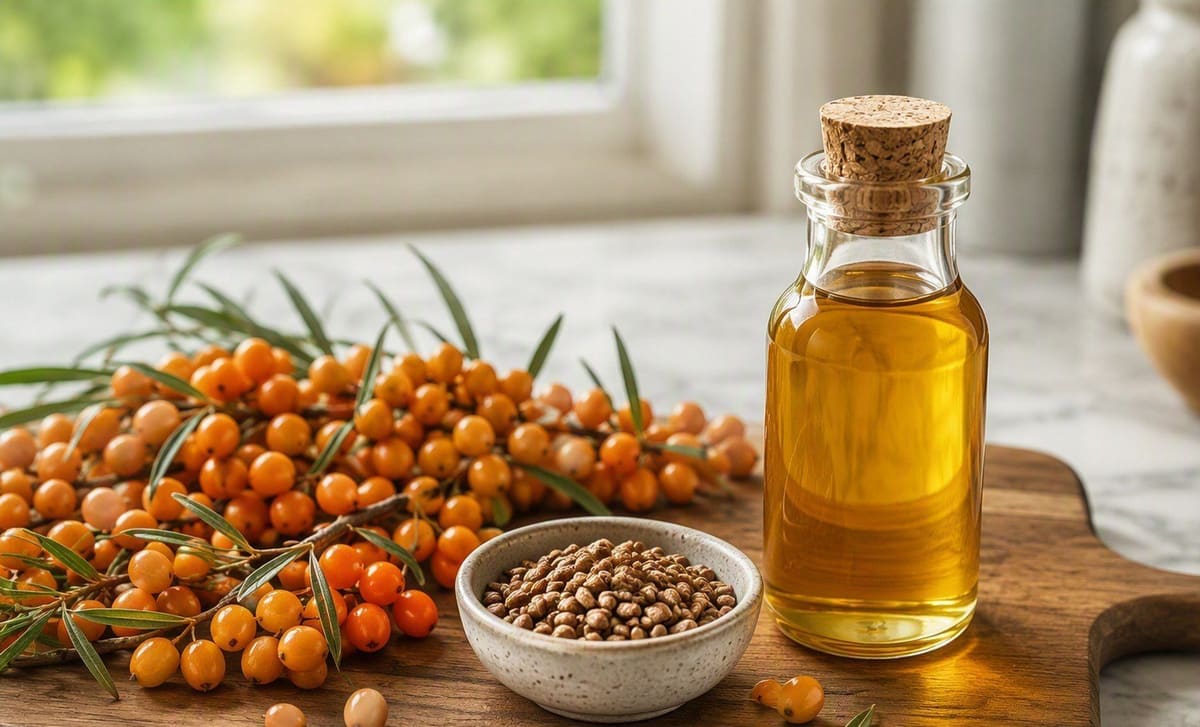
Sea buckthorn’s nutrition story splits in two. The berry flesh gives you vitamin C, carotenoids, and the rare omega-7 fatty acid. The seed gives you a balanced omega-3 and omega-6 oil with almost no omega-7. Most marketing blurs that line. We keep it sharp, because which part you buy decides which nutrients you get.
Nutrition claims for this plant range from well measured to wildly inflated. This hub keeps the verified numbers and flags the slippery ones.
How to read these pages
Every page in this cluster answers the same three questions. What does the plant contain, with the verified range and its source? What survives into each form: fresh, dried, juice, oil, tea? And what does a real serving deliver, measured against your daily needs rather than a lab assay? Pages that answer all three give you the whole picture. Numbers without a plant part, a form, and a serving attached are exactly the marketing this hub exists to catch.
Start with the split that matters
Seed oil vs berry oil: the complete breakdown
One plant, two completely different oils. The berry oil carries omega-7 and carotenoids. The seed oil carries omega-3 and 6 and stays pale. If you read one nutrition page on this site, make it this one, because every product decision downstream depends on it.
The deep dives
Omega-7: the rare fatty acid, explained
The nutrient this whole plant is famous for. Berry oil runs 30 to 40 percent palmitoleic acid, the seed oil carries almost none, and that gap is the reason the plant part on a label matters more than the brand name on the front.
Vitamin C: the real numbers behind the hype
Why the quoted ranges vary sevenfold, what heat and drying and six months on a shelf actually destroy, and how the berry compares to an orange once you stop comparing the best case to the average case.
Omega-3, 6, 9 (and 7): the full map
Which oil carries which omega, why the “all the omegas” claim conflates two oils, and the ratio question in plain words.
Fatty acid profile: every number, both oils
The complete composition table for berry oil and seed oil, with the chart, and what each fatty acid actually does.
Antioxidants and the ORAC myth
Carotenoids, tocopherols, flavonoids, vitamin C: the real cast, plus why the USDA retired ORAC scores as misleading.
Fresh vs dried vs powder: what survives
Nutrient retention by form. Fresh and frozen keep everything, drying concentrates sugar and costs vitamin C, and juice drops the fiber.
Sugar content: the berry vs the products
The fresh berry is low-sugar and intensely acidic. The sugar lives in juice blends, jams, and sweetened dried berries.
Glycemic index: what nobody has measured
No published GI number exists for sea buckthorn. What composition predicts, labeled as prediction, plus the honest word for diabetics.
Oil nutrition: what is in the dropper
Carotenoids, vitamin E, and phytosterols beyond the fatty acids, with the per-teaspoon reality check: 4.5 grams, always with food.
Juice nutrition: what survives the press
Vitamin C, acids, and flavonoids make it into the glass. Fiber and most of the oil do not. Pure vs blend vs concentrate, decoded.
The nutrient-by-nutrient pages
Vitamins
Vitamin E: both oils, one winner
Tocopherols and tocotrienols ride in both oils, the seed oil carries more, and the bottle’s freshness decides how much survives.
Vitamin A: carotenoids, not retinol
The berry supplies provitamin A carotenoids your body converts on demand, which is the self-limiting, safer route to vitamin A.
Vitamin K: present, unremarkable
Modest amounts in the oil, leafy greens own this nutrient, and warfarin users get a consistency note rather than a sales pitch.
B vitamins: present, unremarkable
A food-scale spread across the B family, and zero B12, because it is a plant. Honesty over padding.
Plant compounds
Carotenoids: why the berry is orange
Beta-carotene leads a dense pigment load that puts berry oil among the richest plant sources, and stains your countertop on contact.
Flavonoids: quercetin to isorhamnetin
The three-lead cast behind the plant’s lab reputation, where they sit in the plant, and why every total is a range.
Quercetin: the everyday flavonoid
The same compound onions are famous for, carried as glycosides, with the absorption ceiling that disciplines every headline.
Isorhamnetin: the signature flavonoid
The methylated quercetin that fingerprints genuine sea buckthorn, and the honest line between lab interest and human proof.
Polyphenols: the whole family view
Flavonoids and phenolic acids across berry, leaf, and oil, with the cultivar spread that makes single-number labels fiction.
Phytosterols: cholesterol’s lookalikes
Plant sterols at meaningful levels in the berry oil, the real mechanism, and the dose honesty the claim requires.
SOD: a marketing darling, audited
The antioxidant enzyme is present, oral SOD is largely digested, and the measured nutrients are the better reason to buy.
Organic acids: the sour engine
Malic, quinic, and citric acids drive the taste, the enamel caution, and the reflux flip for sensitive stomachs.
Macros and other pages
Calories: berry, juice, oil
Fresh berries are light, juice depends on the blend, and the oil is pure fat at about 40 calories per level teaspoon.
Protein: the honest short answer
Fruit-scale protein in the berry, a richer fraction in the seed press cake, and no product that replaces a protein source.
Fiber: whole berry yes, juice no
The cargo lives in skin and pulp, so whole berries and powders deliver it while juice and oil drop it entirely.
Amino acids: present, not a protein play
A broad amino acid spread in the seed and pulp protein fraction, at amounts too small to build a strategy on.
Minerals: what the berry carries
Potassium leads a food-scale panel of calcium, magnesium, iron, and trace elements. A fruit’s contribution, not a supplement.
Tea nutrition: leaf vs berry cup
Leaf tea steeps flavonoids into a caffeine-free cup, berry tea is a diluted juice, and neither matches eating the berry.
The headline nutrients
- Vitamin C. The berry is legitimately rich, with reported ranges of roughly 200 to 600 mg per 100 g, depending on variety and where it grew. Heat, drying, and storage cut it hard, so juice numbers and fresh-berry numbers are different conversations.
- Carotenoids. The source of the famous orange. Beta-carotene, lycopene, and zeaxanthin show up in meaningful amounts in berry oil. They also explain why it stains your skin and your countertop.
- Palmitoleic acid (omega-7). Berry oil runs roughly 30 to 40 percent palmitoleic acid, rare among plant oils. This is the fatty acid most sea buckthorn research actually tests.
- Omega-3 and omega-6. The seed oil’s strength, in a ratio close to 1:1, which is unusual and genuinely useful.
- Flavonoids and vitamin E. Present in both oils, with vitamin E especially concentrated in seed oil.
The numbers to distrust
Any label or blog quoting a single vitamin C figure without naming the variety, plant part, and test method is copying someone else’s homework. Same for ORAC antioxidant scores, which the USDA stopped endorsing years ago. When we cite composition numbers, they come from the peer-reviewed analyses listed in our research hub.
From nutrients to doses
Knowing what is in the plant is step one. Step two is knowing how much people actually took in the trials, which is a dosage question. Step three is picking a product whose label matches, which is what our oil guide is for.
Frequently asked questions
What nutrients are in sea buckthorn?
The berries carry vitamin C (amounts vary enormously by variety and processing), carotenoids that give the orange color, and flavonoids. Berry oil is one of the richest sources of palmitoleic acid (omega-7). Seed oil contains almost no omega-7 but is rich in omega-3 and omega-6.
Which sea buckthorn nutrient stands out most?
Two share the podium. Vitamin C is the quantity story: fresh berries carry roughly 200 to 600 mg per 100 g, several times an orange by weight, though processing cuts it hard. Omega-7 is the rarity story: berry oil is among the richest known plant sources of palmitoleic acid. Everything else the plant offers is real but available from more ordinary foods.