Sea buckthorn’s skin claims rest on two human trials of oral oil: hydration improved in both, and elasticity, collagen density, and texture improved in one or the other. Twelve weeks of daily use, not overnight miracles. Acne and wrinkle claims run ahead of the evidence. This hub maps every skin topic with its honest grade.
Skin is where sea buckthorn marketing gets loudest, and where the evidence needs the most careful reading. Search sea buckthorn oil benefits for skin and the results skew heavily topical, which is exactly the reading this page slows down. Start with the topic that brought you here, or step back to the full map of what this berry does if skin is only part of what you came for.
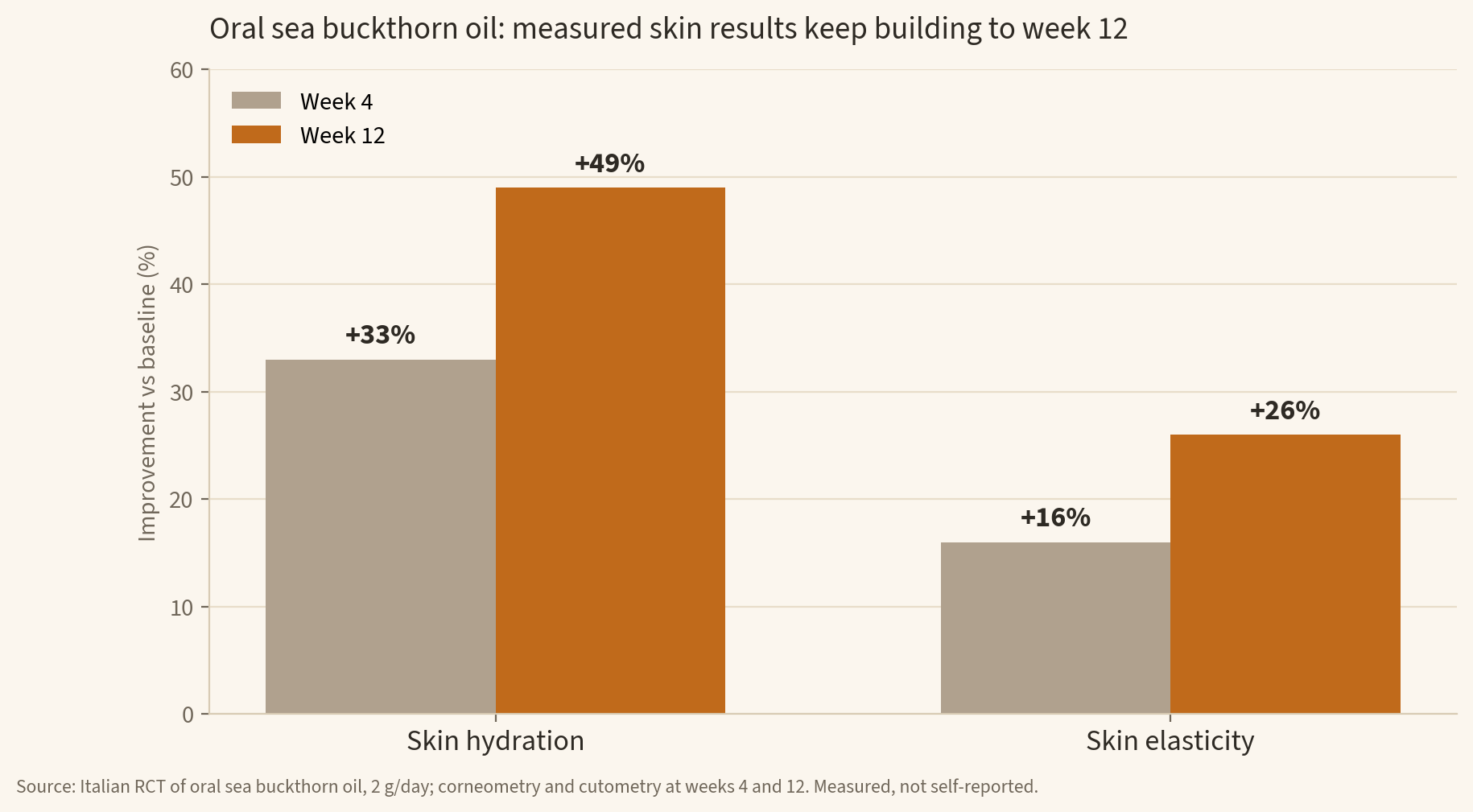
See the data behind this chart
| Measure | Week 4 | Week 12 |
|---|---|---|
| Skin hydration | +33% | +49% |
| Skin elasticity | +16% | +26% |
How this collection is organized
Where sea buckthorn oil benefits skin at all, the pages below sort the case into three honesty tiers. First, the measured claims: dry skin, wrinkles, elasticity, and collagen rest on two human trials of oral oil, with instrument numbers and stated caveats (no oral placebo in 2009, industry funding in 2024). Second, the conditions with no sea buckthorn trials at all: acne, eczema, psoriasis, rosacea, and the rest, where each page’s job is to mark the boundary and point to what does have data. Third, the practical guides: orange stains, comedogenic ratings, sensitive skin, and oily skin, where chemistry and technique matter more than trials. One timeline governs everything: the trial results took 12 weeks of daily use, so any promise faster than that is marketing, not measurement. The grades on each page follow the same scale throughout: instrument-measured trial data outranks self-reports, self-reports outrank mechanism logic, and mechanism logic outranks tradition. When two pages seem to disagree, the grade is usually the explanation.
In this collection
Sea buckthorn for dry skin
The strongest skin claim the plant has. Two trials measured real hydration gains from oral oil. What changed, by how much, and the routine that matches the studies.
Sea buckthorn for wrinkles
Elasticity and collagen density did improve in the trials, which is more than most supplements can say. What “improve” meant in millimeters and weeks, and what it did not mean.
Sea buckthorn for acne
The thinnest evidence of the three. No human trial has tested sea buckthorn for acne. Here is what the comedogenic rating and the fatty acid logic actually support, and what to do instead.
Sea buckthorn for glow: the radiance claim, graded
Glow is hydration plus texture plus good light, and the trial gains are real but measured in weeks and single-digit percentages, not overnight shine.
Sea buckthorn for collagen: what +10% actually means
Collagen density rose about 10 percent in one placebo-controlled trial, and this page separates that measured number from the marketing around it.
Sea buckthorn for eczema and atopic dermatitis
No verified human trial exists for either word, so this page keeps the oil in its place next to treatments with real human data, and gives the adjunct rules that make trying it safe.
Conditions, claims, and practical questions
More honest answers, from the measured to the mythical:
- Sea buckthorn for psoriasis: an autoimmune condition that oils cannot treat, plus what moisturizers can do.
- Sea buckthorn for rosacea: no trials and real cautions, because reactive skin punishes experiments.
- Sea buckthorn for elasticity: the one claim with instrument data, +26% in 2009 with the caveats attached.
- Sea buckthorn for wounds and burns: what is verified (nothing yet) and the rules for minor burns at home.
- Sea buckthorn for scars and stretch marks: moisture and massage help appearance, time does the fading.
- Sea buckthorn for hyperpigmentation: the vitamin C logic, the orange-tint irony, and what actually works.
- Comedogenic rating, explained: where the low number comes from and why patch tests still rule.
- The orange stain guide: why berry oil tints, how to avoid it, and the pale seed-oil fix.
- Sea buckthorn for oily skin: when oil meets oil, the seed-oil nuance, and the valid option of skipping oils.
- Sea buckthorn for sun damage: the SPF myth retired, and the three honest lanes of prevent, treat, support.
- Sea buckthorn for dark circles: circles are mostly anatomy, and what one drop can honestly do.
- Sea buckthorn for lips: the best topical fit the plant has, tint included.
- Sea buckthorn for cellulite: the claim to skip, explained kindly.
- Sea buckthorn for dermatitis: an umbrella term with different rules per type, doctor first.
- Sea buckthorn for sensitive skin: the careful protocol, from 1:10 dilution to the three-day forearm test.
The inside-out insight most pages miss
Both landmark trials fed people the oil. The skin improvements came from the inside, at 1 to 2 grams a day over 12 weeks. Topical products have tradition and formulation logic behind them, but less direct trial data, so the sea buckthorn oil skin care benefits a serum advertises rest on softer ground than the oral numbers do. The skincare buying guide covers the topical route, and the capsules guide covers the route the studies actually used.
Say sea buckthorn oil for skin out loud and most people picture a dropper and a cheekbone. That is the mismatch worth naming. The measured sea buckthorn oil skin benefits on this page came from swallowing the oil for twelve weeks, not from smoothing it on at bedtime, and the topical evidence is thinner than the shelf suggests. Use both routes if you want. Just keep straight which one the numbers belong to. The oil-on-face routine sets honest expectations for the topical half.
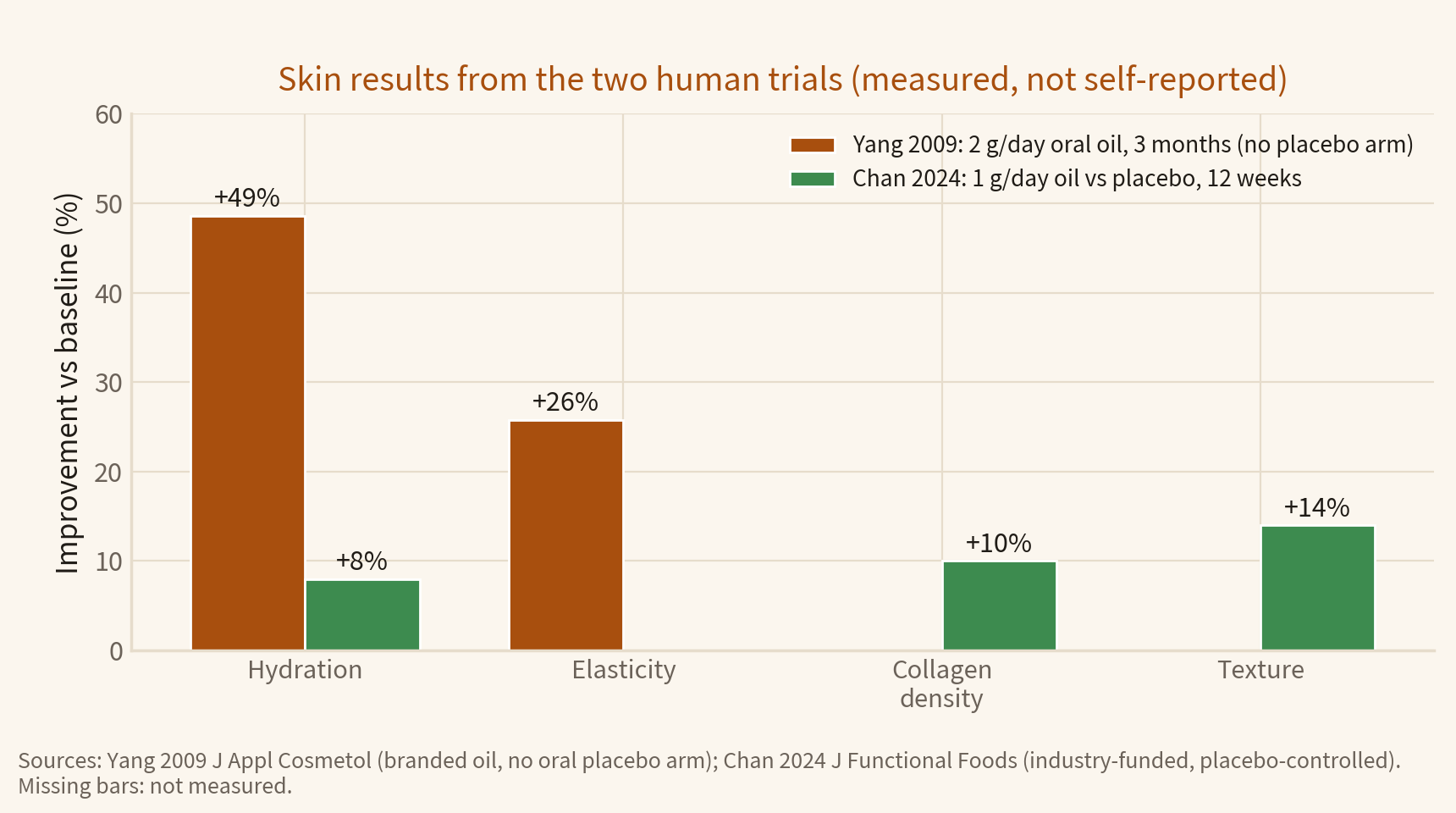
See the data behind this chart
| Measure | Yang 2009 (2 g/day, 3 mo) | Chan 2024 (1 g/day, 12 wk) |
|---|---|---|
| Hydration | +48.6% | +8% |
| Elasticity | +25.8% | not reported |
| Collagen density | not measured | +10% |
| Texture | not measured | +14% |
Safety first
Skin routines fail people when they skip the boring parts: patch tests, dilution, and realistic timelines. The safety hub covers the systemic side, and each page in this collection covers the topical specifics.
Frequently asked questions
Does sea buckthorn really work for skin?
For hydration and elasticity, yes, with caveats. Two human trials of oral sea buckthorn oil measured improved skin hydration, and one also found improved elasticity and collagen density. Results took 12 weeks of daily use. Claims for acne, whitening, and wrinkle removal have much thinner evidence.
How long does sea buckthorn take to work on skin?
Twelve weeks, because that is what the trials ran. The 2009 study measured hydration gains at one month that roughly doubled by three months of daily oral oil, and the 2024 trial judged everything at the 12-week mark. Any page promising faster is describing marketing, not measurements. Topical softness can arrive in days, but the structural numbers belong to the three-month frame.