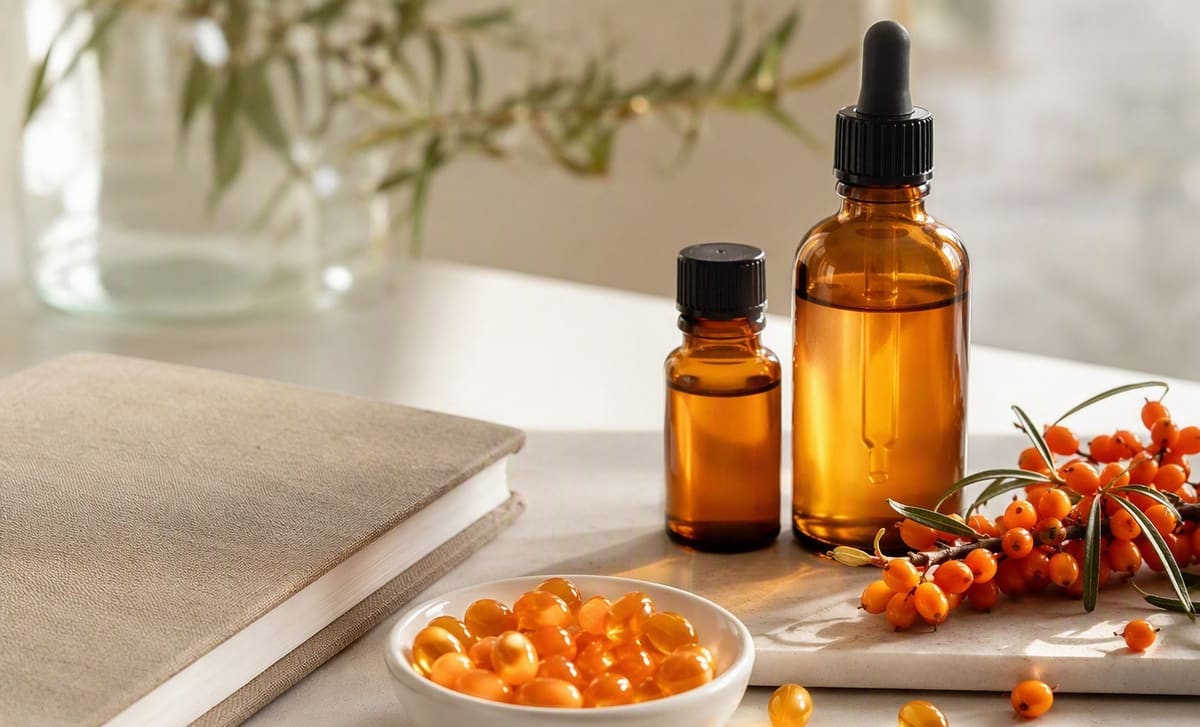
The best sea buckthorn product depends on what you want it for. For dry eyes and general supplementation, a blended seed-and-berry oil softgel is the form the human studies used. For skin, topical products work on the surface while capsules work from inside. Every guide below ranks products with the same published rubric, and every pick shows its cost per day.
This is our buying-guides home. Everything here runs on one rule: we score, we show the math, and we tell you when something is not worth buying.
Our guides
Best sea buckthorn oil
Liquid oils for internal use, ranked. This is the most confusing shelf in the store because “sea buckthorn oil” can mean berry oil, seed oil, or a blend, and those are different products. We scored the labels and picked the bottles worth your money.
Best sea buckthorn capsules and softgels
The form most human studies used, and the easiest way to hit the 2 to 3 grams a day those studies tested. Includes the best blend, the best vegan capsule, and the pick we would skip.
Best sea buckthorn skincare
Face oils, creams, and serums. What sea buckthorn can realistically do on your skin, which products deliver it, and which are ordinary moisturizers wearing an orange costume.
Best sea buckthorn face oils
The narrower version of the skincare page, for people who have decided on a straight oil. Ranked by skin type, with the budget pick, the sensitive-skin pick, and the honest advice on avoiding an orange face.
Best sea buckthorn for skin
The inside-out pairing. Oral oil at trial doses is the part with the human evidence, topical is the part that rounds out a routine, and this guide picks one of each and tells you to give it twelve weeks.
Best sea buckthorn juice
Two verified organic bottles, what juice can and cannot do for you, and the acidity rules nobody mentions on the label.
Best sea buckthorn powder
One single-ingredient pick that passed the label test, plus what drying does to the fresh berry’s vitamin C.
Best sea buckthorn tea
No winner, on purpose. Why this category failed our rubric, and the label checklist to bring shopping instead.
Best organic sea buckthorn
Certified picks only. Every product carries named organic certification, and we show you how to verify a claim in thirty seconds.
Best sea buckthorn for hair
Seed oil for the scalp, berry oil for lengths, and the honest reason no product on this page promises regrowth.
Best budget sea buckthorn
The cheapest verified routes to study-level doses, with real cost-per-day math and the cheap traps that are not budget at all.
Sea buckthorn price guide
What fair pricing looks like per studied day, the cost-per-gram formula, and the patterns that signal overpaying.
How to spot fake sea buckthorn oil
Dilution, mislabeling, and old stock: the color, smell, label, and COA checks that catch them before checkout.
Amazon vs iHerb vs brand direct
The three channels compared on freshness, prices, and buyer protection, with a verdict for each kind of buyer.
Cold pressed vs CO2 extraction
What each extraction method does to the oil, what the research used, and why a missing method line is information.
Premium sea buckthorn: when paying more makes sense
What a premium price should actually buy, the four label checks that justify it, and the three products where the extra money shows up.
How we score (the short version)
Every product gets 0 to 10 across five criteria:
| Criterion | Weight | What we check |
|---|---|---|
| Purity and sourcing | 30% | Species, origin, organic certification, plant part used |
| Fatty acid profile | 25% | Verified omega-7 in berry oil, omega-3 and 6 in seed oil |
| Third-party testing | 20% | Certificates of analysis, contaminant screening |
| Value | 15% | Cost per day at study-level doses |
| Transparency | 10% | Does the label tell you what is actually inside |
The full method, including how we handle research-based reviews before hands-on testing, lives in our editorial policy.
Before you buy anything
Read our seed oil vs berry oil guide first. Ten minutes there will save you from the single most common mistake in this market: paying berry-oil prices for a bottle that is mostly seed oil.
The 60-second route to the right guide
- Goal first. Dry eyes, skin, or general supplementation points to the capsules guide or the oil guide. Kitchen goals point to juice, powder, or tea. Skin goals point to the skincare guide.
- Budget second. The price guide sets the fair bands, and the budget guide finds the floor.
- Trust check third. The fake oil guide and the choosing checklist give you the label filter.
- Channel last. Where to buy and the channel comparison pick the seller.
The mistakes we see in every category
- Berry and seed confusion, still the most common error in this market, still solved by the seed vs berry page linked above.
- Bottle-price thinking instead of cost-per-day math, solved by the cost per day tool.
- Expecting juice, powder, or tea to deliver the oil trial results. The forms compared page maps what carries the research.
- Skipping the safety page when blood thinners, pregnancy, or surgery are in the picture. The safety overview takes five minutes.
After you buy
Two habits make any of these products work. Storage: fridge the oil after opening and finish it in three to six months, per the storage rules. Patience: the trials ran twelve weeks, so judge any product at week twelve, not week two. The how to use hub covers the daily routines for every form.
Frequently asked questions
What is the best sea buckthorn product to start with?
For most people, a blended seed-and-berry oil softgel is the best start, because that is the form used in most human studies. If your goal is skin care specifically, a topical face oil or cream makes more sense than a supplement.
How do you rank sea buckthorn products?
We score every product from 0 to 10 across five published criteria: purity and sourcing (30%), fatty acid profile (25%), third-party testing (20%), cost per day (15%), and label transparency (10%). The full rubric is on this page and in our editorial policy.
What is the cheapest way to try sea buckthorn properly?
A verified liquid oil taken at the studied 2 grams a day, which lands around $0.60 to $0.90 per day from the bottles in our oil guide. That is cheaper than any softgel route to the same dose, and the budget guide lists the current lowest verified options.