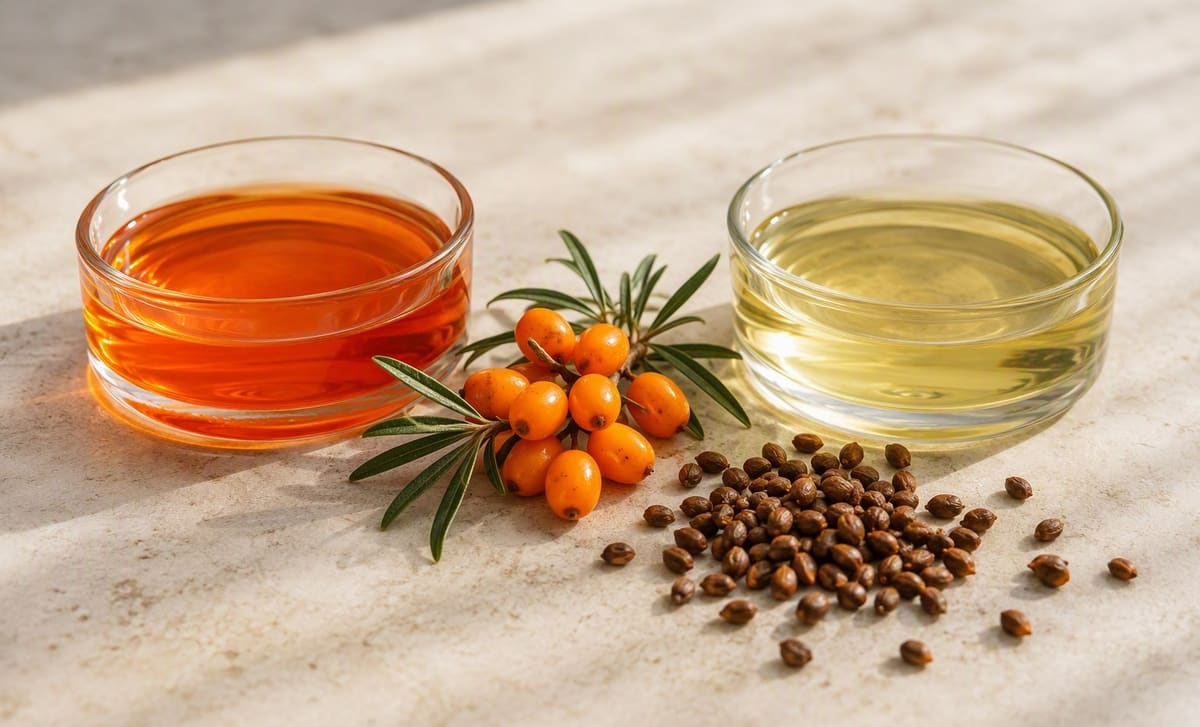
One plant, two oils, almost opposite fatty acid profiles. Berry oil is built on palmitoleic (omega-7) and palmitic acids. Seed oil is built on linoleic (omega-6) and alpha-linolenic (omega-3). Every major number, from the composition studies, is in the table below, with plain-language notes on what each fatty acid actually does.
This is the table the rest of the nutrition hub keeps pointing back to.
The complete profile
| Fatty acid | Berry (pulp) oil | Seed oil | What it does |
|---|---|---|---|
| Palmitoleic (omega-7) | 15 to 54% | Trace | The signature fat. Most sea buckthorn research targets it |
| Palmitic | 25 to 35% | 7 to 10% | Common saturated fat; gives berry oil its richness |
| Oleic (omega-9) | 15 to 25% | 15 to 25% | The olive-oil fat; neutral, well tolerated |
| Linoleic (omega-6) | 2 to 10% | 30 to 40% | Essential fat; skin barrier building block |
| Alpha-linolenic (omega-3) | 1 to 3% | 20 to 35% | Essential plant omega-3; converts poorly to EPA/DHA |
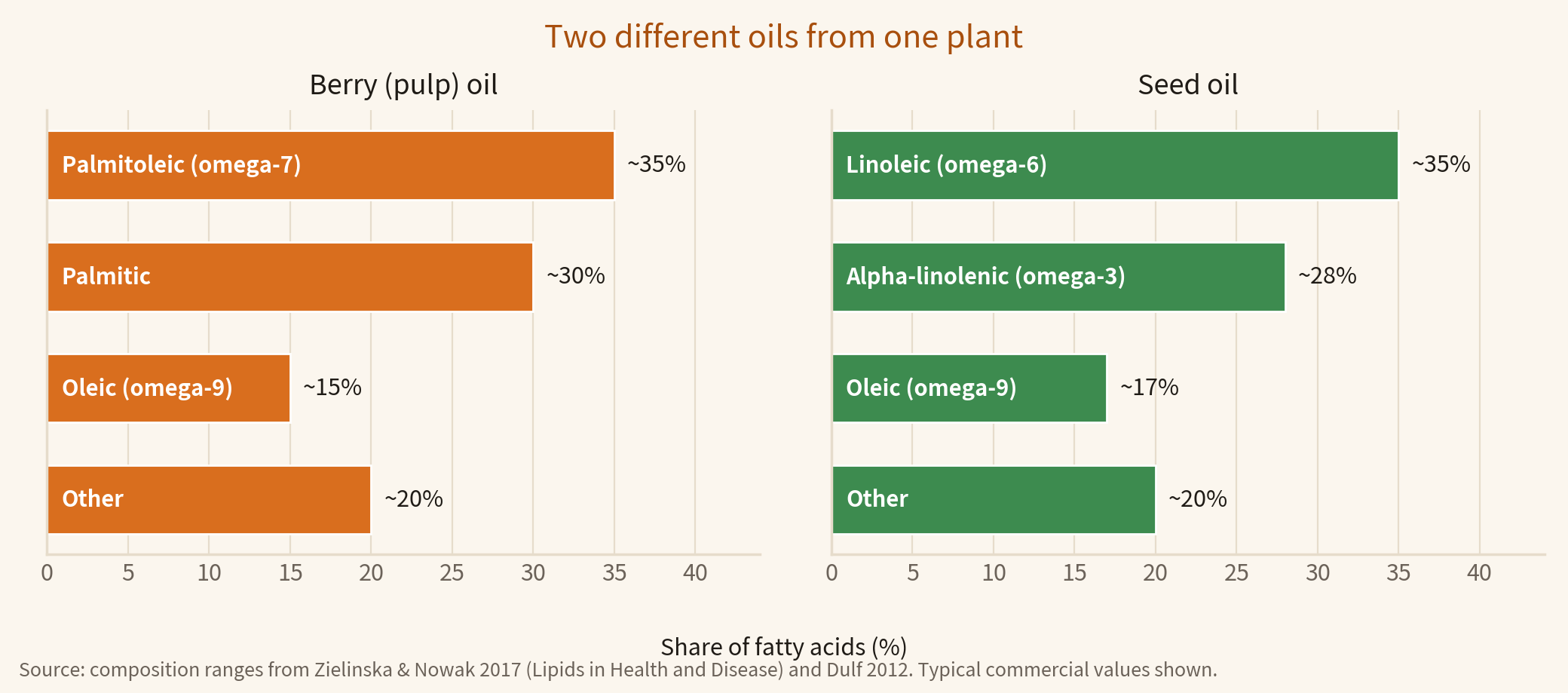
See the data behind this chart
| Fatty acid | Berry (pulp) oil | Seed oil |
|---|---|---|
| Palmitoleic (omega-7) | ~35% | trace |
| Palmitic | ~30% | low |
| Linoleic (omega-6) | low | ~35% |
| Alpha-linolenic (omega-3) | low | ~28% |
| Oleic (omega-9) | ~15% | ~17% |
How to read this table
The wide omega-7 range is real, not sloppy. Subspecies move palmitoleic acid from about 15 to 54 percent of berry oil. Typical commercial berry oils land at 30 to 40 percent, still among the richest known plant sources. A label quoting one exact figure is pretending the variation does not exist.
Palmitic acid is not the villain here. Yes, it is the saturated fat people count in meat and palm oil. In berry oil it arrives inside a whole-food matrix at a few grams a day, a different exposure entirely.
Seed oil reads like a balanced flax. Its omega-3 to omega-6 ratio sits near 1:1, which almost no common oil manages. The catch is shared with all plant omega-3s: conversion to the marine forms is poor, so it complements rather than replaces fish or algae oil.
Berry oil is not a seed-oil substitute, or vice versa. They barely overlap, which is why the seed oil vs berry oil page exists and why the omega map puts these numbers in context.
What a teaspoon of each oil delivers
Kitchen math, using the measured ranges and a level teaspoon of about 4.5 grams. Berry oil at a typical 30 to 40 percent palmitoleic delivers roughly 1.4 to 1.8 grams of omega-7 per teaspoon, which meets or exceeds the total oil dose of most human trials in one pour. Seed oil at 30 to 40 percent linoleic and 20 to 35 percent alpha-linolenic delivers roughly 1.4 to 1.8 grams of omega-6 and 0.9 to 1.6 grams of plant omega-3 per teaspoon. The trials dosed 1 to 3 grams of oil daily, so both oils overshoot the studied range at a full level teaspoon, which is worth knowing before you pour a second one. The omega-7 page goes deeper on the signature fat, and the palmitoleic acid glossary entry defines it.
Beyond the bottle: where else the fats show up
Whole berries carry both fractions in miniature, pulp oil and seed oil together, which is why a whole-berry powder touches all four omega families in small amounts. Juice keeps whatever pulp oil survives pressing and filtering. Softgels are simply the oil pre-portioned, typically at 500 milligrams each, so the teaspoon math above converts directly: two to four softgels cover a studied gram. The flaxseed oil comparison grades the seed oil against the shelf’s other plant omega-3 source, and the comparison is closer than most marketing admits.
Common misreadings
- “One exact percentage on the label.” Subspecies alone moves omega-7 from 15 to 54 percent. A precise figure is a promise no harvest can keep.
- “Palmitic acid makes berry oil bad fat.” Context is dose. A few grams a day inside a whole-food oil matrix is not the exposure that saturated-fat warnings target.
- “Seed oil is the cheap version.” It is the other oil, with the balanced omega ratio and the vitamin E lead. Different job, different bottle, not a downgrade.
The ratio question, kept in proportion
Omega-6 to omega-3 ratio is the discourse’s favorite scorecard, and the seed oil scores unusually well: at 30 to 40 percent linoleic against 20 to 35 percent alpha-linolenic, it sits near parity, which few plant oils manage. Two honest caveats. First, the dose is a teaspoon, so the oil nudges your daily ratio rather than deciding it. Second, the ratio debate is about patterns across the whole diet, and no single bottle fixes a pattern. Flax wins the omega-3 crown on density, as the flaxseed oil comparison shows, and this plant’s seed oil earns its place on balance, not dominance.
Where these numbers come from
The ranges above come from composition studies: a 2017 review in Lipids in Health and Disease pulling together the published analyses, and cultivar work like a 2012 study that measured fatty acids across six sea buckthorn cultivars grown in one Romanian orchard. Same species, same soil, and the cultivars still differed, which is the best single argument for quoting ranges instead of one heroic figure.
Extraction and storage move the numbers at the margins too. Supercritical CO2 extraction and cold pressing are the clean methods, and an oil that has sat warm and open for a year is not the oil the studies measured. Fresh, dark-glass, and recently bottled wins here just like everywhere else in this aisle.
From profile to purchase
Labels should name the plant part (berry, pulp, fruit, or seed) and ideally the subspecies, because the ranges above move with it. Products whose labels clear that bar are scored in our oil guide. What is in the oil beyond fatty acids, the carotenoids, tocopherols, and phytosterols, is on the oil nutrition page.
Frequently asked questions
Which fatty acid is sea buckthorn famous for?
Palmitoleic acid, omega-7. It makes up roughly 15 to 54 percent of the berry oil's fatty acids depending on subspecies (typical commercial oils run 30 to 40 percent), and few plant oils carry meaningful amounts of it. This is the fatty acid behind most of the dry-eye and skin research. Seed oil has only trace omega-7.
Is sea buckthorn oil a good source of omega-3?
The seed oil is a solid plant source: alpha-linolenic acid at roughly 20 to 35 percent of fatty acids, in an unusually balanced ratio with its omega-6. The berry oil is not, at 1 to 3 percent. Like all plant omega-3s, ALA converts poorly to the marine EPA and DHA forms, so it complements rather than replaces fish or algae oil.
How much omega-7 is in a teaspoon of sea buckthorn berry oil?
Roughly 1.4 to 1.8 grams, doing the arithmetic honestly. A level teaspoon of oil is about 4.5 grams, and palmitoleic acid runs 30 to 40 percent of a typical commercial berry oil's fatty acids. That single teaspoon meets or exceeds the omega-7 intake used across most of the human trials, which dosed 1 to 3 grams of total oil daily.