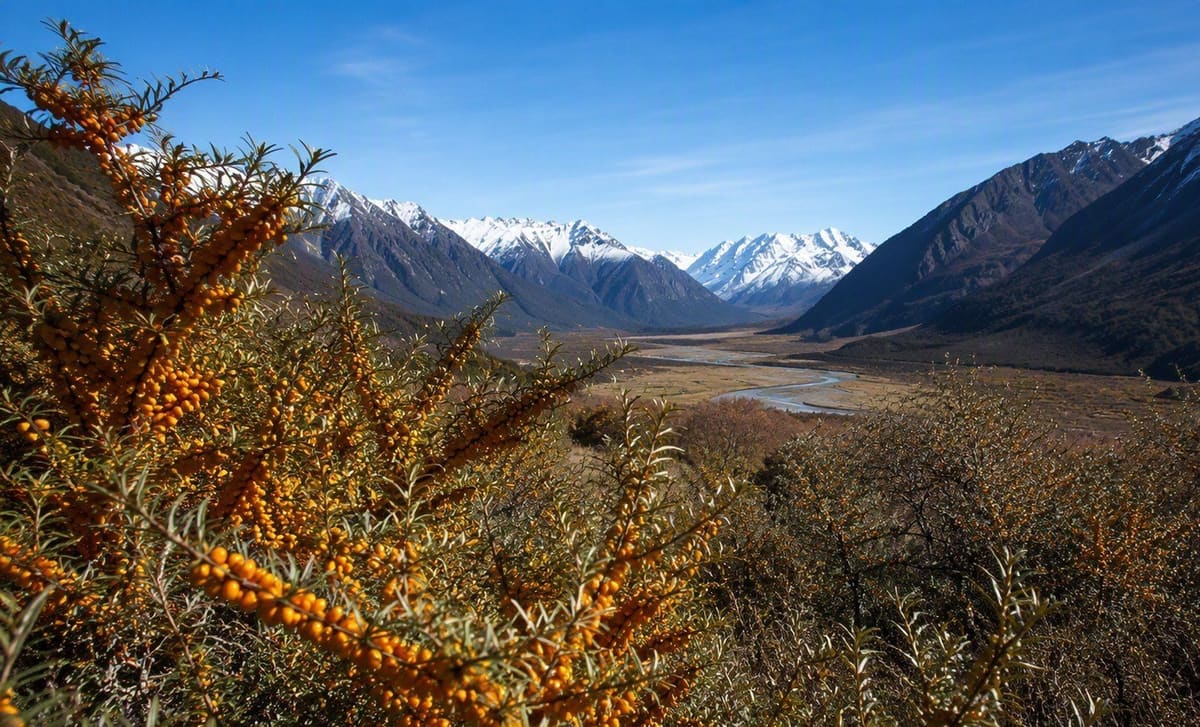
Sea buckthorn grows wild from the Atlantic dunes of Europe to the high valleys of the Himalayas, and it is farmed most heavily in China, Russia, and Canada. Origin matters because altitude, climate, and variety shift the berry’s chemistry, and because honest brands tell you exactly where their berries came from.
“Where was this grown?” is one of the first questions we ask any label. Here is the map behind the answer.
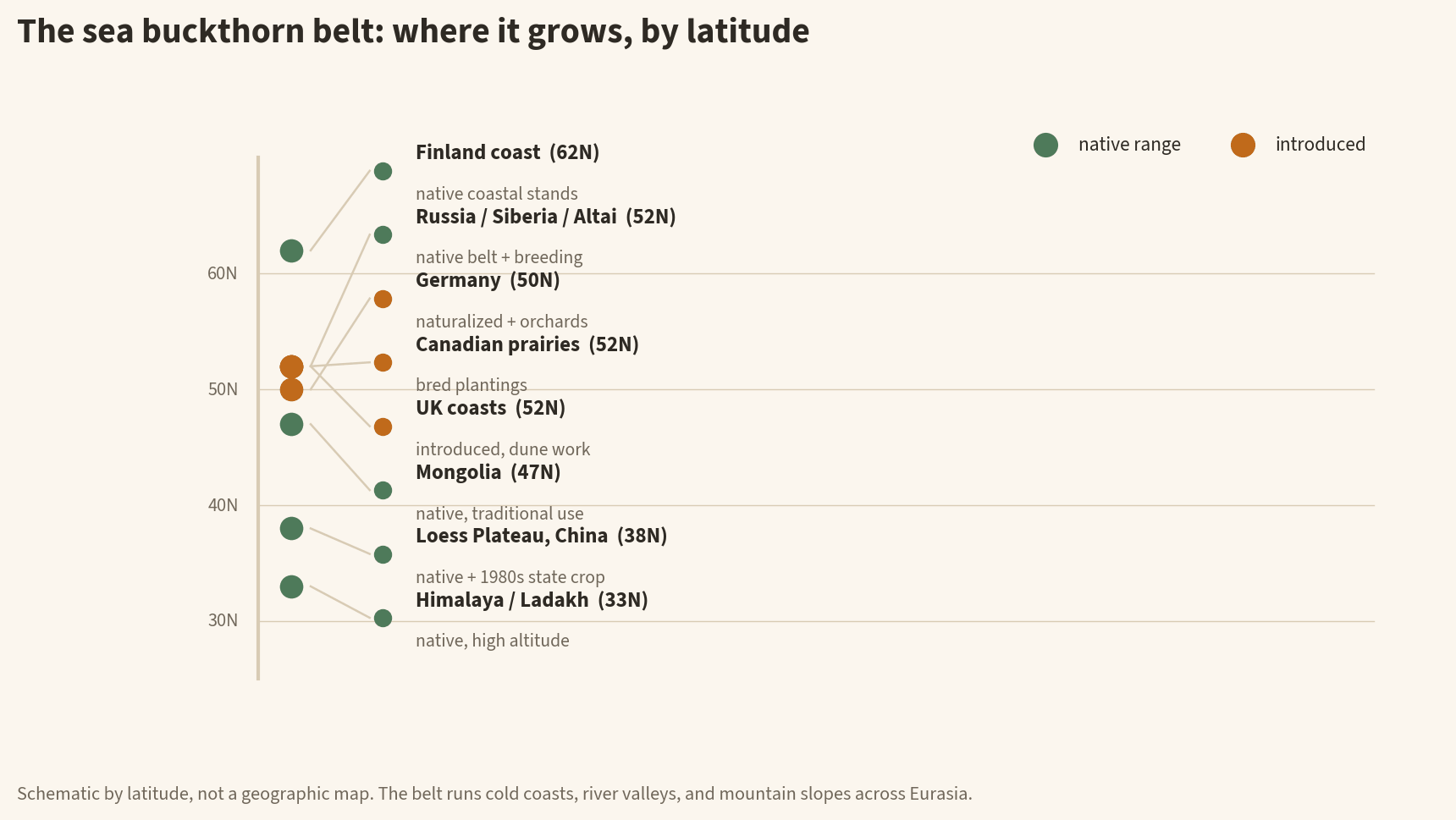
See the data behind this chart
| Region | Latitude | Status |
|---|---|---|
| Finland coast | 62N | Native coastal stands |
| Russia / Siberia / Altai | 52N | Native belt plus breeding |
| Germany | 50N | Naturalized plus orchards |
| Canadian prairies | 52N | Introduced, bred plantings |
| UK coasts | 52N | Introduced, dune work |
| Mongolia | 47N | Native, traditional use |
| Loess Plateau, China | 38N | Native plus 1980s state crop |
| Himalaya / Ladakh | 33N | Native, high altitude |
The Himalayas and Tibet
The prestige origin, and the source behind SIBU, SeabuckWonders, and Puredia’s Omegia oil. High altitude, harsh UV, and brutal temperature swings push the berries toward dense pigmentation and fatty acid profiles that brands rightly brag about. Wild-harvested here mostly means hand-picked on steep slopes, which is part of why Himalayan oil costs more.
Mongolia and Siberia
The northern heartland. Russia has the deepest cultivation history, including the Soviet-era breeding programs that produced many modern cultivars. Siberian berries anchor much of the traditional use record.
Europe’s coasts and river valleys
Sea buckthorn is native across coastal Northern and Western Europe, from the Baltic dunes to the Atlantic fringe, where it stabilizes sand. Germany’s long relationship with the plant is why brands like Weleda have decades of product history. Finland produced much of the modern clinical research, including the dry-eye trial.
Canada’s prairies
The newcomer. Canadian growers, especially on the prairies, planted sea buckthorn seriously from the 1990s onward. Cold winters suit the shrub, and Canadian orchards supply much of North America’s whole-berry and juice trade.
China, the giant
China holds the world’s largest sea buckthorn resources by area, planted at massive scale for erosion control since the 1980s. Most bulk oil and powder on global ingredient markets starts here, which makes traceability the question that separates good suppliers from anonymous ones.
Country and region guides
Himalayan belt
Sea buckthorn in India
Ladakh and the Himalayan belt as the heartland, how Indian consumers meet the berry, and buying notes for India. Indians know it as Leh berry and have no old Hindi word for it, a naming story the sea buckthorn in Hindi page tells name by name.
Sea buckthorn in Himachal Pradesh
The high valleys beyond Ladakh: Lahaul-Spiti and Kinnaur, wild harvest, and smallholder mountain products.
Sea buckthorn in Nepal
Wild harvest in Mustang and the trans-Himalayan districts, and what mountain-scale production means for buyers.
Sea buckthorn in Bhutan
Wild stands in the high valleys and a small gathering tradition in the eastern Himalayas.
East and Central Asia
Sea buckthorn in China
The giant: most of the world’s planted area, erosion-control orchards, and the source of most bulk oil and powder.
Sea buckthorn in Mongolia
Gathered, not farmed: the wild-harvest tradition of the steppe.
Sea buckthorn in Russia
The Altai and Siberian homeland and the breeding programs behind modern sweet varieties.
Europe
Sea buckthorn in Europe
The big picture: native coasts from the Baltic to the Atlantic, research, and the organic market.
Sea buckthorn in Germany
Sanddorn country: coastal dunes, decades of research, and a strong organic sector.
Sea buckthorn in Finland
A native coastal berry with an outsized research record.
Sea buckthorn in the UK
Naturalized on the coast, loved by foragers, and mostly imported on shelves.
North America
Sea buckthorn in the USA
Not native but at home in the cold: where it grows, where Americans buy it, and how to grow your own.
Sea buckthorn in Canada
Prairie orchards, research-backed plantings, and North America’s whole-berry trade.
Buying by country (English-speaking markets)
Buying sea buckthorn in the UK
Where British shops and sites stock it, and why the FSA gives supplements no approval number to look for.
Buying sea buckthorn in Canada
The retail and online channels, plus the eight-digit Health Canada NPN to check on any supplement.
Buying sea buckthorn in Australia
Where to find it, almost all imported, and what a TGA AUST L number on the label really proves.
Buying sea buckthorn in India (Leh berry)
The Leh berry, Ladakh sourcing, the domestic brands, and the FSSAI mark every juice should carry.
What origin means for you
- Named region beats no region. “Himalayan” or “Tibetan Plateau” on a label is a claim you can question. Silence is not.
- Variety plus region shapes chemistry more than region alone.
- Certifications travel with the berry, so organic paperwork should name the origin too.
Our brands hub shows which companies clear this bar, and the plant hub covers the shrub itself.
How to use this map
Three questions bring readers here, and each has a route. Buying? Start with the region on your label, then read its buying notes. Growing? The Canada and USA pages lead to the growing hub for the practical work. Visiting? The Himalayan pages and the UK page cover what a traveler can actually see and do. Every route ends at the same discipline: named origin, named producer, named plant part.
The pattern behind the map
Look across thirteen pages and one pattern repeats: the berry belongs to cold, bright, difficult country, and every origin’s story is a version of stress making flavor. High Himalayas, Siberian rivers, Baltic dunes, prairie winters. The where it grows page explains the biology, and the varieties page shows what breeders then did with it. Origin matters because terrain writes chemistry, and the map above is really a map of stresses.
Frequently asked questions
Which country has the most sea buckthorn?
China, by a wide margin. It holds the largest wild populations and has planted millions of hectares for soil conservation, mostly in the north and on the Tibetan Plateau. Russia, Mongolia, India, and several European countries follow.
Does origin really change the berry?
Yes, through terrain and variety together. Altitude, cold, sun, and poor soil stress the plant into denser pigmentation and richer chemistry, and bred varieties shift the profile again. Origin on a label is worth reading, and worth questioning, because it is the first traceable fact about what is in the bottle.