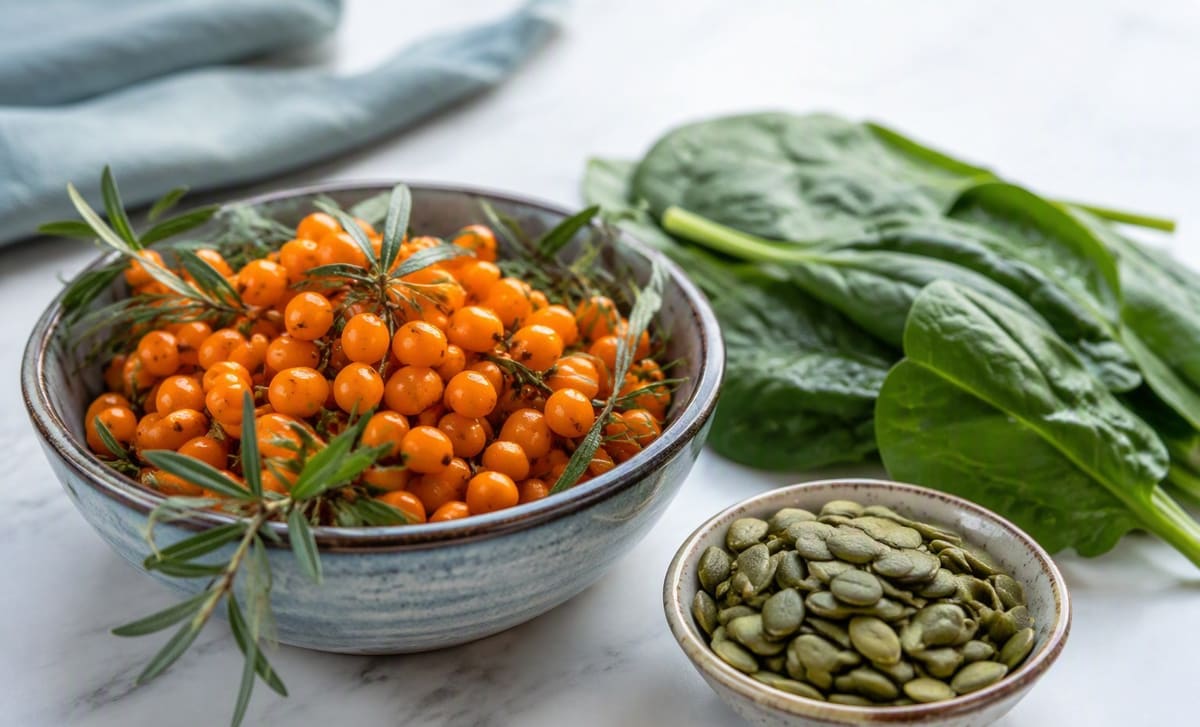
The berry carries a mineral panel led by potassium, with calcium, magnesium, iron, and trace elements alongside, in ordinary food-scale amounts. This is a fruit’s contribution, not a mineral supplement, and the oil form leaves nearly all of it behind.
The panel, honestly scaled
Composition reviews of the plant catalog its minerals, and the pattern is familiar fruit chemistry:
| Mineral | Where it sits | The honest scale |
|---|---|---|
| Potassium | Berry flesh and juice | Leads the panel |
| Calcium | Berry | Food-scale |
| Magnesium | Berry and seed | Food-scale |
| Iron | Berry | Present, in plant (non-heme) form |
| Trace elements | Berry and seed | Cataloged, not standout |
No single line on that table justifies a purchase, and together they make the berry a reasonable, mineral-contributing fruit. That is the whole claim this page is willing to make.
Form decides what survives
Minerals are not fat-soluble, so the split is predictable. Juice keeps the water-soluble share, which is one reason the juice nutrition page treats pure juice as the berry’s closest liquid relative. Whole berries, dried berries, and powders keep the full panel. The oil keeps essentially none of it, the mirror image of where the vitamin E and carotenoids went.
The serving math
No per-serving mineral analysis of the berry exists in the sources we trust, so the honest sentence is structural. A 100-gram bowl of fresh berries delivers a fruit-sized contribution of potassium and smaller amounts of calcium, magnesium, and iron, the same order of help any fruit bowl provides. Juice keeps the water-soluble share, and powder concentrates whatever the drying kept. Against daily requirements, every form is a contributor, none is a solution, and a varied diet covers the panel without effort. The berry’s mineral story is a supporting credit, and its lead roles live elsewhere, as the vitamin C page makes plain.
Why the oil drops the panel
Minerals are salts, and salts do not dissolve in fat. Pressing the berry for oil leaves the mineral panel behind with the juice and pomace, which is why an oil capsule is essentially mineral-free. This is the mirror image of the carotenoid story, where the oil won and the juice lost. Every form keeps some nutrients and drops others, and the juice nutrition page maps the liquid side of that trade.
The iron note, done honestly
Plant iron is non-heme iron, the less-absorbed form, and the berry carries a modest amount of it. The interesting wrinkle is the co-passenger: vitamin C improves non-heme iron absorption, standard nutrition science, and the berry packs one of the richest vitamin C loads of any fruit. The amounts keep this in bonus territory rather than treatment territory. Anyone managing diagnosed iron deficiency needs doses and monitoring only a doctor’s plan provides.
Common misreadings
- “Mineral-rich” label lists. Every fruit has a mineral panel, and listing one is not a distinction.
- Trace-element mystique. Cataloged trace elements at trace levels are background, not a selling point.
- “More minerals than common fruits.” No comparative analysis supports a ranking, and the moringa comparison grades another plant sold on the same density framing, with the same serving-size discipline applied.
The soil variable
Plants do not make minerals. They pull them from the ground, which is why mineral panels are geography rendered as chemistry. Sea buckthorn grows from Himalayan slopes to Baltic coasts, in soils that differ enormously, and the berry’s panel tracks the soil it grew in. This is the deepest reason every honest table quotes ranges. A berry from selenium-rich ground carries more selenium than the same cultivar from poor ground, and no breeding program overrides the dirt. Vitamins the plant synthesizes itself, within limits its genetics set. Minerals it merely collects, within limits the soil sets. That asymmetry is worth remembering whenever one panel looks suspiciously rich: check where the raw material grew before crediting the species. It is also why precise mineral figures on processed products deserve scrutiny. The number came from one batch’s assay or one origin’s soil, and the range is not evasion. It is what honesty looks like when the raw material is a plant that travels.
Where sea buckthorn fits
A varied diet covers potassium from potatoes and bananas, calcium from dairy and greens, magnesium from nuts and grains, and iron from a dozen sources with higher density. Sea buckthorn earns its place with the nutrients other foods do not match, vitamin C and the fatty acids, as the nutrition hub lays out. The minerals are a supporting credit. If you want the form that keeps them, the dried berries page and the fresh vs dried vs powder comparison show the trade-offs, added sugar included.
Frequently asked questions
Is sea buckthorn a good source of minerals?
It is a normal fruit source, not a standout. The berry carries a mineral panel led by potassium, with calcium, magnesium, and iron in ordinary food-scale amounts, and composition reviews catalog trace elements alongside. A varied diet covers these minerals easily, and the oil form drops almost the entire panel.
Does sea buckthorn's vitamin C help absorb its iron?
Yes, and it is one of the berry's quiet synergies. Vitamin C improves the absorption of plant-form (non-heme) iron, which is standard nutrition science, and the berry happens to carry both in the same package. The iron amounts stay modest, so this is a small bonus rather than an anemia strategy. Anyone treating iron deficiency needs the doses only a supplement or diet overhaul provides.