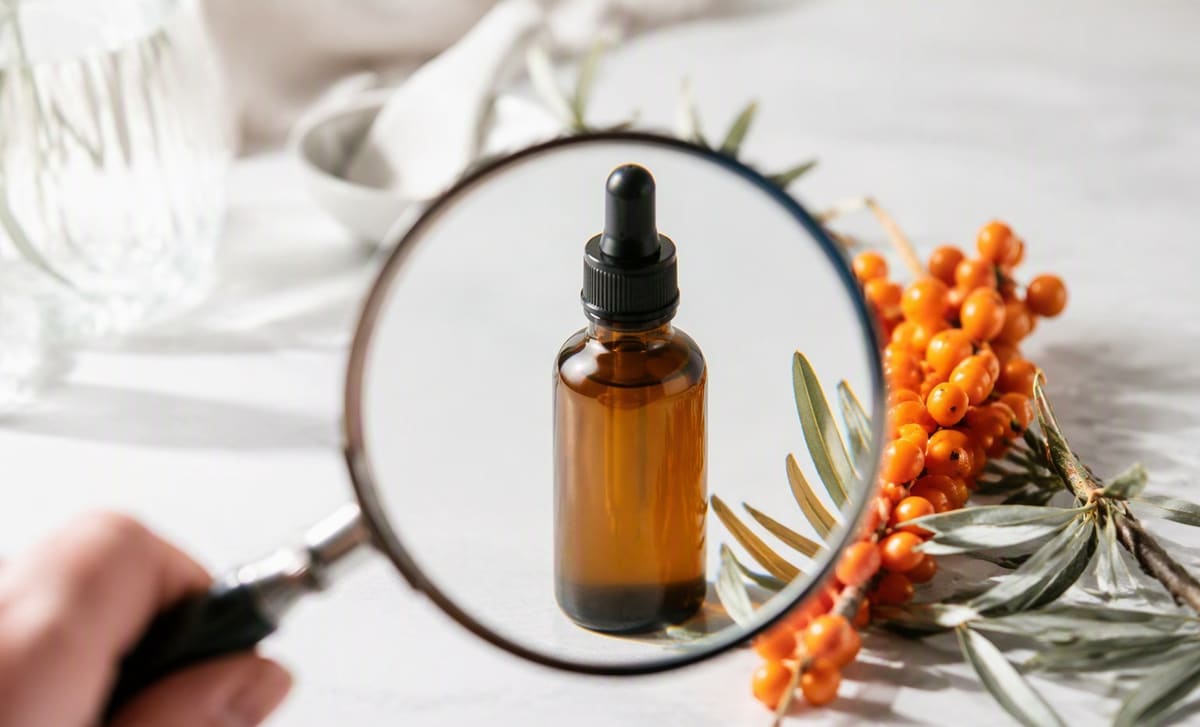
Choosing sea buckthorn oil takes five label checks and two bits of math: plant part, species, extraction, certification, origin, then dose and cost per day. Any bottle that passes all five with numbers you can verify is a good buy. Any bottle hiding one of them has told you something too.
Step 1: The five label lines
- Plant part. Berry, seed, or blend, stated outright. This decides which fatty acids you are buying, per the berry vs seed page.
- Species. Hippophae rhamnoides, the species the research used.
- Extraction. Supercritical CO2 is best, cold pressed is fine, solvent is a pass.
- Certification. Organic with a named certifier (USDA, EU), not a self-awarded badge.
- Origin. A named region. “Himalayan” or “Tibetan Plateau” is a verifiable claim. Silence is not a claim at all.
Step 2: The dose decision
Decide your daily target before comparing prices: 2 grams matches the dry-eye and skin trials, per the dosage page. A cheap bottle that cannot reach your dose affordably is not cheap.
Step 3: Cost per day, not bottle price
(bottle price ÷ total grams of oil inside) × your daily grams. The tools page walks through it with a worked example, and every product in our guides publishes this number.
Red flags that end the evaluation
- “Proprietary blend” hiding the oil split.
- Carrier oils (sunflower, soybean) listed ahead of sea buckthorn.
- No plant part, no origin, no extraction method. One miss is sloppy, three is strategy.
- Health claims the evidence does not support, especially weight loss, per our weight loss evidence page.
What “blend” and “proprietary” actually hide
Two honest meanings and one common one. Honest: a deliberate berry-plus-seed oil blend with the split printed, like the benchmark label’s 800 mg berry plus 200 mg seed. Common: carrier-oil dilution wearing a fancy name, where sunflower or soybean does the volume and sea buckthorn does the label. “Proprietary blend” with no milligram breakdown is never protecting a secret formula. It is protecting the margin, because printed numbers can be checked and adjectives cannot.
Common buying mistakes
- Bottle-price thinking. A $15 bottle that lasts ten days at the studied dose costs more per month than a $45 bottle that lasts sixty.
- One-capsule-a-day dosing. The studies used 2 to 3 grams, and one 500 mg softgel is a quarter of the low end.
- Trusting the front of the pack. Every claim that matters is on the back, in the supplement facts and the ingredient order.
- Ignoring the seller. A perfect label in a hot third-party warehouse is a degraded product, per the fake oil guide.
The two-minute supplement facts read
Three lines settle most bottles. Serving size: how many softgels or milliliters make one serving. Amount per serving: milligrams of sea buckthorn oil, ideally split by plant part. Servings per container: divide bottle price by that to get cost per serving, then scale to your daily target. The “other ingredients” list matters too: gelatin type for vegans, and any carrier oil named before the sea buckthorn.
Matching the form to the person
- Taste-sensitive: softgels. The oil is earthy, and nobody keeps a habit they dread.
- Budget-first: liquid oil, the cheapest route to 2 grams a day.
- Vegan: cellulose capsules or liquid oil. Many softgels use beef gelatin.
- Pill-fatigued: liquid stirred into yogurt or a smoothie, per the how to use hub.
- Travelers: softgels. Liquid oil plus luggage plus orange stains is a known bad combination.
The questions to ask a brand before buying
A short email tells you more than a long listing. Ask four things: where the berries are grown, which extraction method is used, whether they will share a certificate of analysis for the current lot, and when the batch was pressed. Serious brands answer within days with specifics. Silence, or a reply that restates the marketing, ranks the brand for you.
Reading reviews without being read by them
Reviews are useful for exactly two things: catching rancidity complaints and catching packaging failures. Everything else is noise, because reviewers cannot test composition and the trials ran twelve weeks while most reviews are written on day three. Weight the one-star reviews for patterns, ignore the five-star poetry, and never let a review count substitute for the label lines.
A word on organic certification
Organic is worth paying for in this category, because the berries often come from wild or semi-wild harvests where verification is the only assurance on offer. The certifier’s name matters more than the word: USDA, EU, or another named body can be checked in thirty seconds, while a generic leaf logo cannot. No certification is not an automatic fail, but it moves the burden onto the other four label lines.
The 60-second decision path
- Goal named: dry eyes, skin, general use. If the goal has no trial behind it, stop here and save the money.
- Form chosen: liquid for value, softgels for convenience, per the price guide.
- Five label lines pass: plant part, species, extraction, certification, origin.
- Cost per day at 2 grams computed. Inside the fair band, proceed.
- Seller verified: the brand or an authorized retailer.
After you buy: the first week
Fridge the liquid oil after opening, and learn its fresh smell so you will catch oxidation later. Softgels go in a cool, dry cupboard. Start at half the target dose for a few days if your stomach is cautious, then move to the studied amount, split across meals. The storage page covers every form, and the palmitoleic acid entry explains the molecule your label should be quantifying.
The shortcut
If you would rather start from products that already passed this checklist, the oil guide and capsules guide score exactly these criteria, and the brands hub explains who is behind the labels.
Ready to pick?
You have the checklist. If you want the short version, our top-rated oil passed all five label checks and costs about $0.75 a day at the label dose, $1.50 at the full trial dose.
See our top-rated oilOr browse the scored lists yourself: the oil buying guide for liquids and blends, and the capsules buying guide for softgels including a vegan pick.
Frequently asked questions
What should I look for when buying sea buckthorn oil?
Five label lines decide quality: the plant part (berry, seed, or blend), the species (Hippophae rhamnoides), the extraction method (CO2 or cold pressed), organic certification with a named certifier, and a stated origin. Then check cost per day at a real dose, not the bottle price.
Is sea buckthorn oil worth the money?
For the goals with human trial support, at fair prices, yes: dry eyes, skin hydration, and vaginal dryness were tested at 1 to 3 grams a day, and a fair bottle costs roughly $0.60 to $1.50 per studied day. For goals without trials, like weight loss or immunity promises, no price is worth it, because the evidence is not there.