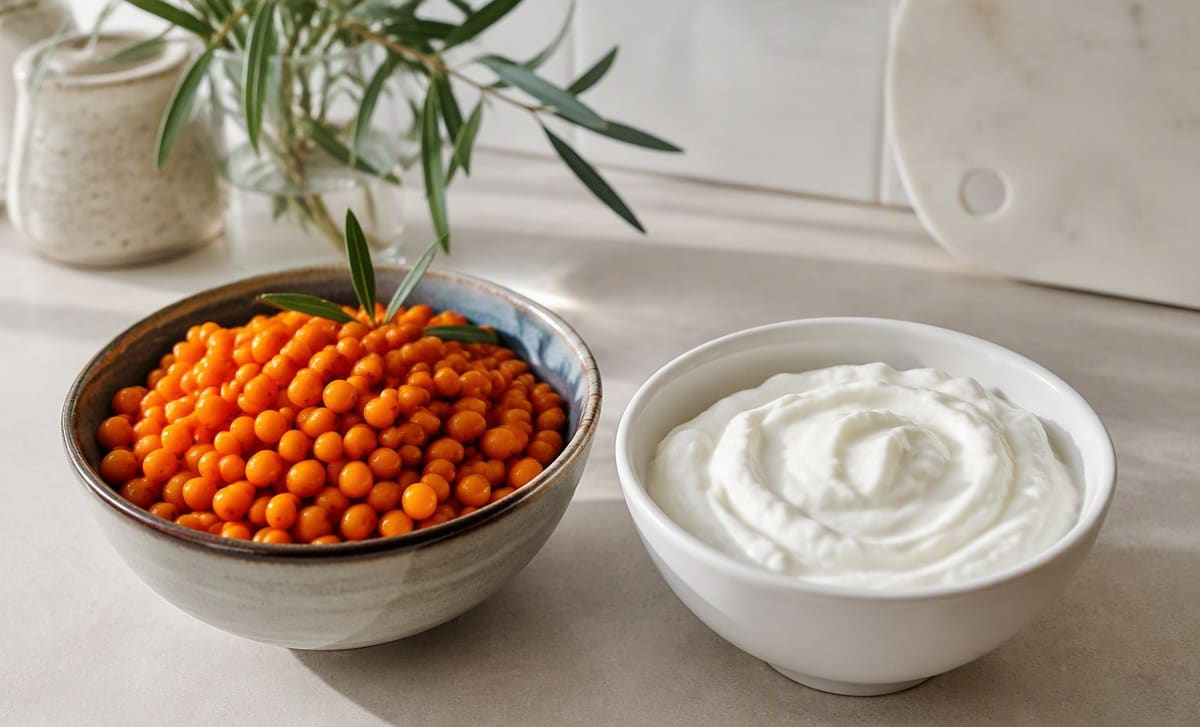
Short answer: sea buckthorn is not a protein food. The fresh berry carries a little, the seed and press cake carry more, and no product in this aisle moves your daily protein number in any way that matters.
The protein geography
The plant’s protein is unevenly distributed. The berry flesh carries fruit-scale amounts. The seed carries a richer fraction, which is why the press cake left over after oil extraction has value as animal feed. That feed market tells you where the protein actually is: concentrated in the part of the plant that consumer products mostly discard.
The press-cake economy
Follow the protein after pressing and the story gets practical. The pomace left behind, skins, pulp, and crushed seed, concentrates the plant’s protein several-fold, and it sells. To farmers. Feed producers value sea buckthorn press cake exactly because the consumer industry discarded it. A few producers in the plant’s home regions mill seed flour for specialty baking, the one place a human might meaningfully eat this fraction. Neither product shows up in the supplement aisle, because the aisle sells what markets well, and “the part we threw away” markets poorly.
Form by form
Whole berries and powders carry the berry’s modest baseline, concentrated a little by drying. Juice carries less, because pressing leaves protein behind with the solids. Oil carries none, because protein is not fat-soluble and never enters the fat fraction. The fresh vs dried vs powder page shows what each form keeps, and protein is never the headline.
The serving arithmetic
Put the forms against a daily target measured in tens of grams. A 100 g portion of fresh berries contributes a couple of grams at most, fruit scale. A glass of juice contributes less, because pressing left the protein with the solids. A spoon of powder gives back a few grams, concentrated by drying. A teaspoon of oil, about 4.5 grams, gives zero, because protein never enters the fat fraction. Even the most generous form moves your daily number by a rounding error, and the calories page runs the same arithmetic from the energy side.
Why the claim appears anyway
Composition reviews list the plant’s protein and a broad amino acid spread, and labels stretch that into a protein story. The discipline is arithmetic: your daily target is measured in tens of grams, and the berry’s contribution is measured in single grams at realistic servings. Presence on a composition table is not a serving-size contribution.
The amino acid footnote
The spread itself deserves a fair sentence. Composition reviews find a broad amino acid panel in the plant’s protein fraction, covering the essentials, and labels occasionally wave that list like a flag. Two qualifiers shrink it back to size. The spread lives mostly in the seed and press-cake fraction, not in the forms people buy. And the total amount is so small that the panel’s breadth never gets a chance to matter. Broad and tiny is still tiny.
The collagen confusion
Because vitamin C participates in collagen formation, some marketing frames the berry as a protein-structure supplement. That is a vitamin story wearing a protein costume. The berry supplies the vitamin C cofactor, not the protein itself, and your body builds collagen from the protein you eat, which brings the question straight back to the foods that supply it. The collagen page separates those two contributions in full.
Protein quality, briefly
Even setting quantity aside, quality does not rescue the story. Plant proteins vary in amino acid completeness and digestibility, and nobody has run human studies on sea buckthorn protein’s quality at any dose, because the doses humans eat are too small to study. The press cake’s richer fraction is valued as feed-grade protein, which is the market’s verdict on where it belongs. This is not a criticism of the plant. It is a reminder that composition tables list ingredients, while nutrition is built from servings, and on servings this plant is a vitamin and fatty acid story.
Who asks, and the honest redirect
This question arrives from two directions: vegans scanning composition tables for plant protein, and athletes scanning them for anything anabolic. Both deserve the same answer. Protein-dense plants exist, and this is not one of them. If you want a supplement-aisle comparison, spirulina built its entire reputation on protein density, and the spirulina comparison grades it against this berry. For everyone else, the foods built for protein, legumes, dairy, eggs, fish, tofu, do the job without arithmetic gymnastics.
If protein is the goal
Reach for the foods built for it: legumes, dairy, eggs, fish, meat, tofu, or an actual protein powder. Sea buckthorn earns its shelf space with vitamin C, carotenoids, and its unusual fatty acids, not with macros you can get better elsewhere. Buy it for its real strengths, and the powder guide will point you at the most food-like form. The nutrition hub keeps the whole honest inventory.
Frequently asked questions
Is sea buckthorn a good source of protein?
No. The fresh berry carries fruit-scale protein, the seed and press cake fractions carry more, and the forms people actually buy (berries, juice, oil) deliver too little to count toward daily targets. The richest protein fraction of the plant ends up as animal feed. If protein is the goal, legumes, dairy, eggs, meat, or an actual protein powder will get you there.
Does sea buckthorn powder contain protein?
A few grams per serving at most, because the powder is the whole berry concentrated, and the whole berry was never protein-rich to begin with. Drying concentrates everything proportionally, so a spoon of powder carries a little more than the same weight of fresh berries. It still lands nowhere near a protein target. Buy the powder for its vitamins and polyphenols instead.