Sea buckthorn’s documented history runs from classical Tibetan medical texts through Soviet breeding programs to modern clinical trials. Along the way it collected legends: shining horses, Genghis Khan’s army, Olympic teams. We tell the story with the legends marked as legends, because the real history is interesting enough without them.
History pages on supplement sites usually blur myth and record into one glowing soup. This one keeps them in separate bowls.
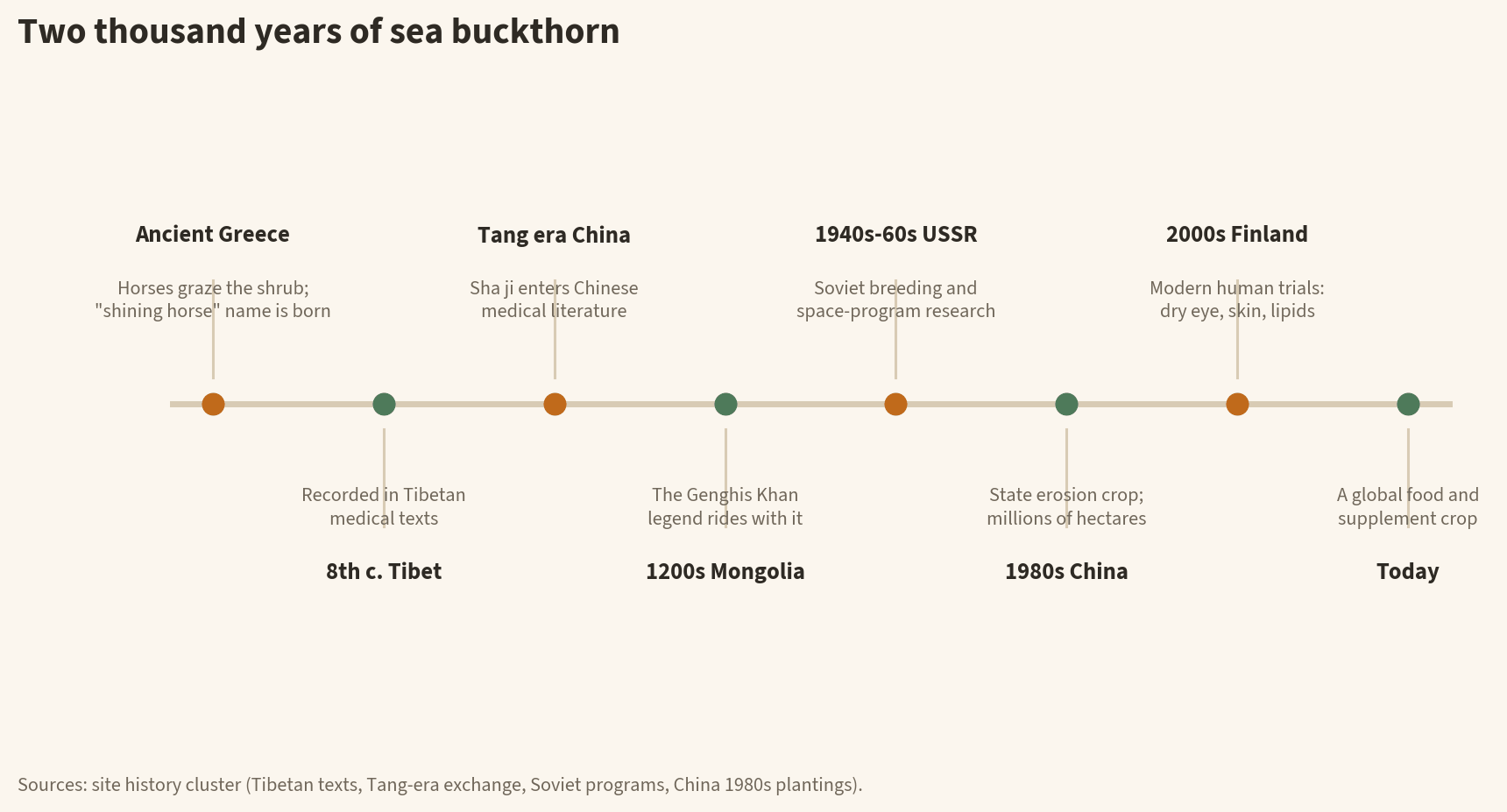
The long story, chapter by chapter
Sea buckthorn in ancient Greece: the horse story
The name Hippophae is real Greek, the shining-horse account is tradition, and the Theophrastus reference is an attribution, not a quotable passage.
Sea buckthorn in Chinese medicine
Tang-era exchange carried sha ji into Chinese medical literature, and the modern pharmacopeia still lists it. Both chapters documented.
Sea buckthorn in Tibetan medicine
The rGyud bzhi tradition records star bu for digestion, coughs, and skin: roughly a thousand years of dated texts, the plant’s deepest record.
Sea buckthorn and Ayurveda: the honest version
Not a classical rasayana, often confused with amla in marketing, and genuinely used in the Himalayan belt where traditions meet.
Genghis Khan and sea buckthorn: a legend, checked
Armies and war horses powered by the berry: everywhere in brand copy, nowhere in the chronicles. The real Mongol connection is better.
Sea buckthorn and the cosmonauts: what we know
Soviet institutional research is documented, cosmonaut use is widely reported, and we name no missions we cannot verify.
The modern sea buckthorn industry
China’s 1980s state plantings, Soviet-bred cultivars, European quality work, and Canadian orchards: forty years from state programs to shelves.
The documented record
Classical Tibetan medicine. Sea buckthorn appears in Tibetan medical texts roughly a thousand years old, prescribed for digestion, coughs, and skin. This is the deepest continuous use record the plant has, and it is why traditional use claims carry real weight on our grading scale.
Soviet science. From the 1940s onward, the USSR took the shrub seriously: breeding programs in Siberia, nutritional research, and use in the space program’s supplies. Much of the world’s cultivated stock descends from Soviet cultivars. This era turned folk knowledge into agronomy.
The modern research era. Finnish researchers ran the landmark skin and dry-eye trials from the 1990s through the 2010s, and Chinese institutions now produce much of the current literature. The trials that anchor our claims are summarized in the research hub.
The legends, labeled
- The shining horse. The genus name Hippophae is often translated as “shining horse,” with stories of ancient Greeks pasturing horses on the shrub for glossy coats. Charming, thinly documented, repeated everywhere.
- Genghis Khan. Claims that his armies ran on sea buckthorn circulate widely. We found no primary source. Treat it as marketing folklore.
- Olympic teams. Stories of Soviet athletes dosed with the juice appear in brand copy. Plausible given the era’s research culture, unverified in any source we could check.
How this cluster grades a story
Every page here sorts its material into three tiers. Documented means a dated text, a state program, or an institutional record exists. Reported means many secondary sources repeat it and no primary record confirms it. Legend means marketing copy with a famous name attached. The tiers matter because tradition earns real weight on our evidence scale, as traditional use versus evidence explains, while legends earn none.
From history to the shelf
The long record has one modern payoff: it tells you which claims are old and which were invented yesterday. Digestion, coughs, and skin use are centuries deep. Omega-7 marketing is decades deep. The benefits hub grades what trials confirmed, and the products hub shows what the industry actually built on the old foundation.
Why the history matters now
A plant with a thousand-year food and medicine record gives us decent confidence about basic safety, which the modern safety evidence supports at studied doses. What history cannot do is prove effects. That job belongs to trials, and the plant hub covers what the shrub itself is like.
Frequently asked questions
How long has sea buckthorn been used?
Documented medicinal use goes back at least a thousand years in Tibetan medical texts, with use in Mongolian and Ayurvedic traditions as well. Scientific study is much younger: serious cultivation and research began in the Soviet Union in the mid-20th century, and modern clinical trials arrived from the 1990s onward.
Which chapter of sea buckthorn's history is best documented?
The Tibetan medical record, dated texts roughly a thousand years deep, followed by Soviet institutional research from the mid-twentieth century and the clinical trial era from the 1990s. The weakest documentation attaches to the loudest stories: the shining horses, the conqueror's army, and the Olympic juice all fail the source test that the Tibetan texts pass.