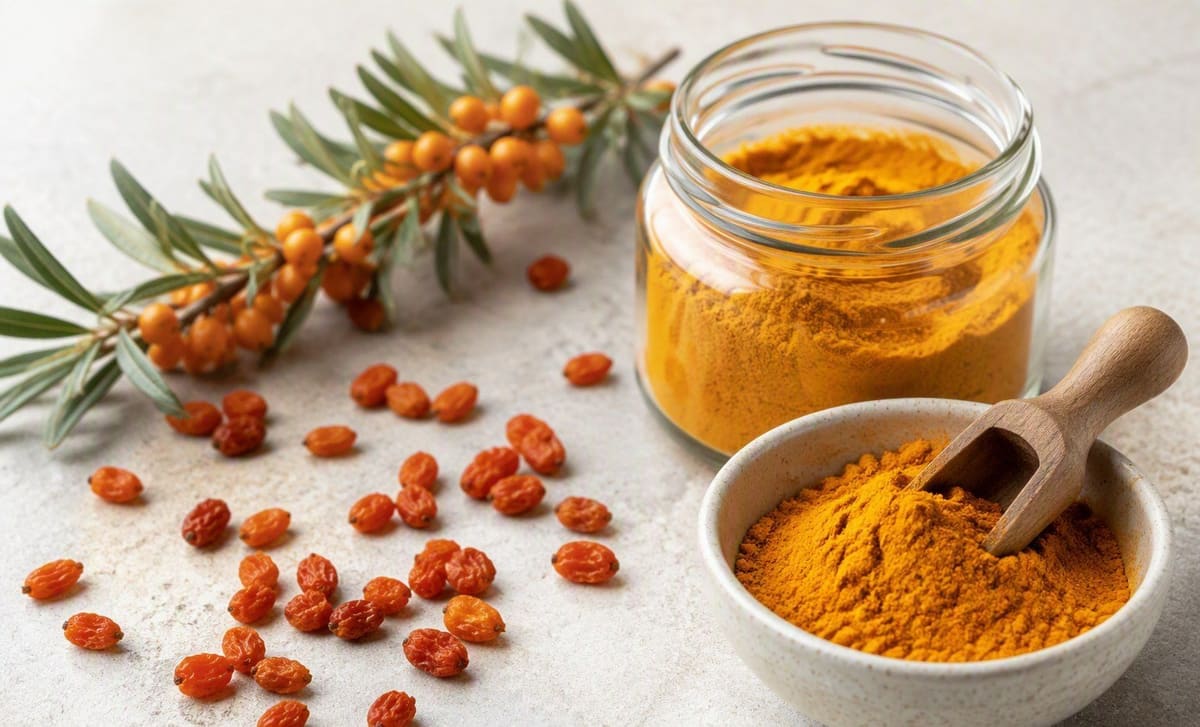
Sea buckthorn powder is dried berry solids milled fine: the water is gone, the fiber and a share of the vitamin C survive, and the oil fraction is minimal. It belongs in smoothies and yogurt as a tart, orange food ingredient. What it is not: the oil the human trials dosed, in any meaningful amount. Buy it for the kitchen, not for the study results.
What powder actually is
Two different products hide behind the same word. Whole-berry powder is the entire fruit (pulp, skin, sometimes ground seed) dried and milled. Juice powder is the pressed juice spray-dried onto a carrier, which keeps the water-soluble side and drops the fiber and most of the pulp.
Freeze-drying is the gentlest method and the one to look for on labels, because it dries at low temperature. Heat drying is cheaper and costs more of the delicate nutrients, vitamin C first among them. Erbology sells a whole-berry version that shows what the category looks like done simply (check current price).
One label check worth doing: juice powders often spray-dry onto maltodextrin, so the first ingredient can be the carrier, not the berry. Whole-berry powders should list exactly one ingredient. The products hub maps how powder compares with every other form.
Freeze-dried, spray-dried, air-dried
The drying method decides what survives. Freeze-drying removes water as vapor from frozen berries at low temperature: the gentlest route, and the best for vitamin C and flavor. Spray-drying blows liquid juice through hot air onto a carrier, fast and cheap, fine for the acids and sugars, rougher on the vitamins. Air-drying with heat is the oldest method and the hardest on the delicate compounds.
Labels do not always state the method. When they do, freeze-dried earns its premium. When they do not, the color tells part of the story: vivid orange-red suggests gentle handling, dull brown-orange suggests heat and time.
What it keeps, what it loses
Keeps: fiber, the berry’s tart acids, most carotenoids (the orange color of a good powder is those pigments), and a useful share of vitamin C when freeze-dried.
Loses: vitamin C first. It degrades with heat during careless drying, then keeps degrading with oxygen, light, and months in the jar. A powder that tested high at production reads lower after a year in your cupboard. Store it sealed, cool, and dark, and buy small jars more often rather than a kilo tub.
Barely there: the oil. A spoonful of powder carries a fraction of a gram of berry oil at most, against the 1 to 3 grams of oil a day the human studies dosed. Nothing about powder matches that arithmetic.
What a teaspoon actually delivers
Drying removes roughly 85 percent of a berry’s weight as water, so a heaped teaspoon of powder (about 2 to 3 grams) represents a small handful of fresh berries, around 15 to 20 grams. That is a real food serving with real fiber and a useful vitamin C contribution. It is also far below what the research worked with, and the study dosages page shows the gap plainly: gram doses of concentrated oil, daily, for months. The fresh vs dried vs powder page runs the same comparison nutrient by nutrient.
How people actually use it
- One to two teaspoons in a smoothie, where the tartness plays well with banana or mango.
- Stirred into yogurt or oatmeal, which softens the acidity.
- Shaken into juice or water as a quick sour-orange drink.
Start with a teaspoon. The flavor is assertive, and more powder means more sour, not more benefit.
Reading the label
- One ingredient for whole-berry powder. Anything else is a carrier or a blend.
- Maltodextrin first means a juice powder where the carrier outweighs the berry.
- Origin on the label is a good sign. The regions hub shows what the main origins mean for the berry itself.
- “Rich in vitamin C” with no number is decoration. Honest labels give milligrams per serving.
One more label note for Indian shoppers. A search for sea buckthorn berry powder in hindi turns up the same milled orange fruit under a name people hope is homegrown, and it isn’t. The powder is the Ladakh berry dried and ground, sold under its English and trade names, and the sea buckthorn in Hindi and Indian names page explains why the Hindi word never existed.
Storage and shelf life
Powder hates three things: air, light, and moisture. Keep the jar airtight, in the dark, with the desiccant packet left in. Clumping means moisture got in, and while the powder is usually still usable, it fades faster from there. Color drift toward brown is age rather than spoilage, but it tracks with nutrient loss.
For long storage the freezer works well: sealed tight, powder keeps its color and potency far longer than in a cupboard. Buy small jars often rather than big tubs seldom.
Dose realism, stated plainly
The studied benefits live in the oil at gram doses. The one whole-berry trial dosed 28 grams of fresh berries daily, a small handful of fruit, and even that found no effect on colds. A teaspoon of powder is a food serving, and food servings deliver food-level effects: some vitamin C, some fiber, bright flavor. The forms compared page puts all of this side by side, and the vitamin C page explains why the raw numbers vary so much.
Who should skip it
Anyone shopping for the studied benefits: those came from oil at gram doses, and no smoothie spoon gets there. Anyone who hates sour. And anyone already eating plenty of fruit, who would be buying a pricey version of something their kitchen already does. For all three, the oil explainer or plain frozen berries make more sense.
If powder is your form, the powder buying guide compares what is actually on the market. If the studied benefits are the goal, the oil explainer is the honest next read.
Frequently asked questions
Does sea buckthorn powder have vitamin C?
Yes, some. Freeze-dried powder keeps a good share of the berry's vitamin C, while heat-dried powder loses more, and all powder keeps losing it during storage. Fresh berries carry roughly 200 to 600 mg per 100 g, so a teaspoon of quality powder contributes a useful but much smaller amount. Treat the label's vitamin C line as a fading number, not a fixed one.
Is sea buckthorn powder as good as the oil?
They are different products. The human trials dosed 1 to 3 grams of concentrated oil daily, and powder cannot match that oil content in a spoonful. Powder is a whole-food ingredient for the kitchen. If you want the studied benefits, oil is the form the research used.
Does sea buckthorn powder expire?
It fades more than it spoils. Sealed, cool, and dark, it keeps for a year or two, and the freezer extends that. Once opened, air and moisture erode the vitamin C and the color within months. Clumps mean moisture got in. A dull brown jar has lost much of what you paid for, though it is rarely unsafe.