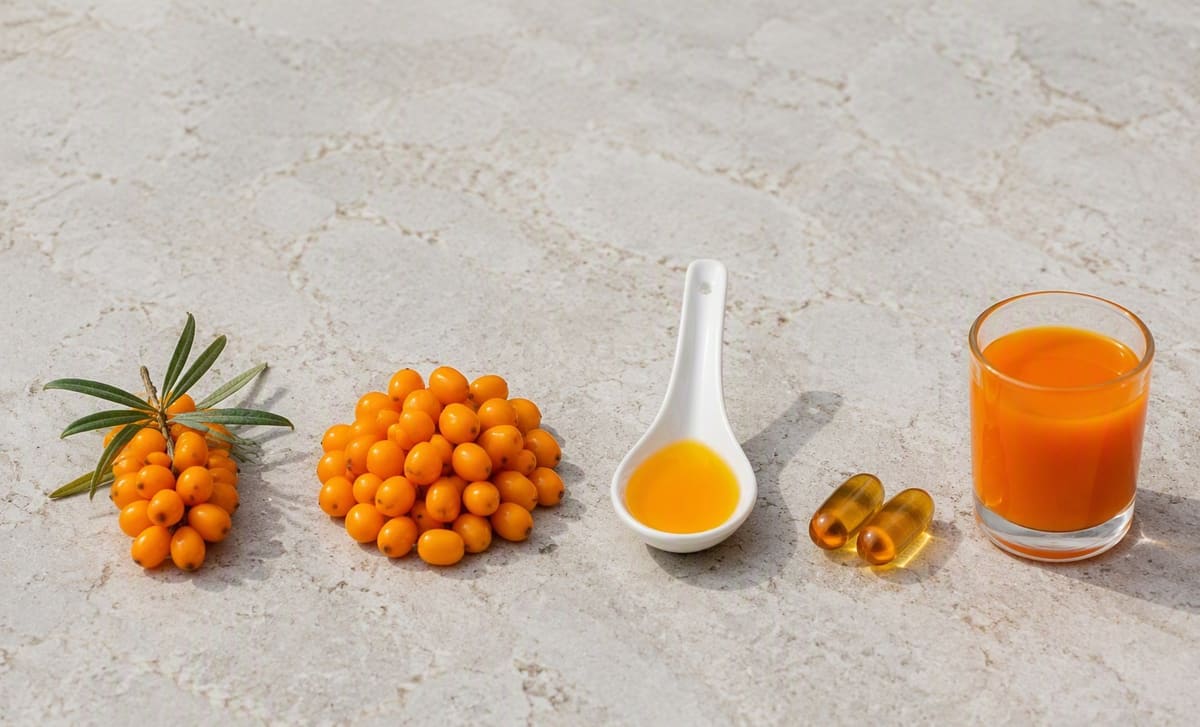
The human studies used 2 grams of sea buckthorn oil per day for dry eyes and skin, and 3 grams per day for vaginal dryness. Take it with food, split the dose across meals, and give it the full 4 to 12 weeks the trials ran. One softgel a day is far below every studied dose, which explains a lot of disappointed reviews.
These numbers sit behind every caution on the safety overview.
Dosing is where supplement marketing gets quietly dishonest. Labels suggest a capsule a day because it makes the bottle last two months and the price look small. The research used four to eight times that. Here are the actual numbers from the actual trials, so you can plan before you buy. The how much daily guide turns them into a routine, and the study dosages page lists every trial amount across every goal.
The doses that were actually studied
| Goal | Studied dose | Duration | What that means in practice |
|---|---|---|---|
| Dry eyes | 2 g/day (1 g twice daily with meals) | 3 months | About 4× 500 mg softgels or 2 ml of liquid oil daily |
| Skin hydration and elasticity | 2 g/day | 3 months | Same as above. Measured changes at weeks 4 and 12 |
| Vaginal dryness (postmenopausal) | 3 g/day | 3 months | About 6× 500 mg softgels daily |
| Cholesterol (meta-analysis range) | Typically 1.5 to 3 g/day across trials | 4 to 12 weeks | Varies by product. Lipid effects strongest in people with abnormal levels |
| Upper safety boundary studied | 5 g/day | 4 weeks | Produced a measurable antiplatelet effect in 12 men. Do not treat as a target |
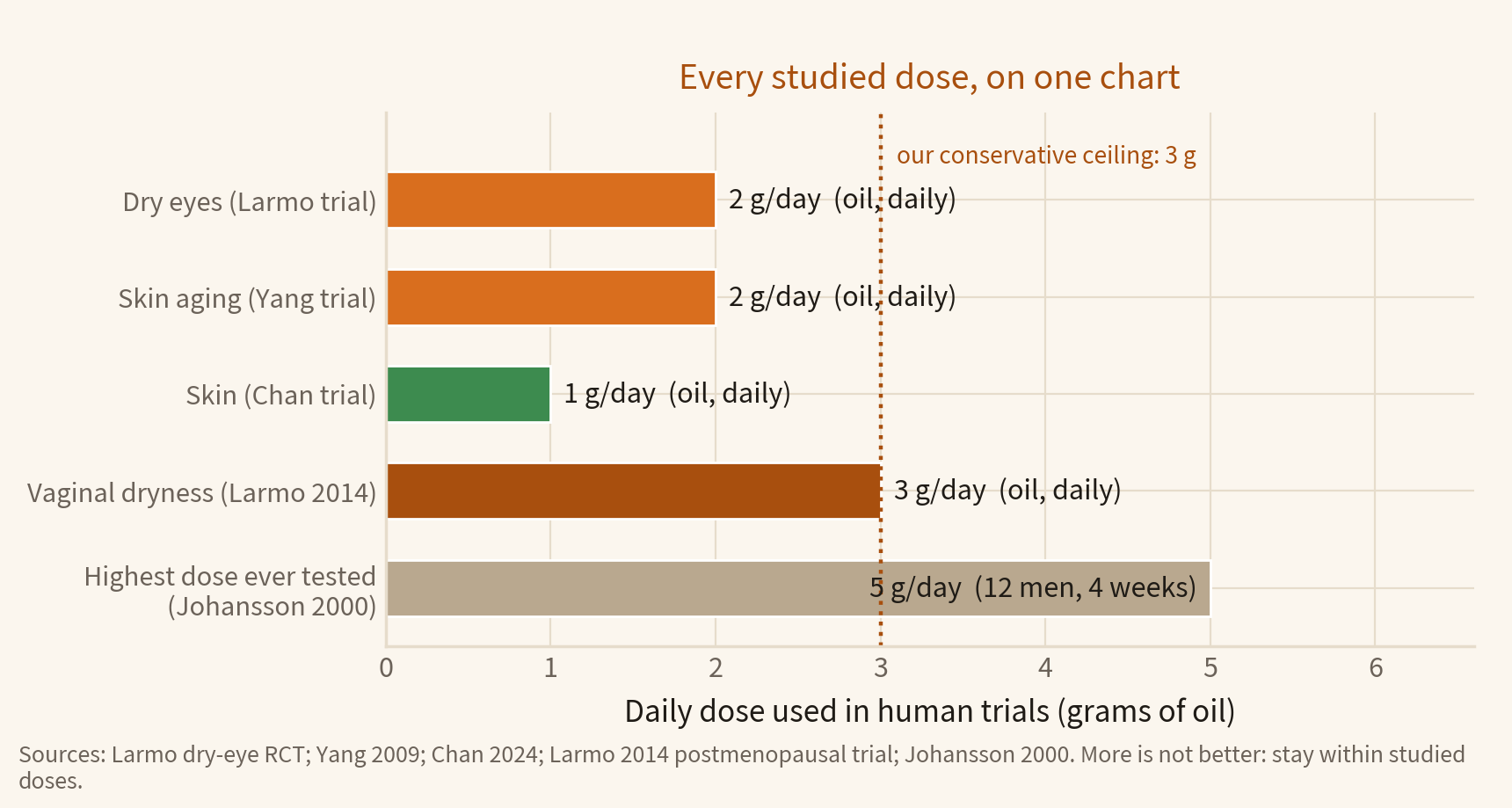
See the data behind this chart
| Trial / goal | Daily dose |
|---|---|
| Dry eyes (Larmo) | 2 g oil |
| Skin aging (Yang 2009) | 2 g oil |
| Skin (Chan 2024) | 1 g oil |
| Vaginal dryness (Larmo 2014) | 3 g oil |
| Highest tested (Johansson 2000) | 5 g oil, 12 men, 4 weeks |
Form by form: what studied doses look like
Liquid oil, measured in milliliters. One level teaspoon holds about 4.9 ml, which for a typical oil is roughly 4.5 grams. The studied doses convert to less than you might expect: 2 grams a day is about 2.2 ml, a scant half teaspoon, and 3 grams is about 3.3 ml, two-thirds of a level teaspoon. A cheap medicine syringe or a measuring spoon set makes this exact, and exact matters more than impressive.
Softgels. At the common 500 mg size, 2 grams a day is four capsules and 3 grams is six, split across meals. At 1000 mg, it is two or three. Check the label for what is inside the capsule, because a softgel diluted with carrier oil delivers less sea buckthorn per count, which is why composition matters more than bottle price. In omega-7 terms, a 500 mg berry-oil softgel at the typical 30 to 40 percent content carries roughly 150 to 200 mg of omega-7, so the studied 2 grams lands around 600 to 800 mg a day.
Berries, juice, and powder. The one food-level trial used 28 grams of whole berries daily, a small handful, for three months with good tolerability (and no cold prevention, for the record). Juice and powder have no studied dose for specific outcomes, so treat them as foods with normal serving sizes rather than supplements with targets.
Starting low, honestly
The trials started everyone at full dose on day one, so “start low and titrate” is practical wisdom, not research protocol. One gram a day for the first week tells you how your digestion handles the oil before you commit to the studied amount, and it costs you a week, nothing more. After that, match the trial dose for your goal and give it the full 4 to 12 weeks. Judging a studied-dose supplement at week two is how people end up disappointed with things that were working.
Cost-per-day reality check
At 2 grams a day, a 120-count bottle of 500 mg softgels lasts one month, not two. That is roughly $0.75 to $1.50 a day for the products in our capsules guide, depending on whether you target 1 or 2 grams. Liquid oil from our oil guide brings 2 grams a day closer to $0.60 to $0.90. If a regimen does not fit your budget at the studied dose, liquid oil is where the math usually lands.
Rules that make the dose work
- Take it with food. The carotenoids and fatty acids are fat-soluble. The dry-eye trial dosed twice daily with meals, and absorption is why.
- Split the dose. Morning and evening beats all at once for keeping blood levels steady, and it is what the trials did.
- Track something. Dry-eye symptom days, skin tightness, whatever your goal is. The trials measured at 4 and 12 weeks, so give it that long and write down whether anything moved.
- Respect the ceiling. Five grams a day reduced platelet aggregation in a small study, so we treat 3 grams (the highest dose with a clean record) as the sensible daily ceiling. More is not better, and long-term high doses are simply unstudied territory.
The ceiling deserves one more sentence of honesty. Three grams is not where harm begins: the 5-gram trial found a lab signal, not injuries, and nobody got sick. Three grams is simply where the clean record ends, the highest dose taken daily for three months by a large-enough group (116 women in the vaginal-health trial) with no serious adverse events. Above it you are not in danger, you are in the dark, which for a daily habit is reason enough to stay in the light. What actually happens when someone piles well past that is taken up on the overdose page.
When to check with a doctor first
Blood thinners, planned surgery, pregnancy, breastfeeding, or any chronic condition: these change the answer. The safety review collects the tolerability record behind them, and your doctor beats this page for personal advice.
Frequently asked questions
How much sea buckthorn oil should I take daily?
The human studies used 2 grams per day for dry eyes and skin, and 3 grams per day for vaginal dryness in postmenopausal women. Take it with food, split across meals, and expect to wait 4 to 12 weeks for measurable effects.
Can you take too much sea buckthorn?
The one trial that dosed 5 grams daily (12 men, 4 weeks) found no serious harm, but it did find reduced platelet aggregation. That is why the conservative ceiling stays at 3 grams. Long-term high-dose use is unstudied. Stick to studied doses unless your doctor says otherwise.
Should I take sea buckthorn with food?
Yes. The oil's carotenoids and fatty acids are fat-soluble, so a meal with some fat improves absorption. The dry-eye trial dosed twice daily with meals.
How do I measure 2 grams of sea buckthorn oil without a scale?
Use milliliters. Oil at typical density makes 2 grams about 2.2 ml, which is a scant half level teaspoon (a level teaspoon holds about 4.9 ml). A measuring spoon set or a medicine syringe gets you there exactly, and 3 grams is about 3.3 ml, two-thirds of a level teaspoon.