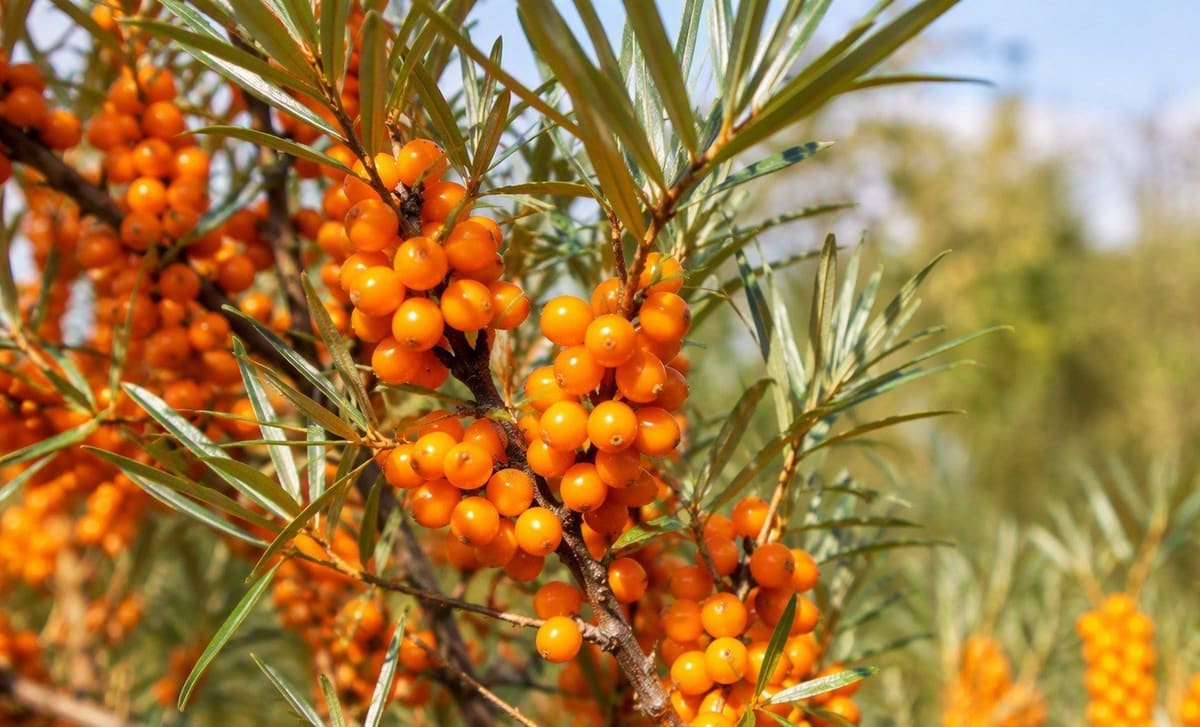
Sea buckthorn (Hippophae rhamnoides) is a thorny, deciduous shrub with silver green leaves and bright orange berries that hang on through winter. It fixes its own nitrogen, shrugs off cold and poor soil, and comes in male and female plants, with only the females fruiting. This hub is the botany and identification reference.
Before the supplements and the skincare, there is a plant, and it is a character. Call it a sea buckthorn tree or a sea buckthorn bush and you are describing the same plant pruned two ways, a large thorny shrub that can be trained to a single trunk but spreads into a thicket left alone. Some sellers skip the common name and list it as the Hippophae plant, leaning on the genus. Knowing it explains half the quirks of the products made from it. Brand new to the word itself? Start with what is sea buckthorn, the plain-language definition page for the whole niche.
In this collection
Identity and naming
Hippophae rhamnoides: the name and the botany
The scientific name decoded, the family the plant sits in, and why this species fills nearly every product.
Sea buckthorn species: meet the genus
One species stocks the shelves. The rest are wild Himalayan relatives, and the exact count depends on the botanist.
Where the name sea buckthorn comes from
Shining horses, coastal dunes, and a surname borrowed from an unrelated family, with the horse story honestly flagged as tradition.
Anatomy and biology
The sea buckthorn berry
The fruit up close: drupe-like botany, the intensely sour taste, what is inside, and why harvest is a stained, thorny job.
Sea buckthorn leaves
Narrow, silver-backed, and quietly useful: the tea tradition and the nitrogen they return to the soil.
Sea buckthorn seeds
One seed per berry, the source of pale seed oil, bird-powered spread, and the slow road to a new shrub.
Sea buckthorn flowers and pollination
Tiny brown flowers, no petals, all wind. Why fruit set depends on a male upwind at the right moment.
Male vs female sea buckthorn
The species is dioecious and only females fruit. How to tell the sexes apart, and the one male to six to eight females rule.
Sea buckthorn thorns
Stiff, sharp, and exactly where the berries are. Why the plant grows them and how pickers work around them.
Sea buckthorn nitrogen fixing
Frankia bacteria in the root nodules let the shrub feed itself on barren ground. Not a legume, and that is the interesting part.
Sea buckthorn lifespan
Single stems are measured in decades, but the suckering thicket renews itself, so a stand can outlive its first shrub.
Where and how it grows
Where sea buckthorn grows
Native range from European coasts to the Himalayan stronghold, what the plant tolerates, and why governments plant it to reclaim land.
Sea buckthorn climate and growing zones
Hardy to roughly USDA zones 3 to 7. Deep cold welcome, humid heat and wet feet not, sun non-negotiable. It sits in the growing cluster, since the zone question is really a can-I-grow-it question.
Sea buckthorn varieties and cultivars
Wild forms versus bred cultivars, what Russian and German breeding changed, and how to match plants to your climate.
Is sea buckthorn invasive?
Sometimes, honestly. Where it spreads, why the suckers are the engine, and how to keep a garden plant honest.
The cultivation history of sea buckthorn
Greek horse tales, Soviet breeding programs, and China’s million-hectare erosion-control plantings.
Foraging and caution
Identifying sea buckthorn
Three field marks that close the case, walked through the seasons.
Sea buckthorn lookalikes
Buffaloberry and autumn olive are the convincing doubles. The marks that split them, and when in doubt do not eat it.
Foraging sea buckthorn
Permission first, thorn-proof picking second, and always leave the birds their winter food.
Start here, by goal
- Holding a plant and wanting a name: the identification guide, then the lookalikes page before any tasting.
- Planning a garden: climate and zones, varieties, and male versus female in that order.
- Chasing the story: name origin and cultivation history cover the legend and the farm.
- Picking wild fruit: the foraging guide is the whole protocol, season to stain.
The name
The genus Hippophae comes from Greek roots often read as “shining horse,” tied to old stories about horses and glossy coats. The species most products use is Hippophae rhamnoides. The family, Elaeagnaceae, is shared with autumn olive, another tough nitrogen-fixer.
One warning belongs right here, because the shared name causes real confusion. Sea buckthorn is not the “buckthorn” of the Rhamnus genus, the common and glossy buckthorns that invade North American woodlands and whose bark and berries act as strong laxatives. Different family, different chemistry, different safety profile. If a foraging guide, a herbal remedy, or a warning about “buckthorn” does not say Hippophae or “sea buckthorn” in full, assume it means the other plant. The species name rhamnoides literally means “resembling Rhamnus,” which is the botanist admitting the lookalike problem is centuries old.
Identification
- Leaves: narrow, willow-like, green above and silvery underneath. A hedge of it flashes silver in wind.
- Bark and thorns: gray-brown branches armed with stiff thorns.
- Berries: small, oval, traffic-light orange, packed tight against the branches, persisting deep into winter.
- Roots: wide-spreading, sucker-producing, and home to nitrogen-fixing Frankia bacteria, which is why the plant feeds itself on barren ground.
Male and female
The species is dioecious. Males make inconspicuous pollen flowers, females make the berries. For identification outside fruiting season, male flower buds are rounder and larger. For growing, the practical rules live in the growing hub.
Where it fits in the landscape
It is a pioneer: one of the first shrubs to colonize bare riverbanks, dunes, and landslide scars, stabilizing soil and enriching it for whatever comes next. China has planted it by the millions of hectares for exactly that job. The geography story continues in the regions hub, and the long human relationship with the plant in the history hub.
Frequently asked questions
What kind of plant is sea buckthorn?
A deciduous, thorny shrub or small tree in the Elaeagnaceae family, scientific name Hippophae rhamnoides. It has narrow silver-green leaves, bright orange berries that cling through winter, and roots that fix nitrogen. Plants are male or female, and only females bear fruit.
Is sea buckthorn easy to grow?
Where the climate fits, yes: full sun, sharp drainage, and one male for every six to eight females covers the essentials, and the shrub forgives neglect that would kill fussier fruit. The two genuine dealbreakers are waterlogged soil and shade. The growing hub walks the whole process.