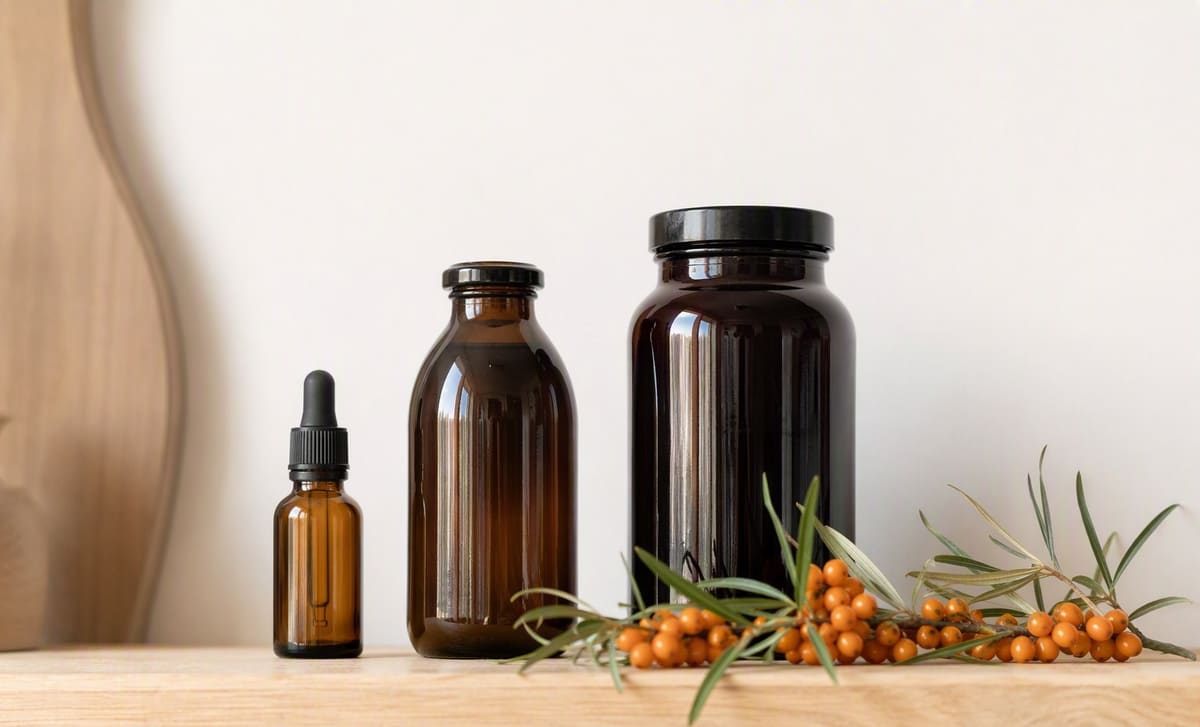
Fair sea buckthorn pricing, measured at the studied 2-gram daily dose: about $0.60 to $1.20 a day for liquid oil and $0.75 to $1.50 for softgels. Seed oil should undercut berry oil clearly. Juice, powder, and tea are groceries, not supplements, and should be priced like them. The only honest way to compare is cost per gram of actual oil inside, and the formula takes thirty seconds.
Every number below comes from listings we verified in July 2026, printed with sources inside our buying guides. Prices move, so treat this as the map, not the territory.
Fair cost per studied day, by form
| Form | Fair cost per 2 g day* | Notes |
|---|---|---|
| Liquid berry oil | about $0.60 to $1.20 | Cheapest per gram; you pay in taste and stains |
| Softgels (blend or berry) | about $0.75 to $1.50 | The convenience premium, roughly 25 to 50% over liquid |
| Liquid seed oil | Below berry oil | Cheaper to produce; at berry prices it is a bad deal |
| Juice, powder, tea | Grocery math | No studied dose exists; price them like foods |
| Topical products | Varies widely | A different purchase entirely; compare per ounce |
The formula that settles every price argument
(bottle price ÷ total grams of oil inside) × your daily grams.
That is the whole method. A $45 bottle of 120 softgels at 500 mg of blend each holds 60 grams, so a 2-gram day costs $1.50. A $31 bottle holding 52 ml (about 48 grams) of liquid oil costs about $1.29 at the same 2 grams, or $0.60 at the lighter 1 ml serving. Suddenly the expensive-looking bottle and the cheap-looking bottle trade places. Try the calculator: the cost per day tool runs this formula on any bottle you enter, with prefills for the products we track. The tools page walks through more worked examples.
Watch the blend trap inside this math: a softgel that is part carrier oil inflates the capsule weight without inflating the sea buckthorn content. Check how many milligrams of actual sea buckthorn oil the label states per serving, and put that number in the formula, not the capsule size.
Worked examples from verified products
Three anchors from products we verified, so you can sanity-check any bottle against real math:
| Verified product | Bottle math | Cost per day |
|---|---|---|
| SIBU Sea Berry Oil, 52 ml | about $31, roughly 48 g of oil | about $0.60 at 1 ml a day |
| SeabuckWonders Omega-7 Complete, 120 softgels | $44.86 for 60 g of blend | $0.75 at 2 softgels a day |
| SIBU Organic Sea Berry Seed Oil, 30 ml | $24.95, roughly 28 g of oil | about $0.83 at 1 ml a day |
Note what the anchors teach: bottle size and brand prestige hide the math, and only the formula reveals it. Compute yours before checkout.
Common pricing mistakes
- Comparing bottle prices across sizes. The formula is the only fair comparison.
- Bulk-buying a fragile oil to save 10 percent, then throwing out the oxidized last third, per the storage rules.
- Falling for serving-size games, where “60 servings” means 60 softgels at a quarter of the studied dose.
- Paying premium for packaging, per the premium guide verdict on frosted glass.
The 60-second price check
- Find total grams of actual sea buckthorn oil inside (serving milligrams times servings).
- Run the formula at your real daily target: 2 g for the studied goals.
- Compare against the fair band for the form.
- Outside the band in either direction, find out why before buying, per the fake oil guide.
The channel layer on every price
The same bottle carries different prices by channel: list price brand-direct, discounted at iHerb or Vitacost, variable on Amazon. The channel comparison below maps who does what to freshness and buyer protection, and the cheapest legitimate price usually lives with the high-turnover specialists. What should make you suspicious is not variance but a price no channel can explain, which loops straight back to the formula and the fair bands.
The loyalty layer
Subscriptions and loyalty programs shave roughly 5 to 15 percent at most channels, real money for a daily habit. The discount only counts on products already inside the fair band, because 15 percent off an overpriced bottle is still an overpriced bottle. Run the formula first, then let the loyalty layer improve a price that was already fair.
When prices move
Sea buckthorn pricing shifts with harvests, promos, and marketplace sales, so any printed number ages. The bands above age slowly because they reflect production reality, not promotions. Check current listings, rerun the formula, and the budget guide tracks the cheapest verified options while the channel comparison explains why the same bottle prices differently by store.
Why the price range is honest
The berry yields little oil, which is the base cost of everything downstream. On top of that, the products we score highest pay for organic certification, supercritical CO2 extraction, and small-batch handling. Those three add real cost, and they are exactly the things worth paying for, because they are the verifiable parts of quality. What should not cost extra: pretty frosted bottles, exotic marketing adjectives, and “proprietary” blends.
What overpricing looks like
- Seed oil at berry prices. Seed oil costs less to produce. A seed oil priced like a berry oil is a margin play, and vague labeling is how it survives.
- Carrier blends at full-spectrum prices. Sunflower or soybean oil ahead of sea buckthorn on the ingredient list means you are buying cheap oil at a premium rate.
- The luxury skincare markup. A cream with sea buckthorn far down the ingredient list priced like an active treatment is moisturizer wearing an orange costume. Our skincare guide scores the real ones.
- Per-bottle thinking. A $15 bottle of 60 softgels at a studied dose lasts about ten days. That is $45 a month, triple the fair range, wearing a budget costume.
What underpricing looks like
Prices far below the fair range are not bargains either. A premium-labeled oil at a third of the going rate is usually old stock, a diluted product, or a marketplace seller with unknown storage. The fraud patterns, the label tells, and the certificate-of-analysis move are all in our fake oil guide, and the budget guide shows the cheapest pricing that still passes verification.
If you take blood thinners, are pregnant or nursing, or have surgery planned, read our safety notes and talk to your doctor before starting any dose. When you are ready to shop the verified fair-price picks, they are ranked in the oil guide and the capsules guide.
Frequently asked questions
Why is sea buckthorn oil so expensive?
Because the berries are small, yield little oil, and the good products add costs: organic certification, CO2 extraction, and small-batch handling. Fair pricing works out to roughly $0.60 to $1.50 per studied day depending on form. Anything far above that range is markup, and anything far below it is usually a cut or mislabeled product.
What is a fair price for sea buckthorn oil?
Judge by cost per day at a studied dose, not bottle price. Verified fair ranges: liquid oil about $0.60 to $1.20 per 2-gram day, softgels about $0.75 to $1.50. Seed oil should cost noticeably less than berry oil. Juice, powder, and tea are groceries and should be priced like them, not like supplements.
Is subscription pricing worth it for sea buckthorn?
Usually yes for a daily user: brand-direct subscriptions typically shave 10 to 15 percent and keep fresh stock rotating to you. The trap is over-stocking a fragile oil. Match the delivery interval to what you actually finish in three to six months, not to the discount.