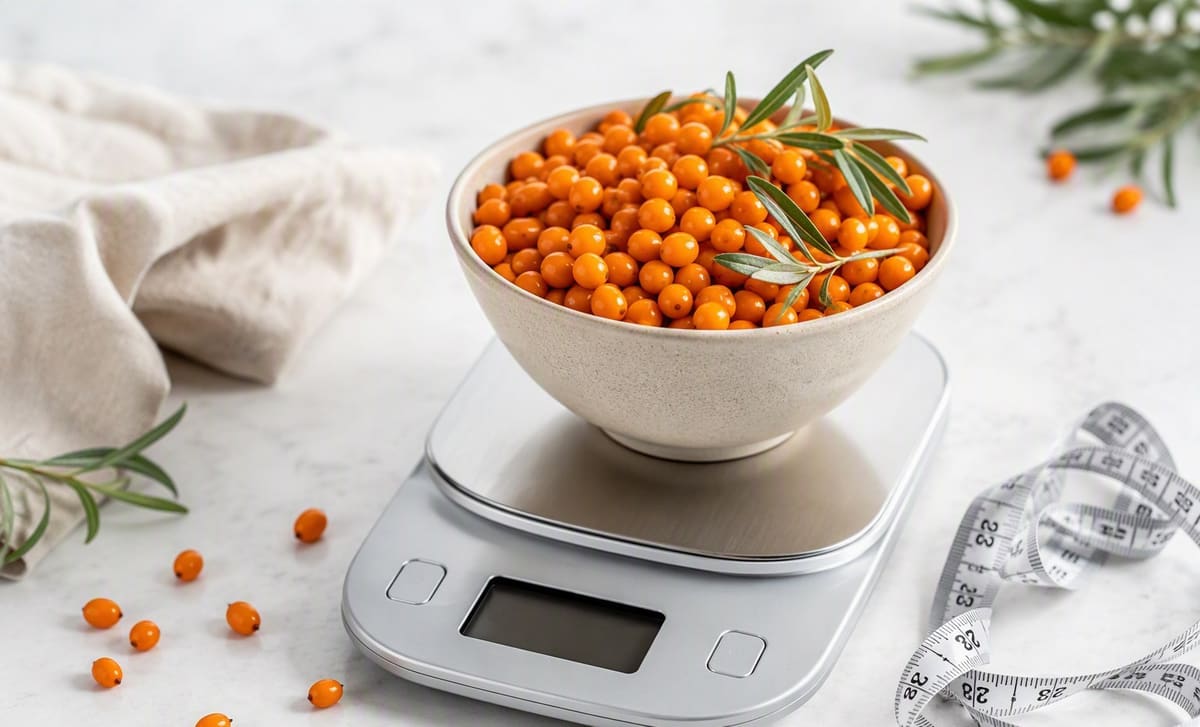
Calories depend entirely on the form. Fresh berries are water-rich and light, juice ranges from lean to sugary depending on the blend, and the oil is pure fat at about 40 calories per level teaspoon. The berry and the bottle are different calorie conversations.
Fresh berries: the light form
Sea buckthorn berries are mostly water, carry little sugar, and arrive in small servings. Nobody eats them by the bowlful: a small handful is a snack, and its calorie cost is snack-sized. There is no official database entry we trust enough to print one kcal figure, so we say it structurally: a water-rich, low-sugar fruit is a light food. The sugar page shows why the fresh berry stays lean where the products do not.
Juice: read the blend
Pure sea buckthorn juice is tart and low in sugar, so a small diluted glass stays modest. Blends are the swing factor. Many bottles cut sea buckthorn with apple or grape juice, and the calorie count follows the blend rather than the berry. The label’s per-100-ml line, plus the dilution habits on the juice nutrition page, do the math honestly.
Oil: the dense one
All oils are pure fat, and fat is 9 calories per gram. One level teaspoon of sea buckthorn oil is about 4.5 grams, which lands near 40 calories. The human trials dosed 1 to 3 grams daily, about 10 to 30 calories, so a supplement routine costs less than a bite of bread. The oil nutrition page has the full teaspoon math.
The daily-cost math, all forms
Putting the forms on one receipt:
- A small bowl of fresh or frozen berries (100 g): a light snack by structure, water-rich and low in sugar. Nobody has published a database calorie figure we trust, and the bowl’s cost is small enough that the missing number does not change any decision.
- A diluted juice glass: a shot of pure juice stretched with water costs what a small serving of tart fruit costs. The blend decides everything, and apple-or-grape-based bottles cost what apple or grape juice costs.
- A studied oil dose (1 to 3 grams): 10 to 30 calories. The entire supplement routine costs less than a bite of bread.
- A handful of sweetened dried berries: the outlier. Drying concentrates, sugar is often added, and the handful prices out closer to candy than to fruit.
Where the calories actually hide
Never in the plain berry. They hide in three places. Sweetened juice blends, where the base juice supplies the sugar. Sugared dried berries, where the fruit is a vehicle. Jams, where sugar is the recipe. The sugar content page reads those labels line by line, and the weight loss page covers the larger honesty point: pooled human trials found no weight effect for this plant in either direction.
Common misreadings
- “Oil capsules are fattening.” At studied doses the oil adds fewer calories than a single bite of most foods. Fat-phobic math fails here.
- “Dried equals fresh.” Remove the water and every remaining gram counts more. Equal handfuls are not equal servings.
- “Juice is always light.” Pure and diluted, yes. Blended with sweeter juices, it is the base juice in disguise. The fiber page adds the second reason whole berries beat the glass for appetite-friendly eating.
The 100-gram trap
Every calorie table in this aisle, ours included, quotes per 100 grams or per 100 milliliters, because that is the standard. Nobody eats the standard. The glass of juice you pour is two to two and a half times the 100-milliliter line on the label. The handful of dried berries is a third of the 100-gram column. The teaspoon of oil is a twentieth of it. Fresh berries are the only form where the column nearly matches the serving, because a generous bowl of these small berries genuinely approaches 100 grams. Read the column, then multiply or divide by what you actually serve, or the number you remember will be fiction in both directions.
This cuts hardest with dried fruit. Per 100 grams, sweetened dried berries look alarming next to fresh. Per actual handful, the alarm shrinks to a modest sugar note. Juice runs the opposite way: the 100-milliliter line looks innocent, and the real glass multiplies it. Same label, two opposite illusions, both cured by doing the serving math before the verdict. The sugar content page applies the same discipline to the sweet side of the ledger.
Dried berries and powder
Drying removes water and concentrates everything else, sugar included, so dried berries and powders are calorie-denser per spoon than the fresh fruit. The fresh vs dried vs powder page maps that trade form by form. For the whole picture, the nutrition hub keeps the verified numbers in one place, and our juice guide scores bottles whose labels tell you the truth.
Frequently asked questions
Is sea buckthorn fattening?
Not in any realistic form. Fresh berries are water-rich and light, a trial-sized oil dose adds 10 to 30 calories a day, and the only products that get calorie-dense are sweetened juices, jams, and dried berries with added sugar. Read the label for added sugar rather than blaming the berry.
How many calories are in a tablespoon of sea buckthorn oil?
About 120. A tablespoon is three level teaspoons, and a level teaspoon of this oil is about 4.5 grams, so a tablespoon lands near 13.5 grams of fat. At 9 calories per gram, that is roughly 120 calories, the same as any other oil. The human trials used 1 to 3 grams daily, so a studied supplement dose costs 10 to 30 calories, not a tablespoon's worth.