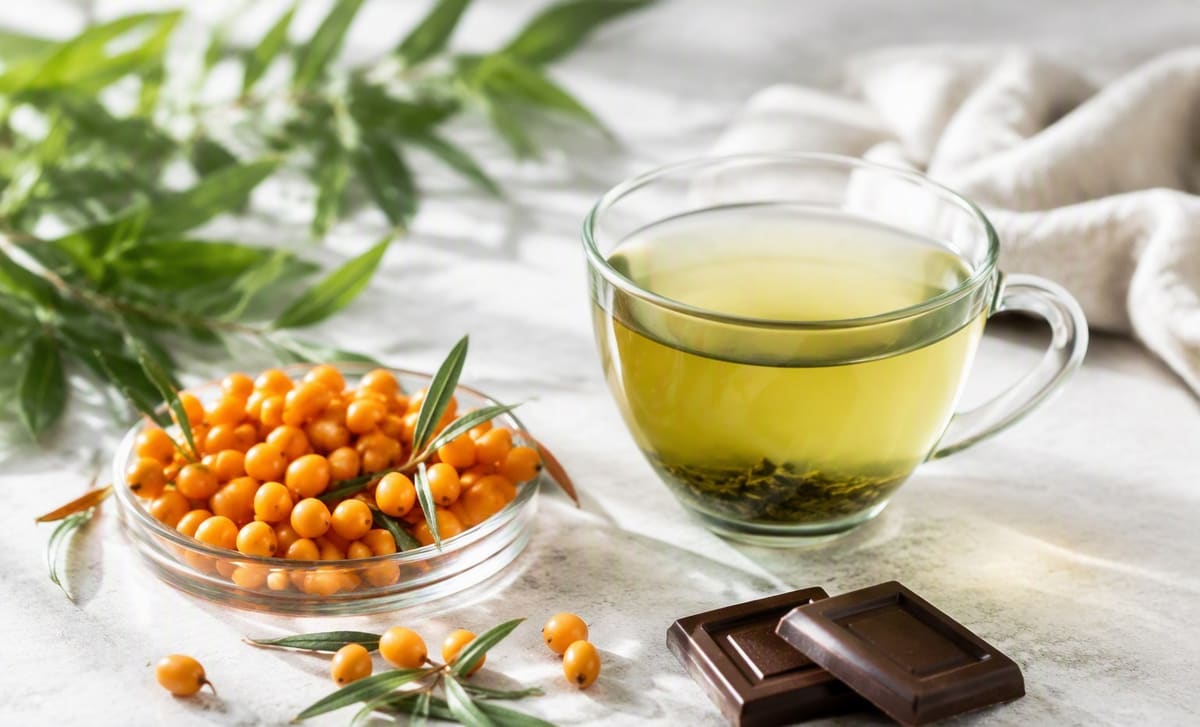
The berry’s flavonoid cast has three leads: quercetin, kaempferol, and isorhamnetin, carried mainly as glycosides. They concentrate in the berries and leaves rather than the oil, their levels swing by cultivar, and they sit behind most of the plant’s laboratory research. Human outcome trials are the missing chapter.
The three leads
Quercetin is the famous one, common across onions, apples, and berries. Kaempferol is its quieter sibling. Isorhamnetin, a methylated quercetin, is the signature: uncommon in everyday foods and consistent enough in sea buckthorn to work as a fingerprint for the genuine plant. Each gets its own page here, starting with quercetin and isorhamnetin. In the plant they ride as glycosides, bound to sugars, which shapes how they survive processing and how your gut handles them.
Where they sit in the plant
Flavonoids are water-leaning compounds, so they live in the berry flesh and skin, and in the leaves, rather than in the oil. Pressing berries for juice keeps a share of them. Pressing for oil leaves nearly all behind. That is why the flavonoid conversation belongs to berries, juice, powder, and leaf tea, and why oil capsules are the wrong purchase for this nutrient family. The polyphenols page zooms out to the wider family these three belong to.
What a serving delivers
Flavonoids lean water-soluble, so the delivery forms are the watery ones: fresh or frozen berries, juice, powder, and leaf tea. A daily serving of any of these delivers the trio as glycosides, with levels that swing by cultivar and harvest, which is why no honest number exists. The oil is the wrong vehicle, carrying little of the family. Absorption is partial and mostly downstream: digestion and gut microbes convert the glycosides into smaller metabolites, and blood levels after eating run far below lab-study concentrations. That gap is the honest reason lab excitement stays lab excitement.
The glycoside detail
In the plant, these flavonoids ride bound to sugars, and that packaging shapes everything downstream. The sugar bond affects how the compound survives drying and pasteurization, how it releases during digestion, and which microbes get a say in the process. It is also why “flavonoid content” on a label can mean the free compound, the glycoside, or a total, three different numbers wearing one name. When a study reports sea buckthorn flavonoids, the first question is which form was counted.
Comparison context
Quercetin and kaempferol are common citizens: onions, apples, kale, and most berries supply them. Sea buckthorn’s distinction is isorhamnetin, uncommon enough in the diet that this berry is one of its few regular sources, as the isorhamnetin glossary entry notes. The fair framing is not “more flavonoids than everything” but “a familiar duo plus a rare third,” which is a composition distinction, not a proven advantage.
Common misreadings
- Lab results as human promises. Cell studies use concentrations no meal produces. The mechanisms page shows how far the road is from petri dish to person.
- Single totals as quality scores. A 2015 cultivar study found real spread between varieties before storage even starts. One number hides a range.
- “Flavonoid content” as an antioxidant score. The retired ORAC logic in a new outfit, graded on the antioxidants page. The turmeric comparison shows the same lab-to-human discipline applied to the other famous polyphenol.
Storage, light, and the clock
Flavonoids are sturdier than vitamin C and less armored than fiber. They tolerate gentle drying and reasonable shelf time, but they are not immortal. Prolonged heat trims them, bright light works on them slowly, and a juice that has sat open in the fridge for weeks is not the juice the analysis measured. The practical rules are the same as everywhere in this aisle. Buy dark glass or opaque packaging, respect dates, and do not stockpile. Frozen berries hold their share well. Powder keeps what the drying spared, sealed and cool. The storage guide covers the mechanics, and the vitamin C losses on the vitamin C page are the cautionary extreme the flavonoids only mildly imitate.
Why every total is a range
A 2015 study measured phytochemicals across sea buckthorn cultivars and found real spread between them, before origin, harvest, and storage add their own variation. Any label quoting one exact flavonoid total is pretending that spread does not exist. Ranges are how honest labels talk.
The honesty line
Flavonoids do interesting things in cell and animal studies, and reviews of the plant’s pharmacology catalog plenty of that work. Cell behavior at lab concentrations is not a human outcome, and no trial has dosed sea buckthorn flavonoids in people and measured a clinical endpoint. Buy the berry forms for their measured nutrition, and let the flavonoid research be what it is: promising, early, and unproven in humans. The antioxidants page applies the same standard to the antioxidant claim, the nutrition hub maps the rest, and the powder guide scores the form that carries the most.
Frequently asked questions
Which sea buckthorn form has the most flavonoids?
Whole berries and powders carry the most, because flavonoids live in the berry flesh and skin rather than the fat fraction. Juice keeps a share, and the oil carries little. Leaf tea is a separate, genuinely flavonoid-rich route. Whatever the form, expect variation between cultivars and harvests, and treat single-number claims with suspicion.
Are sea buckthorn flavonoids actually absorbed?
Partly, and mostly as metabolites. The glycoside forms in the berry are processed by gut microbes and digestion before absorption, and blood levels after eating flavonoid-rich foods run far below the concentrations used in cell studies. That gap is why we report the composition honestly and refuse to translate lab findings into promised effects.