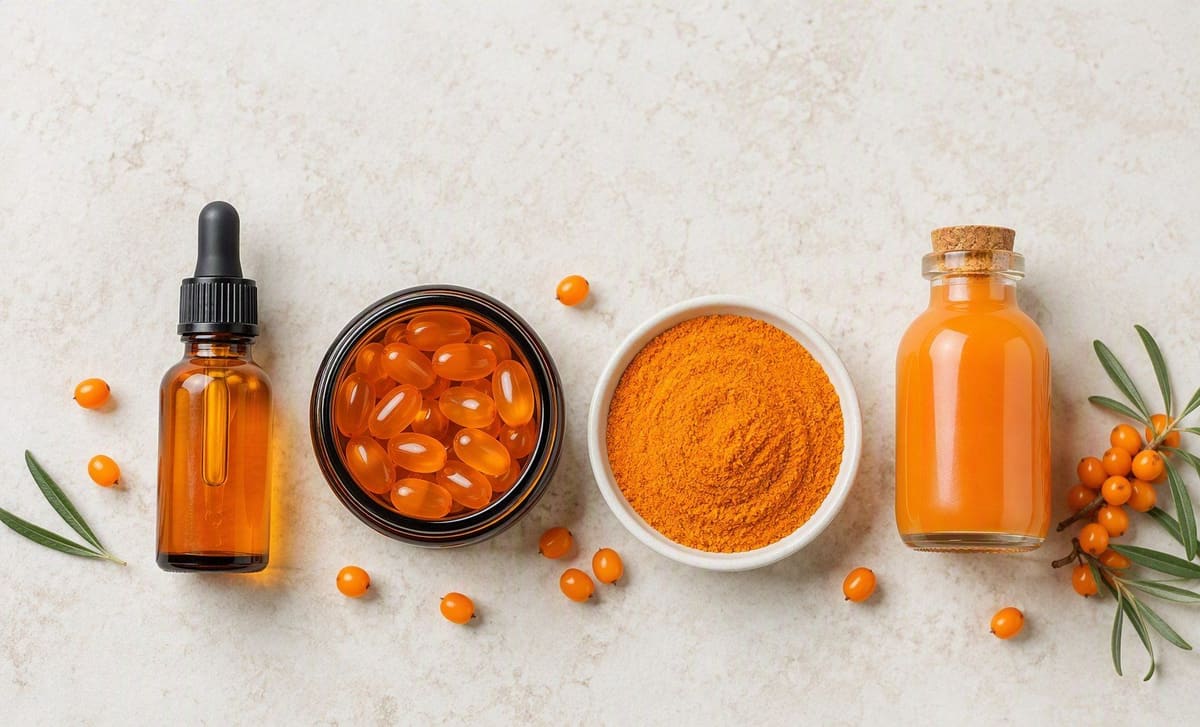
Liquid oil and capsules deliver the identical oil with identical absorption. Liquid costs 25 to 50% less per gram and doses flexibly. Capsules kill the taste, the stains, and the measuring. Juice, powder, and dried berries are foods, not study material. Tea is a tart drink with no trials behind it. The right form is whichever one you will still be taking daily in week twelve.
The full comparison
| Form | Cost per gram | Convenience | Matches study doses | Watch out for |
|---|---|---|---|---|
| Liquid oil | Lowest | Low: taste, stains, measuring | Yes, easily | Countertop stains, earthy taste |
| Softgels | 25-50% higher | Highest | Yes, with 2-6 per day | Under-dosing at 1 per day |
| Juice / puree | Varies | Medium: dilute and chill | No: different nutrient profile | Acidity on teeth and stomach |
| Powder | Varies | Medium | No: food form | Vitamin C losses in drying |
| Dried berries | Low | Medium | No: food form | Easy to overeat once dried |
| Tea | Low | High | No: untested as a dose | Tart infusion, not a supplement |
| Skincare (topical) | N/A | High | Different lane entirely | Berry oil tint if overused |
Each row above has a page of its own, and the aisle-level view links every one of them.
What each form actually is
Liquid oil. Pressed or CO2-extracted oil in a bottle, sold as berry oil, seed oil, or a blend of the two. This is the form behind nearly every human trial, and the oil explainer decodes the two types. The studied range is 1 to 3 grams a day, which in kitchen terms is a scant quarter to half teaspoon.
Softgels. The same oil sealed in gelatin. Nothing that matters is added or lost, so the choice between liquid and capsules is logistics, not chemistry. Most shells hold 500 or 1,000 mg, and that number decides whether a studied dose means two capsules a day or six.
Juice and puree. The water-soluble side of the berry: vitamin C, organic acids, flavonoids, and sugars, with little of the oil unless the puree keeps it. Fresh berries carry roughly 200 to 600 mg of vitamin C per 100 g, varying by species and harvest. Undiluted juice is sharply acidic, so dilute it, rinse your mouth after, and skip it on an empty stomach.
Powder. Dried, milled berry for smoothies and yogurt. Drying costs some vitamin C, and what you get is a food ingredient, not a measured supplement dose.
Dried berries. The shelf-stable whole food: chewy, tart, easy to sprinkle. The one whole-berry trial dosed 28 g a day, roughly a small handful.
Tea. An infusion of dried berries or leaves. You get water-soluble compounds and a pleasant tart drink. No human trial has tested sea buckthorn tea for any health outcome, so file it under pleasure, not protocol.
What the studies actually used
Most comparison pages skip this part, and it changes the answer.
- Dry eyes: 2 g of a seed-and-berry oil blend daily for three months. Oil, not juice.
- Vaginal dryness after menopause: 3 g of oil daily for three months. Oil again.
- Skin hydration: 1 to 2 g of oral oil daily in the two trials.
- Whole berries: 28 g a day for three months in the infection trial. Colds were unaffected, though an inflammation marker (C-reactive protein) did come down.
- Juice, powder, tea: never dosed for a health outcome in a human trial. That does not make them useless. It makes them foods.
The pattern is blunt: the studied benefits live in the oil at gram doses. The how much per day page maps every studied dose to its form.
The cost math that settles most debates
Using verified prices from our guides: the 2-gram daily study dose costs about $0.60 to $1.20 as liquid oil and about $0.75 to $1.50 as softgels, depending on brand. Run your own numbers with the formula on the tools page: (bottle price ÷ total grams) × daily grams.
Juice, powder, and dried berries have no cost per studied dose, because no studied dose exists. Compare them on grocery math, not supplement math.
Who should pick what
- Budget-first daily user: liquid oil. Cheapest path to study doses.
- Traveler, commuter, taste-hater: softgels. The premium buys adherence.
- Kitchen person: juice, puree, or dried berries for food uses, with the acidity rules respected.
- Smoothie regular: powder, with food-level expectations.
- Tea drinker: tea, honestly labeled as a tart drink and nothing more.
- Skin-first user: topical products from the skincare guide, optionally paired with oral oil for the inside-out route the trials used.
The decision guide
Match your goal to the form the research actually dosed:
- Dry eyes: the studied form was a seed-and-berry oil blend at 2 g a day, split across meals. Liquid or softgels both deliver it. Details live on the dry eye page.
- Skin hydration from inside: the studied form was oral oil at 1 to 2 g a day.
- Vaginal dryness after menopause: the studied form was oil at 3 g a day, per the trial covered on the menopause page.
- General nutrition: berries, juice, or powder in the kitchen, for the vitamin C and the tartness, not for the oil benefits.
- A warm drink: tea, for taste alone.
What each form keeps and loses
Every form is a trade, and seeing the ledger once makes the table above obvious. The oil keeps the fat-soluble compounds: omega-7, carotenoids, vitamin E. It carries no vitamin C at all, because vitamin C is water-soluble and stays in the juice fraction. Juice and puree keep the vitamin C, the acids, and the flavonoids, but little of the oil unless the puree keeps it in. Drying keeps the fiber and the acids while spending vitamin C on heat and time. Freezing keeps nearly everything and costs only texture. Gummies dilute a small active dose into sugar, and tea pulls the water-soluble fraction for as long as the steep runs. No form is the whole berry. The berry is the whole berry.
The with-food rule
Oil forms absorb alongside dietary fat, so capsules and liquid go down with meals, not on an empty stomach, as the best time page explains.
Storage reality by form
One line each. Liquid oil: dark glass, cool shelf, fridge after opening. Softgels: cool and dry, never a hot car. Frozen berries: frozen, and never refrozen. Dried berries and powder: airtight, dark, months not years once opened. Juice and puree: refrigerate after opening. The storage guide has the per-form details.
Two forms the table did not rank
Gummies are the adherence form: weak doses, strong habits, judged on their own page. Tinctures are a different, thinner evidence lane, closer to herbal tradition than to the oil trials. When price enters the debate, the cost per day tool runs the arithmetic on your actual bottle, and the study dosages page keeps the trial numbers straight.
The verdict
Forms are a logistics question, not an effectiveness question. Pick for your routine, dose for the studies, and re-evaluate at twelve weeks. Specific products for the two main forms are scored in the oil guide and the capsules guide.
Frequently asked questions
Is sea buckthorn oil or capsules better?
Neither absorbs better; the oil is identical. Liquid oil wins on cost (roughly 25 to 50% less per gram) and dose flexibility. Capsules win on convenience, taste, and portability. Pick the form you will actually take every day at the full studied dose, because consistency decides results more than form does.
Which form of sea buckthorn has the most vitamin C?
Fresh or frozen berries and juice, because vitamin C is water-soluble and lives in the fruit, not the oil. Oil and capsules contain none. Dried berries and powder keep a share that shrinks with heat and storage time.