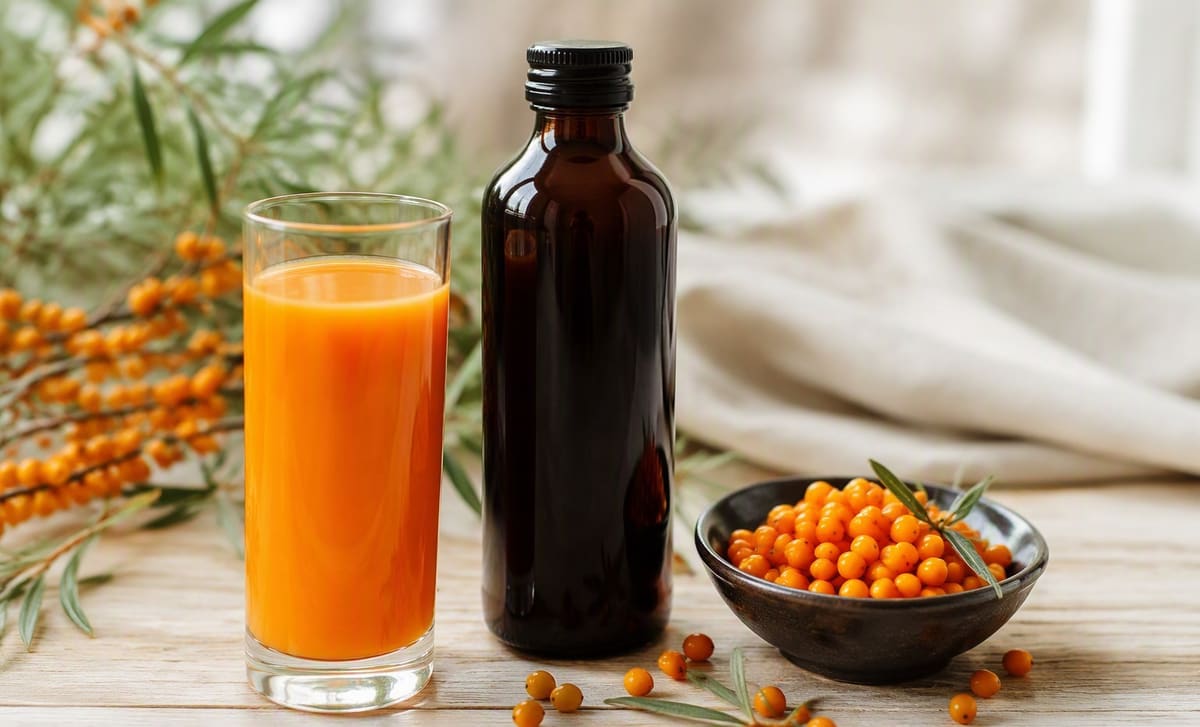
Sea buckthorn juice comes three ways: pure, blended, and concentrated. All three share one trait, serious acidity from malic, quinic, and citric acids, so you dilute it (about 1 part juice to 3 parts water), protect your enamel, and skip it if your stomach is touchy. It is a genuine vitamin C food. It is not the oil the trials used.
The three forms on the shelf
Pure juice. One ingredient, pressed berries. Intensely sour, slightly thick, the honest version. If a label says 100% sea buckthorn, this is what you are getting.
Blends. Sea buckthorn cut with apple, grape, or orange juice to tame the sour. Check the ingredient order: if apple juice leads, you are buying apple juice with a sea buckthorn accent. Sugar content climbs accordingly.
Concentrate. Pure juice with water removed, meant to be diluted back. Good value per serving and lighter to ship, with the same acidity rules once reconstituted, and the products hub sets these bottles beside every other form. Erbology’s bottle is a fair example of the pure category (check current price).
From berry to bottle
Pure sea buckthorn juice starts as pressed berries, and pressing often skims off part of the oil, because the oil is worth more sold separately. That detail matters: it is one more reason juice carries so little of the famous fatty acids even when it is 100% fruit.
Most bottles are pasteurized, which keeps them shelf-stable but trims some vitamin C, on top of what time and oxygen take later. Sediment at the bottom is normal and good: it is the pulp that filtered through, and it carries much of what makes the drink interesting. Shake before pouring.
“Not from concentrate” means pressed, pasteurized, bottled. “From concentrate” means the water was removed near the source and added back later, which is cheaper to ship and slightly rougher on flavor. Neither is a scam, but the first usually tastes closer to the berry.
The acidity reality
This is the part the marketing skips. Pure sea buckthorn juice is one of the most acidic drinks in the grocery aisle, and the safety guide treats it accordingly:
- Dilute roughly 1:3 with still or sparkling water.
- Rinse your mouth with plain water after, and wait half an hour before brushing, because acid-softened enamel scrubs away.
- Avoid it on an empty stomach.
- Reflux, gastritis, or an ulcer changes the conversation entirely. That is a doctor question, not a dilution question.
The sugar question
Pure juice is sour, not sweet. Blends are where sugar sneaks in, either from the sweeter juices or added outright. Read the grams per serving, not the front of the bottle. A blend that drinks like soda delivers like soda, whatever the berry on the label promises.
What the fruit percentage means
A bottle labeled 100% sea buckthorn juice is the pure form. Below that, the wording does the work. “Nectar” in many markets can legally run well under half fruit, padded out with water and sugar, and “juice drink” can go lower still. The ingredient list and the declared fruit percentage settle what the front label leaves vague, and the sugar content page gives the baseline numbers to compare against.
The names on the bottle
One drink, a whole shelf of spellings. You will see sea buckthorn fruit juice, sea buckthorn berry juice where a label leans on the fruit, seabuckthorn juice run together as one word, seabuck juice where a brand shortened its own name, and plain buckthorn juice where somebody dropped the sea. Phone keyboards mangle it further, which is how c buckthorn juice ends up in a search box. All of it points at the same pressed orange berries.
In India the same pressed berries sell as Leh berry juice, the name a Ladakh drink made famous, and there is no old Hindi word for the plant at all. The sea buckthorn in Hindi and Indian names page explains why one of the world’s biggest sea buckthorn juice markets runs on a borrowed name.
Indian shoppers who search sea buckthorn juice in hindi, or sea buckthorn juice ke fayde, are asking what a benefits search asks anywhere. What does the drink actually do? The honest seabuckthorn juice benefits are the vitamin C and flavonoids covered above, not the oil trials. Most of the sea buckthorn juice benefits in hindi write-ups promise the oil’s results on the juice’s label, and that is the one claim to distrust.
The bare “buckthorn” is the one alias worth a second look. True buckthorns are Rhamnus, an unrelated group of shrubs with dark berries and nothing to do with this bottle, so check the Latin before you check the flavor. If the label says Hippophae rhamnoides, you have the right plant, and the lookalikes page sorts the confusion out in full.
Reading the label in ten seconds
- Ingredient order. One ingredient means pure juice. Anything leading with apple or grape is a blend with a sea buckthorn accent.
- “100% juice” is not “100% sea buckthorn.” A blend can be entirely juice and still be mostly cheaper fruit.
- Sugar per serving. Pure runs low, blends climb. The number on the panel settles it.
- Cloudiness is normal. Pure juice throws sediment, and pasteurization trims some vitamin C. Shake, pour, dilute.
What a serving actually contributes
A diluted glass gives you vitamin C (fresh berries carry roughly 200 to 600 mg per 100 g, varying by species and harvest, and processing plus storage trim that), some flavonoids, and hydration with flavor. What it does not give you is the oil. The human trials dosed 1 to 3 grams of concentrated oil daily for dry eyes, skin, and vaginal dryness. Juice carries trace oil at best, so none of those results transfer. The forms compared page shows the gap in one table, and the juice nutrition page breaks down what is actually in the glass.
Storage and shelf life
Unopened bottles keep for months in a cool cupboard. Once opened, the clock runs fast: refrigerate, cap tightly, and finish within about a week. Vitamin C falls off quickly with air exposure, and the juice itself can ferment. If you cannot finish a bottle in time, freeze the rest in ice cube trays and drop the cubes into water or smoothies.
Cloudiness and sediment are normal at every stage. Fizzing, a bloated cap, or a boozy smell mean the bottle has turned.
Who should skip it
Anyone with reflux, gastritis, or an ulcer, until a doctor says otherwise, per the safety notes above. Sugar-watchers should treat blends as the sweetened drinks they are. And anyone here for the studied benefits should read the study dosages page first: those results came from oil, and no amount of juice drinking reproduces them.
Who it suits
Kitchen people and tart-drink fans who want a real fruit in the glass. If you want ideas beyond diluting, our juice recipes put it to work. Anyone chasing the studied benefits should read the oil explainer instead. Bottle-by-bottle picks live in the juice buying guide.
Frequently asked questions
How do you drink sea buckthorn juice?
Diluted, about 1 part juice to 3 parts water, and not on an empty stomach. The pure juice is sharply acidic. Rinse your mouth with plain water after drinking, and wait before brushing your teeth. If you have reflux or an ulcer, ask your doctor first.
Is sea buckthorn juice good for you?
As a food, yes: it delivers vitamin C and flavonoids with real tartness. As a supplement, no trial has dosed juice for a health outcome. The studied benefits came from 1 to 3 grams of oil daily, and juice carries almost none of that oil.
How long does sea buckthorn juice last after opening?
About a week in the fridge, tightly capped. Vitamin C degrades with air exposure, so the drink gets less interesting every day it sits. Freeze leftovers in ice cube trays if you will not finish the bottle. If it starts to fizz or smell fermented, pour it out.