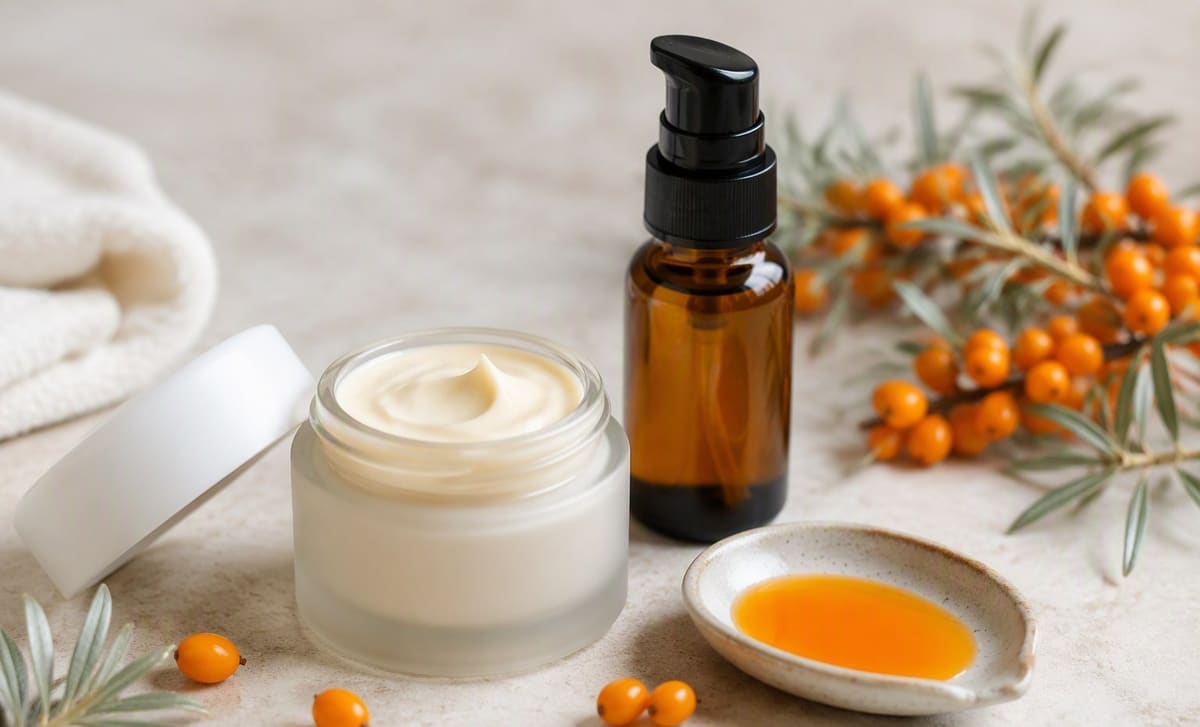
The best sea buckthorn skincare pairs a real concentration of the oil with a formula you will use daily. SIBU’s Sea Berry Therapy line is the most complete option, The Ordinary’s fruit oil is the budget pick for mixing into your routine, and Weleda’s body oil is the classic for everything below the neck. Set your expectations at “noticeably better hydrated skin,” not miracles.
Prices and availability checked July 2026. Confirm at checkout. Research-based reviews per our editorial policy.
First, what sea buckthorn can honestly do for skin
Two human trials anchor the evidence. In 2009, a 60-woman study put 30 of them on 2 grams of sea buckthorn oil daily and saw skin hydration rise about 49% and elasticity about 26% over three months (no placebo group, so temper that). In 2024, a placebo-controlled trial of 40 women taking 1 gram daily measured more modest gains: hydration up 8%, collagen density up 10%, texture up 14% over 12 weeks. Both studies fed people the oil rather than rubbing it on. Topical products have logic and tradition behind them, but less direct trial data. That is the honest picture, and any brand telling you more is selling.
The picks at a glance
| Product | Best for | Type | Our score |
|---|---|---|---|
| SIBU Sea Berry Therapy line | Best overall routine | Cream, serum, cleanser | 8.9 |
| The Ordinary Sea Buckthorn Fruit Oil | Best budget face oil | Single-ingredient oil | 7.8 |
| Weleda Sea Buckthorn Body Oil | Best body oil | Body oil | 8.3 |
| SeabuckWonders Facial Cream | Best dedicated face cream | Cream | 7.9 |
1. SIBU Sea Berry Therapy: best overall
SIBU Sea Berry Therapy (face cream, serum, cleanser)
Best overallWhy it wins. The most complete sea buckthorn line from the brand that sources Himalayan berries and publishes its extraction standards. The system approach (cleanse, serum, cream) is also how you actually get results: daily use over weeks, not a one-off mask.
What we do not love. Buying the full line adds up fast, and the formulas include more than sea buckthorn, so if you want the pure single-ingredient experience, the budget pick below is closer to that.
Best for: anyone building a routine around sea buckthorn rather than dabbling in it.
We may earn a commission at no cost to you.
2. The Ordinary Sea Buckthorn Fruit Oil: best budget face oil
The Ordinary 100% Organic Cold-Pressed Sea Buckthorn Fruit Oil
Budget pickWhy it made the list. One ingredient, organic, cold-pressed berry oil, at a price that lets you experiment without commitment. Mix one or two drops into your night moisturizer. That is the whole technique, and it softens the orange tint enough for most skin tones.
What we do not love. Used straight, it will tint you. It also smells earthy in a way that divides households, and cold pressing preserves less than CO2 extraction.
We may earn a commission at no cost to you.
3. Weleda Sea Buckthorn Body Oil: best body oil
Weleda Sea Buckthorn Body Oil
Best body oilWhy it made the list. Weleda has made this formula for decades, and it shows: a sesame-and-sea-buckthorn blend that spreads well, absorbs fast, and smells like something you would choose rather than tolerate. For dry arms and legs in winter, it is the easy winner.
What we do not love. It is a blend, so the sea buckthorn share is modest. If you want maximum omega-7 on your skin, a pure berry oil mixed into body lotion gets you closer.
We may earn a commission at no cost to you.
4. SeabuckWonders Facial Cream: best dedicated face cream
SeabuckWonders Sea Buckthorn Facial Cream
Face cream pickWhy it made the list. From the brand whose supplement oil we rate best overall, a face cream that puts their organic oil into a daily-use format. Good middle ground if pure oil feels like too much and a full system feels like too little.
What we do not love. One product cannot carry a routine, and the cream alone will not match what the oral studies measured. Pairing it with a softgel is the combination the research most resembles.
We may earn a commission at no cost to you.
How to choose for your skin
- Dry or mature skin: a dedicated cream plus a drop of berry oil at night. The hydration research is the strongest card sea buckthorn has.
- Acne-prone skin: pale seed oil only, a few drops, patch test first. Publisher ratings place it at the low end of the comedogenic scale, so clogging is unlikely but not impossible.
- Body dryness: the Weleda oil after showering, while skin is damp.
- Inside-out approach: the trials fed people oil. Our capsules guide covers that route, and the dosage page explains the amounts studied.
Reading a skincare label: the INCI check
Skincare labels list ingredients by concentration, so the position of Hippophae rhamnoides oil is the whole game. Top third means a meaningful share. After the fragrance or the preservatives (parfum, phenoxyethanol), it is a label ingredient, present for the marketing. Check which oil too: “fruit oil” or “pulp oil” is the orange berry oil, “seed oil” is the pale one. A “sea buckthorn cream” where sea buckthorn sits below the perfume is a moisturizer with a story, per the serum explainer and the cream and lotion page.
Common buying mistakes
- Paying active-treatment prices for a cream with sea buckthorn near the end of the ingredient list.
- Expecting topical products to reproduce the oral trials. The studies fed people oil. Topical logic is real but less tested.
- Straight berry oil on the face in daylight. It tints. One or two drops in night cream is the technique.
- Buying the full system before testing one product for two weeks.
The 60-second decision path
- Goal: face hydration, body dryness, or a routine? Face goes oil or cream, body goes body oil, routine goes system.
- Berry or seed, named? Breakout-prone faces start with seed, per the comedogenic entry.
- INCI position: top third or walk away.
- Patch test on the inner arm for three days before any face use.
Storage and handling
The same oxidation rules as the kitchen oils: dark bottles, cool storage, caps tight, finished within three to six months of opening. Droppers touch skin, so wipe them. Berry oil stains collars and pillowcases, so evening application earns an old pillowcase. The storage page has the full rules, and the skincare routine page slots these products into a day.
Frequently asked questions
Is sea buckthorn good for your skin?
Evidence is moderate. A 2009 study found oral sea buckthorn oil improved skin hydration by about 49% and elasticity by about 26% over three months, though it had no placebo group. A 2024 placebo-controlled trial found smaller but real improvements (hydration up 8%, collagen density up 10%). Topical use has less direct research behind it.
Will sea buckthorn oil stain my face?
Berry (fruit) oil can temporarily tint skin orange because of its carotenoids. Mix one or two drops into your night cream instead of applying it straight, or use pale seed oil during the day. The tint washes off. It is not permanent.
Is sea buckthorn oil safe for acne-prone skin?
Generally yes. Publisher and formulator ratings place it at the low end of the 0 to 5 comedogenic scale, though no lab study has pinned an exact number on it. The lighter seed oil is the safer daily choice for breakout-prone skin, and patch testing first is always smart.
Can I combine sea buckthorn oil with retinol or vitamin C serums?
No interaction is documented, and layering an oil over water-based serums is standard practice. The practical rules: introduce one new product at a time, patch test, and keep tinted berry oil for evenings. If your skin is mid-adjustment to a retinoid and already irritated, wait rather than stacking variables.