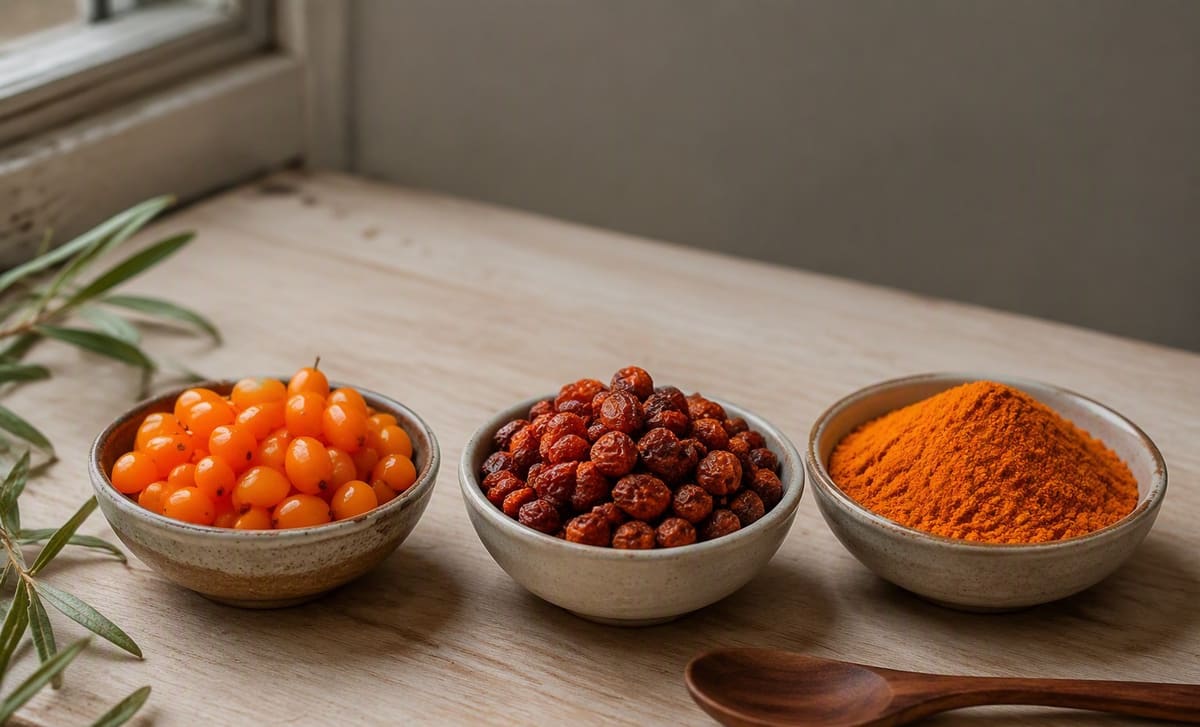
Fresh berries keep everything and spoil in days. Frozen keeps nearly everything. Drying concentrates sugar and costs a large share of the vitamin C. Powder keeps fiber and some vitamin C but leaves the oil fraction behind. Juice keeps the vitamin C and the acids but drops the fiber and, unless it is pulp-rich, the oil. The form is the nutrition.
Form by form
| Form | Vitamin C | Oil fraction | Fiber | Watch out for |
|---|---|---|---|---|
| Fresh | Full (200-600 mg per 100 g) | Full | Full | Perishable in days, hard to find |
| Frozen | Nearly full | Nearly full | Full | Freezer burn. Thaw gently |
| Dried berries | Heavy losses | Some retained | Concentrated | Concentrated sugar, often sweetened |
| Powder | Some remains | None, unless whole-berry | Kept | Vitamin C varies by drying heat |
| Juice | Kept, fading with heat and time | Only if pulp-rich | Minimal | Blends diluted with other juices |
The logic behind the losses
Vitamin C is fragile against three things: heat, oxygen, and time. Fresh berries spend none of those currencies. Freezing pauses the clock, which is why frozen berries keep nearly the full value and why our vitamin C page treats fresh and frozen as equals.
Drying spends all three at once. It also concentrates whatever survives, including sugar: remove the water and every gram of the remainder counts double. That is why dried berries taste like candy and why sweetened versions are candy.
A word for frozen berries, the quiet winner of this page. They keep the full nutrition of fresh for months, they thaw into smoothies and sauces in minutes, and their only real cost is freezer space and a softer texture. If a supplier near you sells frozen sea buckthorn, that bag beats every shelf-stable form on nutrition.
Powder is dried berries (or juice) milled fine. It keeps the fiber and a share of the vitamin C and flavonoids, and unless the powder is whole-berry with the oil retained, the fatty acid fraction never made it into the bag. Our powder guide sorts which products are which.
The serving math behind the table
The table’s vitamin C row carries the only firm numbers on this page, so here is what they mean per serving. A 100-gram bowl of fresh berries delivers 200 to 600 mg of vitamin C depending on variety, several times the daily requirement in one sour sitting. Frozen matches it almost completely, because freezing pauses the clock the day the berries are bagged. Dried and powdered forms deliver a fraction, and the fraction is honestly unknowable without the product’s own analysis, because drying temperature decides it. Juice delivers a share that shrinks with every week on the shelf, which is why the best-by date is a nutrition fact.
Storage: the fourth form nobody sells
Every form on this page degrades on its own clock, and your kitchen controls the speed. Berries in the fridge keep for days, in the freezer for months. Oil wants cool and dark, and seed oil wants the fridge after opening. Powder wants a sealed jar away from the stove. Juice wants the fridge after opening and a quick finish. The storage guide runs the full shelf-life table, and it doubles the value of any form you buy.
The purchase decision, tied to guides
Each form has a trap, and each trap has a guide. Powder: whole-berry versus juice powder, sorted in the powder guide. Dried berries: unsweetened versus candy, on the dried berries page. Usage ideas live on the powder how-to page for anyone holding a bag and a blank look.
Common misreadings
- “Freeze-dried equals fresh.” Freeze-drying is the gentlest shelf form, and it still spends vitamin C that freezing keeps. It beats air-dried, not the freezer bag.
- “Sweetened dried berries are a health snack.” They are candy with a fiber inheritance. Unsweetened is the health snack.
- “Concentrate is fake juice.” From-concentrate is a logistics choice that costs some vitamin C at each heat step. It is a downgrade, not a fraud, and the label must say it.
The two oil questions
If your goal is omega-7 or the skin and dry-eye research, no amount of dried berry or powder replaces the oil. The studied doses were 1 to 3 grams of oil daily, and that oil either stayed in the product or it did not. Whole-berry powders retain some, while juice and seed-free powders retain little to none.
Juice sits in between. It keeps the water-soluble nutrition (vitamin C, acids, flavonoids) and drops the fiber to nearly nothing. Pulp-rich juices carry some carotenoids and oil, while clear filtered ones carry far less. The juice guide reads labels for exactly this.
The in-between products
Blends, leathers, and jams sit between the forms, and they inherit the trade-offs of whatever they started from. A juice blend is a juice question, priced by its base. A fruit leather is dried berry logic with drying’s losses, and the fruit leather recipe shows what homemade keeps. Jam is dried-plus-sugar territory, whatever the jar claims. When a product does not fit a form on this page, find its base form and apply that form’s expectations, including the sugar check.
Pick by goal
- Maximum nutrition, you have a source: fresh or frozen, full stop.
- Pantry staple for smoothies and yogurt: powder, vitamin C expectations adjusted.
- Trail snack: dried, unsweetened, in small handfuls.
- Daily vitamin C habit: fresh-pressed juice, recently bottled, diluted.
- The researched oil benefits: softgels or liquid oil, covered in the forms compared page.
Frequently asked questions
Which form of sea buckthorn keeps the most vitamin C?
Fresh berries keep everything, and properly frozen berries keep nearly everything, since freezing pauses the vitamin C clock. Juice loses some vitamin C at pressing and more to pasteurization and shelf time. Dried berries and powders lose the most, because heat, oxygen, and time all work against the vitamin. If vitamin C is the goal, frozen berries or a fresh-pressed, recently bottled juice are the reliable forms.
Is sea buckthorn powder as good as fresh berries?
It is different, not equal. Powder keeps the fiber and some vitamin C and flavonoids, and it stores for months, but drying costs a large share of the vitamin C and the oil fraction stays behind unless the powder is whole-berry with oil retained. Powder earns its place on convenience and shelf life, not on matching fresh-berry nutrition.
Is freeze-dried sea buckthorn better than air-dried?
Generally yes for nutrition, at a price. Freeze-drying works cold, so it spares more of the vitamin C and flavor than hot air drying, and the berries keep their shape instead of shriveling. It still loses to frozen for vitamin retention, and it costs more than ordinary dried fruit. Think of it as the best shelf-stable form, not a fresh-berry equal.