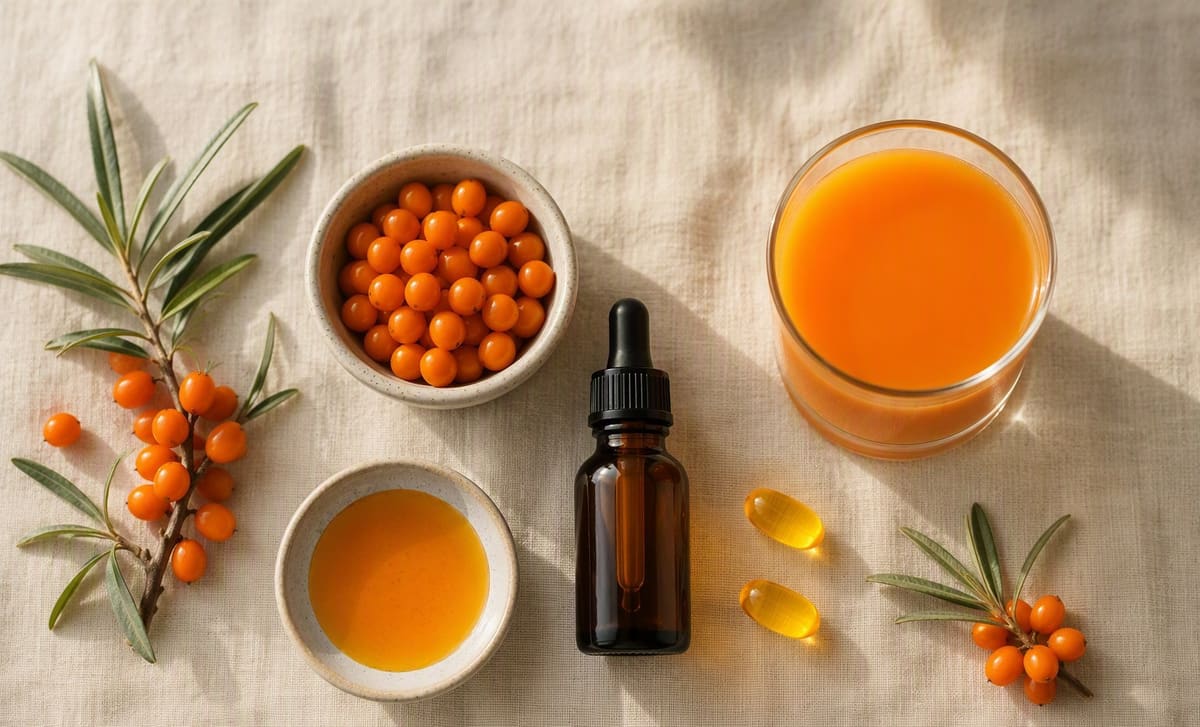
The studied dose for dry-eye and skin benefits was 2 grams of oil daily, about 2.2 ml (a scant half teaspoon) or 4× 500 mg softgels, split across meals. The vaginal-health study used 3 grams. The highest dose formally studied, 5 grams for four weeks, produced a mild blood-thinning effect, so treat 3 grams as the sensible daily ceiling and give any dose twelve weeks before judging it.
Every guide on the how-to-use hub assumes these numbers.
Daily amounts by goal
Try the calculator: the dosage tool converts your goal and your bottle into softgels or ml per day, split per meal, with the days a bottle lasts.
| Goal | Daily amount | In softgels (500 mg) | In liquid oil |
|---|---|---|---|
| Dry eyes | 2 g | 4 softgels | 2.2 ml (a scant half tsp) |
| Skin hydration and elasticity | 1 to 2 g | 2 to 4 softgels | 1.1 to 2.2 ml |
| Vaginal dryness | 3 g | 6 softgels | 3.3 ml (about two-thirds tsp) |
| General daily use | 1 g | 2 softgels | 1.1 ml (a scant quarter tsp) |
| Upper boundary studied | 5 g | not recommended | not recommended |
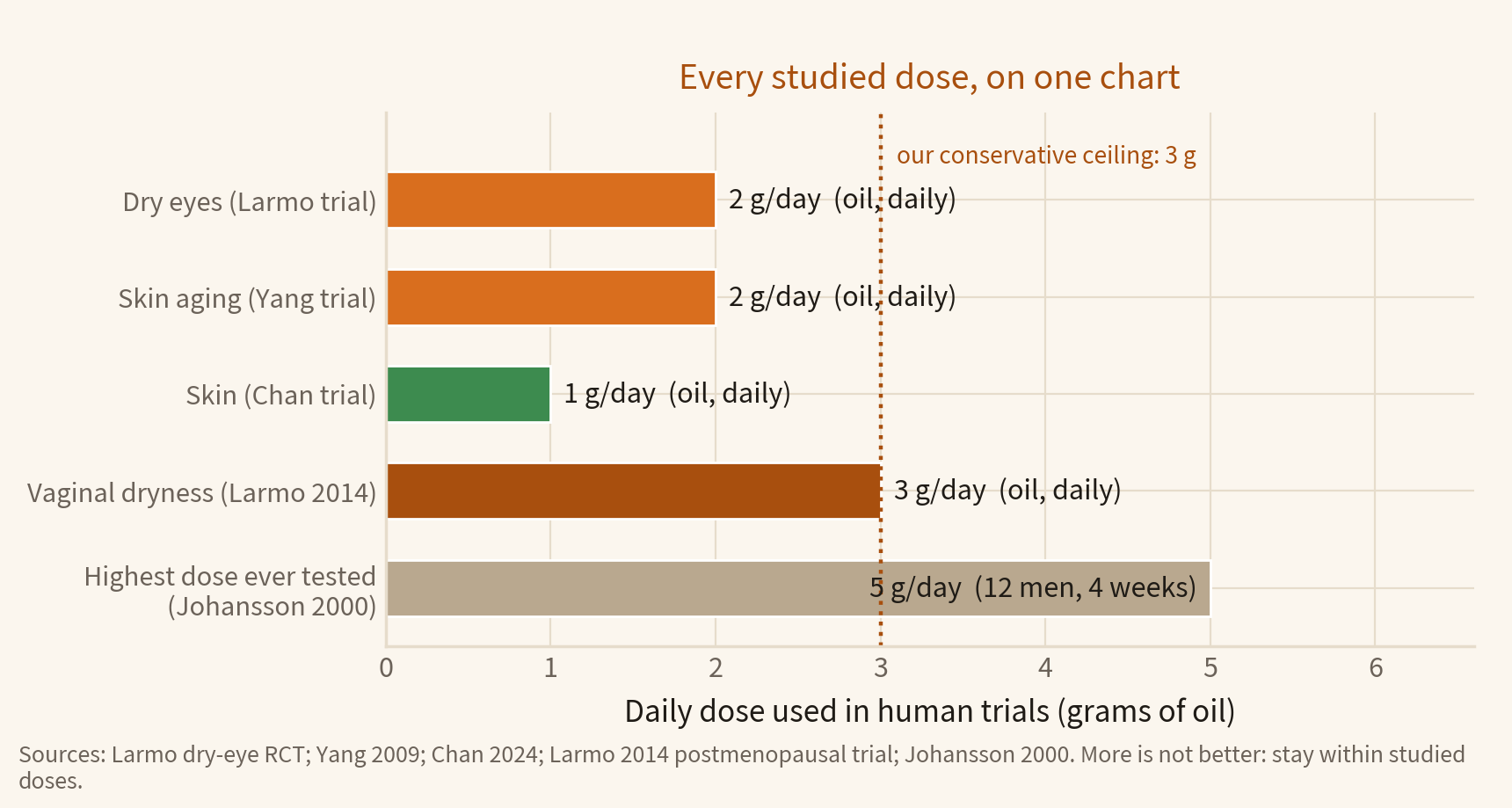
See the data behind this chart
| Trial / goal | Daily dose |
|---|---|
| Dry eyes (Larmo) | 2 g oil |
| Skin aging (Yang 2009) | 2 g oil |
| Skin (Chan 2024) | 1 g oil |
| Vaginal dryness (Larmo 2014) | 3 g oil |
| Highest tested (Johansson 2000) | 5 g oil, 12 men, 4 weeks |
Why we give the numbers in milliliters
Most dose pages on the internet tell you one teaspoon equals about 2 grams of sea buckthorn oil. That is wrong, and the error matters. A level teaspoon holds 4.9 ml of liquid. Because oil is lighter than water, that teaspoon actually carries close to 4.5 grams of oil, more than double the studied 2-gram dose.
If you dose by teaspoon using the wrong conversion, you land near 5 grams a day, the dose where a small trial saw reduced platelet aggregation. Measure in milliliters with the dropper or a medicine syringe if your bottle has one, or use softgels, where the label does the math for you.
By form, practically
Liquid oil: 2 grams is about 2.2 ml, a scant half teaspoon. Take it with food, straight or stirred into yogurt.
Softgels: check the oil per softgel on your label. At 500 mg, the 2-gram studies mean four a day. At 1,000 mg, two. The capsules guide lists verified content per product.
Juice: a food, not a dosed supplement. A small diluted glass (1:3 with water) daily fits normal food patterns. Do not try to reach oil-study doses with juice. The acidity will object first, per the safety hub.
Three rules that outrank any number
- With meals. Every trial dosed with food, for comfort and absorption.
- Twelve weeks before judging. The studies measured at week 12. Week 2 verdicts are noise.
- Check interactions first. The blood-thinner caution applies at these doses. Details on the dosage and safety page, which also maps each number here to its source trial.
Reading your actual bottle
Liquid bottles vary, and two minutes with yours prevents the teaspoon trap. If the dropper is marked in milliliters, trust the marks: 2.2 ml is the 2-gram studied dose. If it is unmarked, a full standard dropper holds about 1 ml, so two full droppers plus a little lands near the dose. A 5 ml medicine spoon from any pharmacy is the cleanest tool: fill it just under halfway for 2 grams, per the density math in the table above.
Juice, powder, and berries: the food forms
The gram doses on this page describe oil, and no food form reaches them sensibly. A small diluted glass of juice, one to two teaspoons of powder, or a small handful of berries (the 28 grams the whole-berry trial dosed) are food-pattern amounts with food-pattern effects. Trying to reach 2 grams of oil through juice would mean drinking the acidity of a citrus grove. The food forms earn their place as nutrition, and the oil forms carry the studied doses.
The 5-gram boundary, in context
The highest dose ever formally studied was 5 grams of oil daily for four weeks, in 12 healthy men, and the finding was a mild reduction in platelet aggregation. Small trial, short run, healthy volunteers. What it means practically: doses above 3 grams a day are unmapped territory with a blood-thinning signpost, which is why this page caps at 3 and why anyone on anticoagulants needs the blood thinners page before any dose at all.
Starting low, moving to studied
If you are cautious by nature, a two-step works: 1 gram daily for two weeks to confirm your stomach approves, then the 2-gram studied dose for the remaining ten. Do not stretch the low phase, because judging the experiment at 1 gram answers a question the trials never asked. The best time page covers how to split whatever dose you land on.
Children, pregnancy, and other special cases
The trials dosed adults, full stop. Berries and juice as food are fine for children, per the children page, but supplement doses for kids have never been studied. Pregnancy and nursing sit in the same evidence gap, mapped on the pregnancy page. For everyone in these groups: food yes, capsules no, doctor decides the rest.
The cost reality
Dose math is also budget math. At 2 grams a day, a 100 ml bottle lasts about 45 days, so the twelve-week experiment is roughly two bottles or 336 standard softgels. Knowing the full cost upfront is part of choosing the dose honestly, and the storage page keeps both bottles honest through the run.
Frequently asked questions
How much sea buckthorn oil should I take daily?
The studied dose for dry-eye and skin benefits was 2 grams of oil per day (about 2.2 ml, a scant half teaspoon, or 4× 500 mg softgels). The vaginal-health study used 3 grams. The highest dose formally studied was 5 grams daily for four weeks, which showed a mild blood-thinning effect, so 3 grams is the sensible ceiling. These are the amounts the trials used, and the amounts to discuss with your doctor.
Is 1 gram a day enough to do anything?
It is the lowest studied dose, used in the 2024 skin trial, which found smaller but real gains at twelve weeks. The dry-eye and 2009 skin studies used 2 grams, and that is the dose with the deepest evidence. If you start at 1 gram to test tolerance, move up before judging.