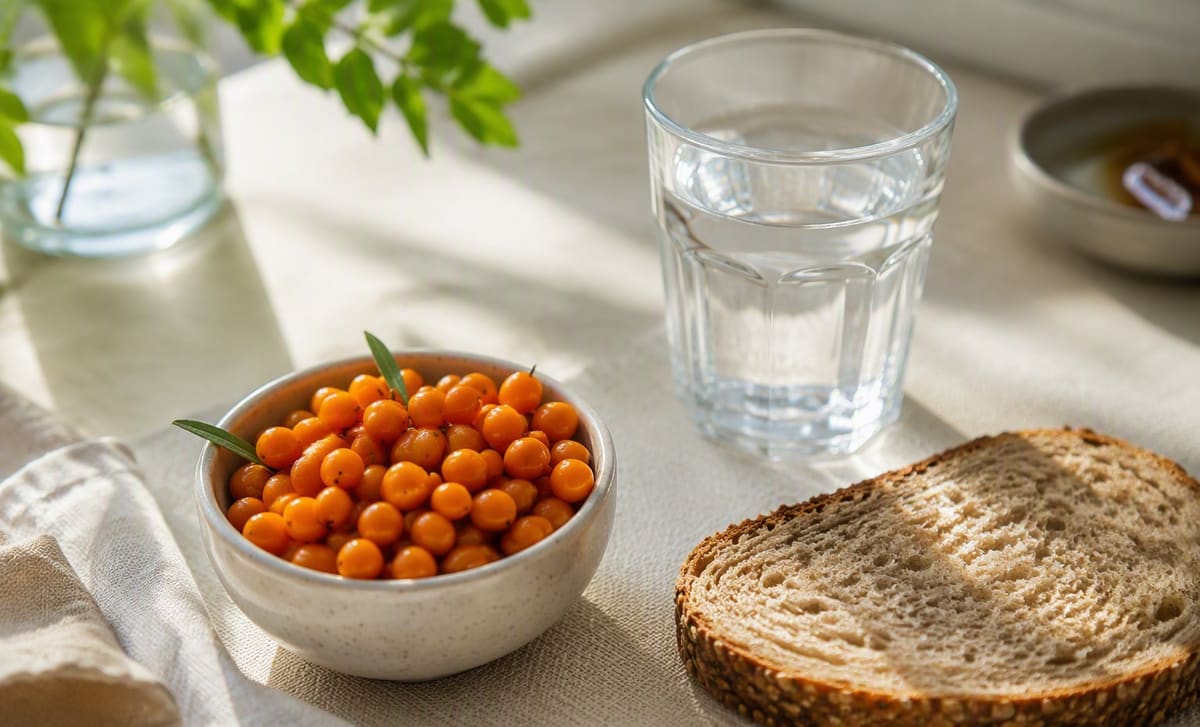
The berry carries a spread of B vitamins in food-scale amounts. That is the honest headline, and it is shorter than the marketing version: sea buckthorn is not a B-complex in disguise, and as a plant food it contains no B12 at all.
The panel, honestly
Composition reviews catalog B-family vitamins among the berry’s residents. The pattern:
| B vitamin | Status in sea buckthorn |
|---|---|
| B1 (thiamine) | Present, food-scale |
| B2 (riboflavin) | Present, food-scale |
| B6 | Present, food-scale |
| Folate (B9) | Present, food-scale |
| B12 | None, it is a plant |
Food-scale means a serving contributes a slice of the daily value, the way most fruits do. Nothing on that table justifies buying sea buckthorn for the B vitamins, and this page will not pretend otherwise.
Form notes
B vitamins are water-soluble, so they follow the juice fraction rather than the oil. Juice and whole-berry forms carry them, and the oil carries little, the same split the minerals page maps. Heat and storage cost some of them, so the freshest forms keep the most, as the fresh vs dried vs powder page details.
The eight, briefly
The B family is a team of eight, and each member has a day job. B1 runs energy release from food, B2 handles cellular chemistry and keeps skin and eyes in working order, B6 processes amino acids and helps make neurotransmitters, and folate builds DNA, which is why it matters most in early pregnancy. B12 works alongside folate and keeps nerves intact, and it is the only one absent here, because plants do not make it. Sea buckthorn carries the first four at food scale, plus smaller appearances from the rest of the family. That is a normal fruit’s resume, and it complements a varied diet rather than replacing anything in it.
What the numbers mean at a real serving
No composition review we trust publishes per-serving B-vitamin figures for the berry, so the honest sentence is structural. Water-soluble vitamins live in the juice fraction, a 100-gram berry serving or a diluted glass of juice delivers a slice of each present B vitamin, and the slice is fruit-sized. Powder concentrates whatever the drying spared. Oil contributes little, because the family does not travel with fat. If a label prints precise B-vitamin percentages for a sea buckthorn product, ask which analysis produced them, because published per-serving data is thinner than the labels suggest.
Common misreadings
- “Natural B-complex.” A marketing phrase stapled onto a normal fruit panel. A complex implies measured doses of all eight, which this is not.
- “B vitamins for energy.” B vitamins let cells release energy from food, which is not the same as giving you energy. Deficiency causes fatigue, and repleting a deficiency fixes it. Extra B vitamins on top of enough add nothing you will feel.
- “Plants have B12 if you ferment or sprout them.” Unreliable at best, and the stakes of B12 deficiency (nerve damage) are too high for folk routes. The spirulina comparison covers the most famous plant-B12 mirage, and the juice guide scores the form that carries the water-soluble family best.
Who should actually care
Vegans, for the B12 line and nothing else on this page. Older adults, whose B12 absorption declines and who should handle that with their doctor, not a berry. And anyone pregnant or planning it, whose folate needs are a medical conversation, never a fruit conversation. For everyone else, the B panel is background nutrition that a decent diet already covers.
What processing and storage do
The B vitamins are water-soluble, which decides their fate in the factory. Pressing berries into juice keeps them in the liquid fraction, so juice carries a share of the panel, while the oil gets none of it. The losses come later. Heat and long storage erode several members of the family, and drying, which concentrates most nutrients, taxes the fragile ones. A fresh or frozen berry is the best-preserved panel. Juice holds a share that shrinks with time on a bright shelf. Powder keeps what the drying temperature allowed. None of this is unique to sea buckthorn. It is how water-soluble vitamins behave in every food, and it is why “contains B vitamins” on a label tells you less than the form and freshness of the product in front of you.
The vegan B12 line
This berry attracts a plant-based crowd, so the B12 point deserves its own paragraph. No unfortified plant food is a reliable B12 source, sea buckthorn included, and B12 is the one vitamin vegans genuinely cannot skip. A supplement or fortified foods handle it. The berry brings real strengths, led by the vitamin C the same water-soluble family made famous, and B12 is simply not among them.
For the letters where the plant does lead, the nutrition hub keeps the honest ranking, and the powder guide covers the form that keeps the water-soluble crowd best.
Frequently asked questions
Does sea buckthorn contain B12?
No. B12 is made by microbes and found reliably in animal foods and fortified products, not in plant foods, and sea buckthorn is a plant. Vegans drawn to this berry for its other strengths should handle B12 the standard way, with a supplement or fortified foods. Any label implying a plant supplies meaningful B12 deserves skepticism.
Can sea buckthorn replace a B-complex supplement?
No. The berry's B vitamins arrive in food-scale amounts spread across several family members, which is what a normal fruit does. A B-complex supplement delivers measured doses of all eight, which is a different product for a different job. If your doctor flagged a specific B deficiency, eat the berry for its real strengths and handle the deficiency with the supplement built for it.