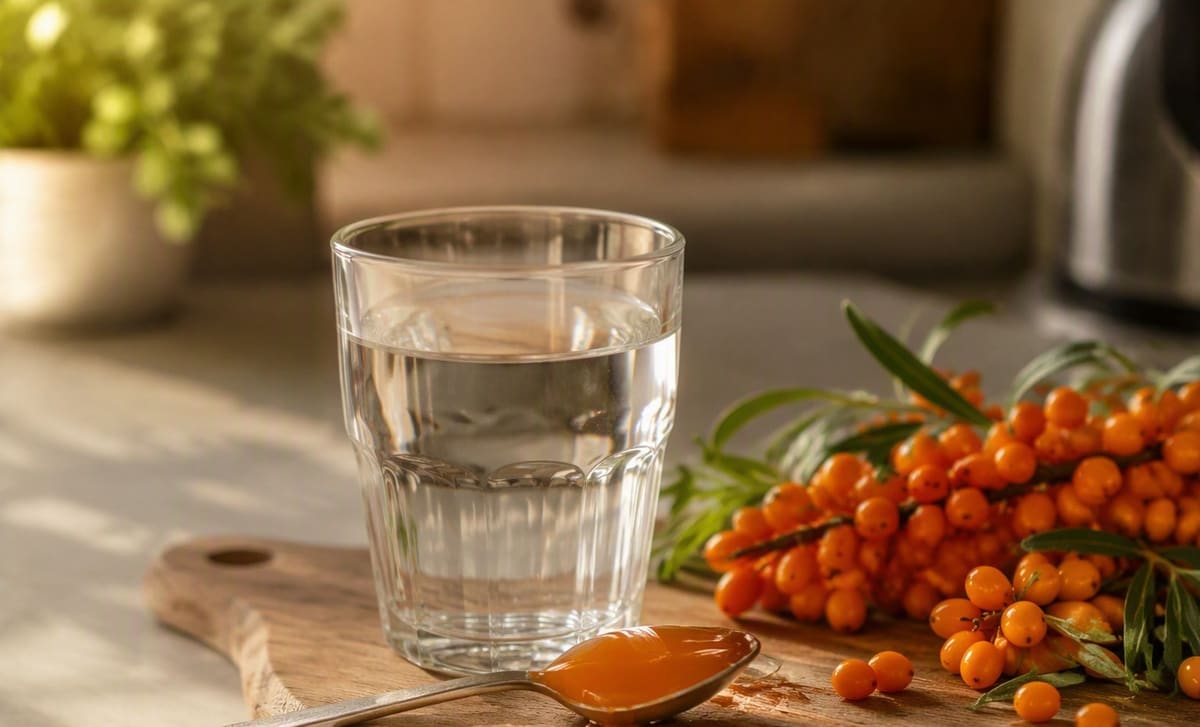
How you use sea buckthorn depends on the form. Oil goes in with meals at study-level doses of 1 to 3 grams a day. Capsules are the same oil with easier math. Juice needs diluting. Skincare needs restraint, because berry oil tints. This hub collects the routines that match the evidence and the common sense.
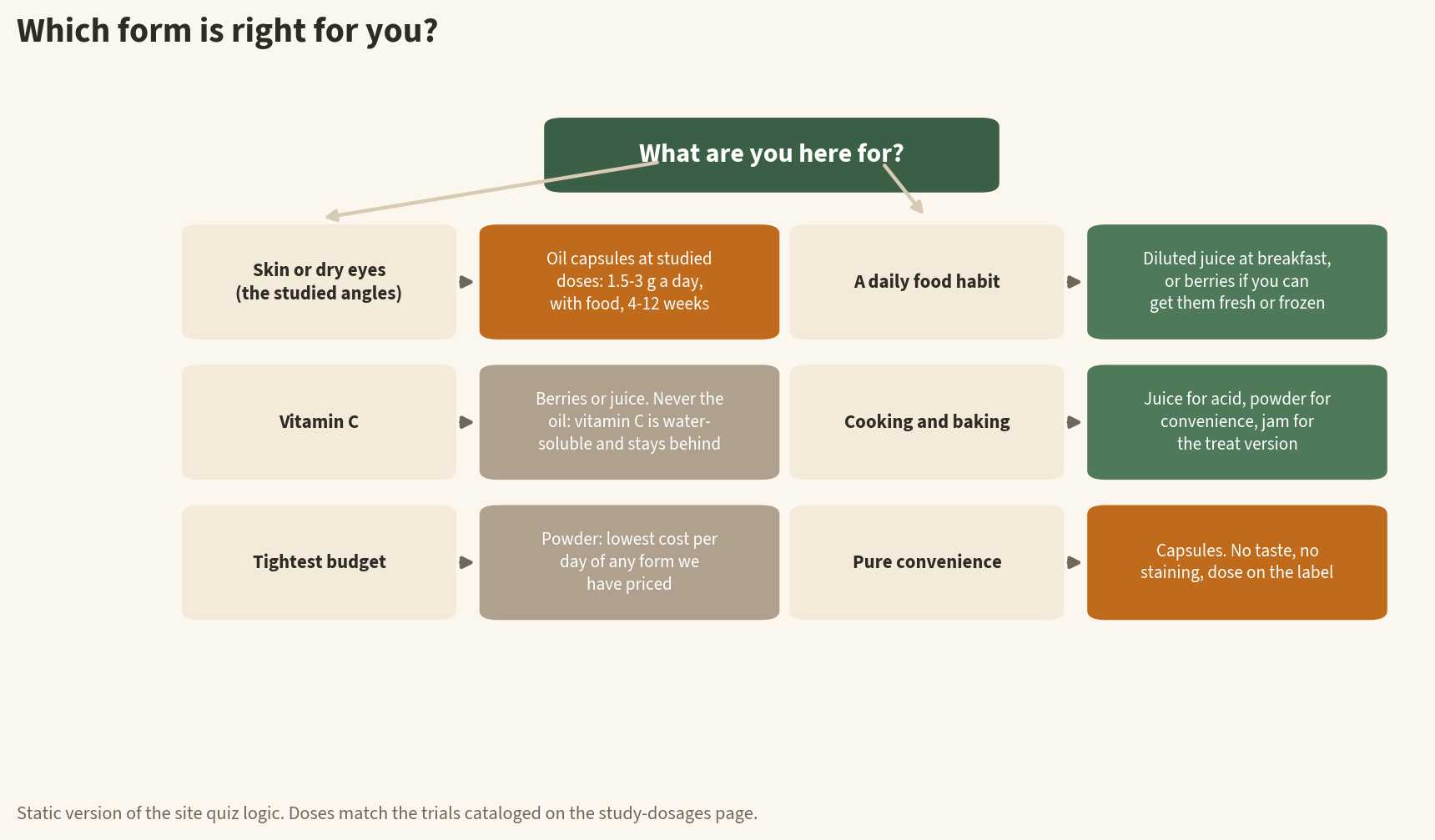
See the data behind this chart
| Goal | Form |
|---|---|
| Skin or dry eyes (studied angles) | Oil capsules, 1.5-3 g daily with food |
| Daily food habit | Diluted juice or berries |
| Vitamin C | Berries or juice, never the oil |
| Cooking and baking | Juice, powder, or jam |
| Tightest budget | Powder |
| Pure convenience | Capsules |
Taking the oil
The trials dosed with meals, usually split morning and evening. A gram of oil is about half a teaspoon. Straight from the spoon works if you can handle the earthy taste. Stirring it into yogurt or a smoothie works better for most people. Exact amounts per goal live on the dosage page.
Capsules without the math headache
Check the oil content per softgel, then count up to your target dose. For the common 500 mg softgel, the studied 2 grams means four capsules a day. Our capsules guide lists verified oil content per product so the counting is already done.
Juice, safely
Straight sea buckthorn juice is acidic enough to bother teeth and stomachs. Dilute it roughly one part juice to three parts water, drink it alongside food, and rinse your mouth with water afterward. The reasoning is on the safety page.
On your face
Two workable routines:
- The mixer. One or two drops of berry oil blended into your night moisturizer. You get the carotenoids without the full orange tint.
- The pale route. Seed oil straight, a few drops pressed into damp skin. Lighter, no tint, friendlier for breakout-prone faces.
Either way, patch test on your inner arm for a few days first. Product picks for both routines are in the skincare guide.
The one rule above all
Give it time. The trials ran twelve weeks. Judging any routine inside a fortnight tells you nothing, good or bad.
The detailed routines
How much sea buckthorn per day
The amounts by goal and by form, in grams and in spoons, with the trial dose each one is trying to reach. Read this before any of the routines below.
How to take sea buckthorn capsules
The daily ritual: with food, split morning and evening like the trials, and how many 500 mg softgels actually reach the studied 2 grams.
Best time to take sea buckthorn
With your largest fat-containing meal. Morning versus evening has never been tested, so consistency beats timing.
How long sea buckthorn takes to work
The honest timeline: week 4 signals, week 12 verdicts, and why nothing real happens in three days.
Eating raw sea buckthorn berries
Yes you can, and they are shockingly sour. The freezing trick, where to find them, and the thorn-and-stain picking notes.
Making sea buckthorn juice at home
Six steps from berries to glass, with the dilution rule that protects your teeth built in.
Making sea buckthorn tea
Two teas, two temperaments: the tart berry infusion and the mild leaf tea, plus what is actually in the cup.
How to dilute sea buckthorn oil
Carriers, ratios, and tint control for the potent berry oil, from a careful 1:10 up to a confident 1:3.
Using sea buckthorn oil on your face
The long version of the two routines above: which oil, how many drops, damp skin or dry, what order it goes in, and the tint management that keeps you from photographing badly.
A complete skincare routine
Morning, evening, and weekly steps, the inside-out oral pairing, and the rules that make any routine work.
Storage and shelf life
Oil in the fridge after opening, powder airtight, juice frozen in cubes, and the smell test that settles rancidity.
How to use sea buckthorn powder
Five daily uses from smoothie spoon to baking fold-in, plus the dose realism nobody prints on the jar.
How to use dried sea buckthorn berries
Snack, trail mix, overnight-oats soak, tea simmer, and baking, with the sweet-and-fat pairing rule.
Cooking with sea buckthorn
Add it late to protect the vitamin C, point the acidity at rich food, and keep the oil off the heat.
Oil cleansing with sea buckthorn
The massage-and-warm-cloth method, seed oil for faces, and who should skip it entirely.
How to use this hub
Start with your goal, not the product. A goal picks a form, the form picks a routine, and the routine pages below carry the exact steps. Skin and dry eyes point to oral oil at studied doses. Cooking and general nutrition point to the berries, juice, and powder. Topical curiosity points to the oil-on-skin pages, with patch tests attached. Every path ends at the same two rules: studied amounts, twelve weeks.
The three rules every page shares
- With food, or on damp skin. Oral forms absorb with a meal’s fat, topical forms spread on damp skin. The form changes, the principle holds.
- Twelve weeks before judging. Every human trial measured at three months. Any page in this cluster that mentions a result measured it on that clock.
- Patch test before faces. Every topical page opens with the same inner-arm ritual, and the allergy page explains the reactions that override enthusiasm.
Who should check with a doctor first
Concentrated oil supplements, at studied doses, carry a mild blood-thinning effect, so anyone on anticoagulants, anyone heading to surgery, and anyone pregnant or nursing gets a clinician’s answer before a routine, per the pregnancy page and the safety hub. The berries, juice, and powder as food remain open to nearly everyone. That split, food versus supplement, decides most safety questions on its own.
Frequently asked questions
How do you take sea buckthorn oil?
The studies gave 1 to 3 grams daily with meals, either as liquid oil (about half a teaspoon per gram) or softgels. Splitting the dose across two meals is the common trial pattern. Take it with food, both for comfort and because the fatty acids absorb better.
Which form should a beginner start with?
Match the form to the goal. For skin or dry eyes, capsules or liquid oil at studied doses. For the kitchen, juice, powder, or dried berries. For topical use, seed oil is the gentle start. One form, one goal, twelve weeks: that is the beginner protocol every page in this cluster teaches.