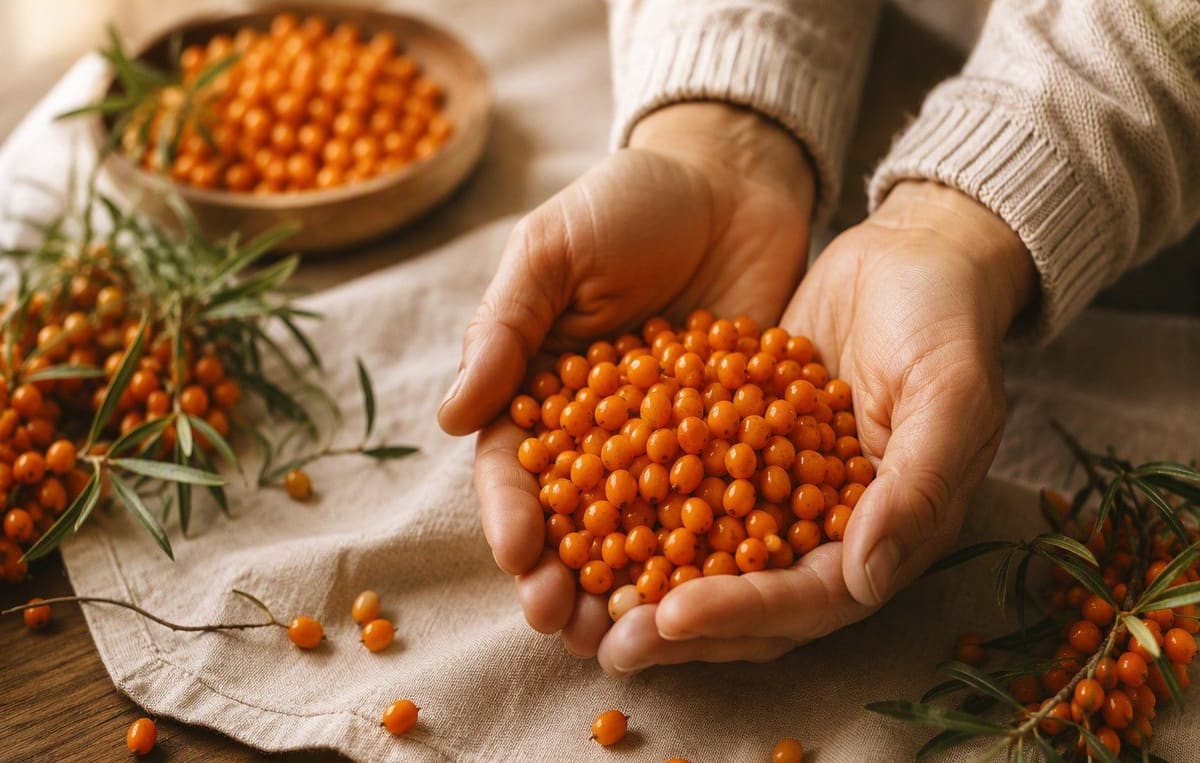
Omega-7 is the common name for palmitoleic acid, a monounsaturated fatty acid that is rare across the plant world and abundant in sea buckthorn berry oil. Composition studies put it at roughly 15 to 54 percent of the berry oil’s fatty acids depending on subspecies, with typical commercial oils around 30 to 40 percent. It is the compound behind most supplement interest in the plant.
The chemistry, in one breath
Palmitoleic acid is a 16-carbon monounsaturated fat, written 16:1 n-7. The “7” says the first double bond sits seven carbons from the tail end of the molecule, the same naming logic the whole omega family uses. Your body makes some on its own, so it is not essential in the dietary sense. The glossary hub defines the rest of the omega family the same way.
Where it occurs
Macadamia nuts are the other well-known source, at a meaningful but lower share of their oil. Most common foods contain very little. Sea buckthorn berry (pulp) oil stands alone among widely sold plant oils, which is why the supplement aisle treats omega-7 and sea buckthorn as nearly the same word. One important catch: the seed oil has almost none, so the plant part on the label decides everything, as our seed vs berry comparison shows.
On labels: the percentage that matters
Good berry oils print the omega-7 share of the oil as a percentage of total fatty acids, and typical commercial berry oils land around 30 to 40 percent. That one number lets you compare two bottles honestly. “Rich in omega-7” with no number attached is an adjective, not a measurement, and adjectives cost nothing to print.
Concrete example: one bottle says “omega-7 32%,” another says “high in omega-7.” The first commits to something a lab can check. The second commits to nothing. One subtlety worth keeping: the percentage describes the oil, not your daily dose, so capsule size and count still decide how much you actually take.
Why it matters here
The dry-eye, skin, and vaginal-health trials all dosed sea buckthorn oil containing omega-7, which is why it became the plant’s marketing headline. The honest note: the trials tested the whole oil, not isolated palmitoleic acid, so credit belongs to the oil as tested. The percentage also measures the oil, not the capsules, so a strong number on a weakly dosed product still disappoints, and freshness and origin sit alongside the printed figure as the rest of the quality picture. The full research picture lives on the omega-7 page.
Where you meet it on this site
The omega-7 research page walks through the human trials one by one, the oil buying guide applies the percentage check to real bottles, and the fatty acid profile page places omega-7 next to every other fat in the oil.
Related terms: palmitoleic acid, the omega family, carotenoids.
Frequently asked questions
Is omega-7 an essential fatty acid?
No. Your body can make palmitoleic acid on its own, so it is classed as non-essential, unlike omega-3 and omega-6 which must come from food. Interest in it comes from research into mucosal and skin health rather than from any deficiency state.
How much omega-7 should a good sea buckthorn oil contain?
For berry oil, typical commercial products land around 30 to 40 percent of fatty acids, with a wider natural range across subspecies and harvests. The real warning sign is no printed number at all, because 'rich in omega-7' without a percentage is an adjective, not a measurement.