
Most healthy adults can take sea buckthorn oil at the studied doses (1 to 3 grams daily) without trouble. Five groups should pause first: anyone on blood thinners without doctor approval, pregnant or breastfeeding women (supplements untested in people), people with surgery inside two weeks, those whose stomachs cannot handle acidic juice, and children. Check the list before you buy.
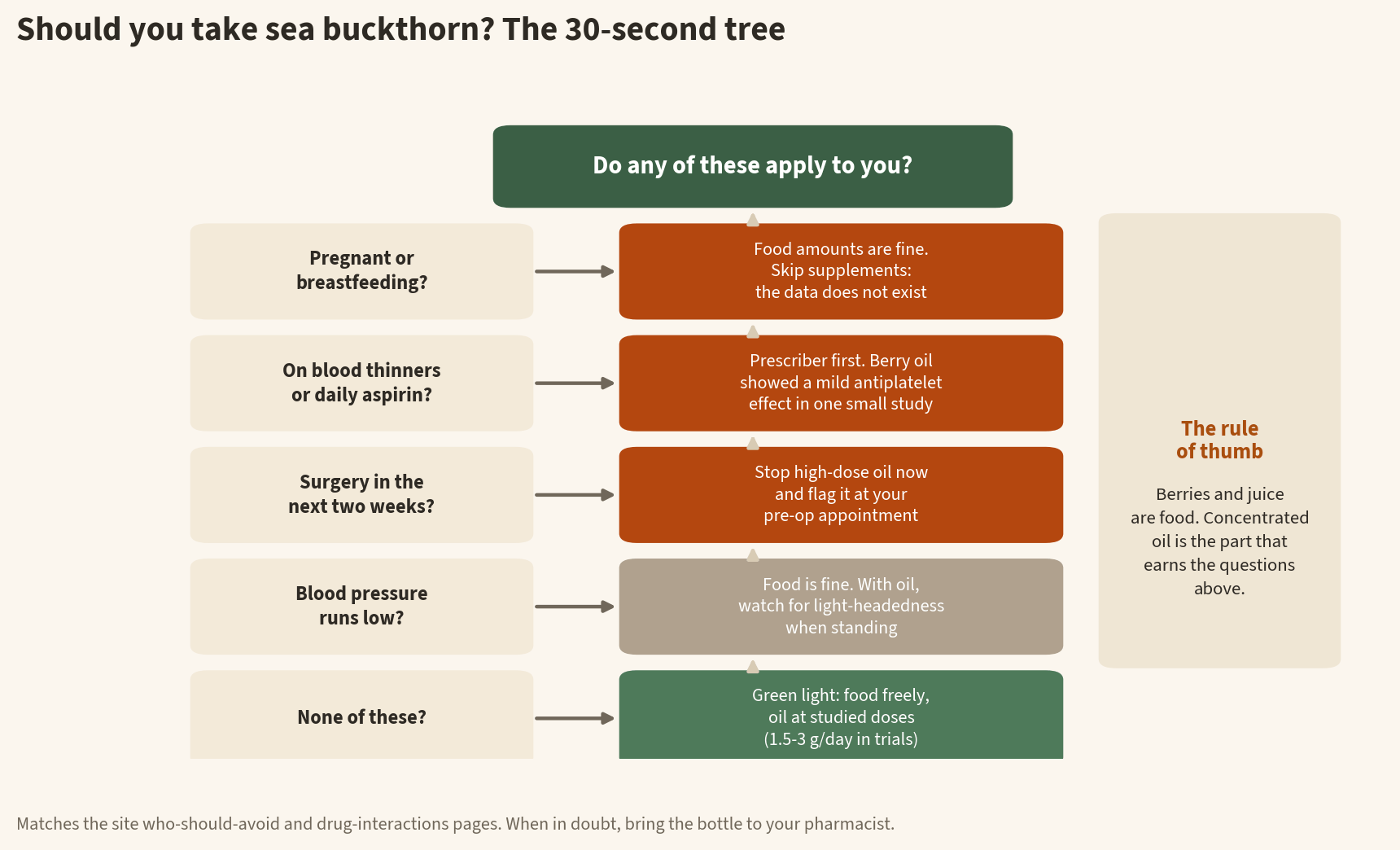
How to use this checklist
Read it like a pre-flight check, not a verdict. Each item names a situation where the evidence runs out or the stakes change, and the action is almost always a conversation, not a prohibition. If you find yourself in one of the five, the page for that situation goes deeper. If you find yourself in none, the last section applies, and it is short for a reason. Five items, two minutes, and you know which page you need next.
The checklist, item by item
1. Blood-thinner users, without a doctor’s yes. High-dose berry oil reduced platelet aggregation in a small controlled study. On warfarin, aspirin, clopidogrel, or similar drugs, that combination belongs to your doctor, not your judgment. Details on the blood-thinner page, and the wider medication picture on the drug interactions page. The study behind it: 12 healthy men, 5 grams of berry oil daily for four weeks, and platelet aggregation clearly down on the lab test. A signal, not a casualty report, aimed at exactly the people in this item.
2. Pregnancy and breastfeeding, for supplements. Berries as food are fine, with centuries of use behind them. No human trial has tested concentrated oil supplements in pregnant women, so the honest answer is unknown. The only pregnancy safety data is one animal study, in which rats dosed with the berry oil across the organ-forming window showed no maternal or embryo toxicity, and a rat result does not settle a human dose (PMID 30081653). That study also stopped at gestation day 16, so it says nothing about breastfeeding. The standard conservative position still applies. Skip the supplements, enjoy the food, ask your doctor. The pregnancy page walks through that animal study in full.
3. Surgery inside two weeks. Because of the antiplatelet signal, stop high-dose oil about two weeks before any planned procedure, dental work included, and tell your surgical team what you take.
4. Reflux, ulcers, or acid-sensitive stomachs, for juice. Undiluted sea buckthorn juice is seriously acidic, with malic, quinic, and citric acids doing the work. It can irritate stomachs and, over time, dental enamel. Dilute it, take it with food, rinse your mouth after, or skip juice for the oil capsules we rate highest, which carry no acid at all.
5. Children and teenagers. Every dosing trial enrolled adults. Berries and diluted juice as food are unremarkable for kids, but concentrated oil supplements are unstudied in anyone under 18, and unstudied means we do not recommend them.
The gray zones
Between “clearly fine” and “clearly ask first” sit a few common cases:
Daily low-dose aspirin users. The combination logic from the blood-thinner page applies, but millions of people take aspirin alongside fish oil and similar supplements with their doctor’s knowledge. This is a mention-it conversation, not an automatic no.
Older adults on several prescriptions. The more daily medications, the more the supplement question belongs to the pharmacist who can see the whole list, because interactions live between items, not inside one.
Anyone with a procedure on the calendar. A colonoscopy with possible biopsy counts. A dental extraction counts. Check the surgery page against your calendar before starting, not after booking.
People planning pregnancy soon. The supplement rule for pregnancy starts whenever trying starts, because the unstudied window opens before the test turns positive. The food stays fine throughout.
Who is actually fine
Healthy adults at 1 to 3 grams of oil daily, taken with food, for stretches of up to 3 months: this is the group the trials actually measured, and no serious adverse events appeared. That covers most readers of this page. The dosage page converts the studied grams into softgels, and is it safe gives the one-paragraph verdict. The study dosages page maps those amounts trial by trial.
One honest caveat sits above all of it: the longest trials ran 3 months, so years of daily use are unstudied territory for everyone. That is not a warning sign, just a data gap worth knowing. The safety hub keeps the full picture in one place, and the safety review shows the trial evidence behind every item on this checklist.
If your doctor says yes
Clearance from a professional is not the end of the process, it is the start of the sensible version of it. Begin at the low end of studied doses, 1 gram of oil a day with food, and give it two weeks before moving to 2 or 3. Note anything odd. Mention the supplement at every future visit the way you would mention a medication, because prescriber changes and new drugs are exactly when old conversations go stale. The how much daily guide turns the studied amounts into a routine you can actually keep. And keep using the bottle you were cleared on: switching brands mid-plan means a new composition, which is a small but real change to what your doctor approved.
Frequently asked questions
Who should not take sea buckthorn supplements?
Five groups: people on blood thinners without doctor approval, pregnant or breastfeeding women (no human trial has tested concentrated oil supplements), anyone with surgery in the next two weeks, people whose reflux or ulcers cannot handle acidic juice, and children, since no dosing trial has enrolled anyone under 18. Most other healthy adults tolerate 1 to 3 grams of oil daily well in trials up to 3 months.
Is sea buckthorn safe for most people?
Yes. Human trials of 1 to 3 grams of oil daily for up to 3 months reported no serious adverse events, and the berries have centuries of food use behind them. The cautions on this page target specific situations: medications that thin blood, pregnancy, surgery windows, acid-sensitive stomachs, and children. If none of those is you, the evidence supports sensible daily use at studied doses.
I am healthy and take no medications. Is there anything left to check?
Three quick things: nothing on the calendar that involves cutting or biopsies in the next two weeks, no pregnancy or breastfeeding in the picture for concentrated supplements, and a stomach that handles acidic juice or a plan to choose oil instead. If all three are clear, the trial record supports sensible daily use at 1 to 3 grams.