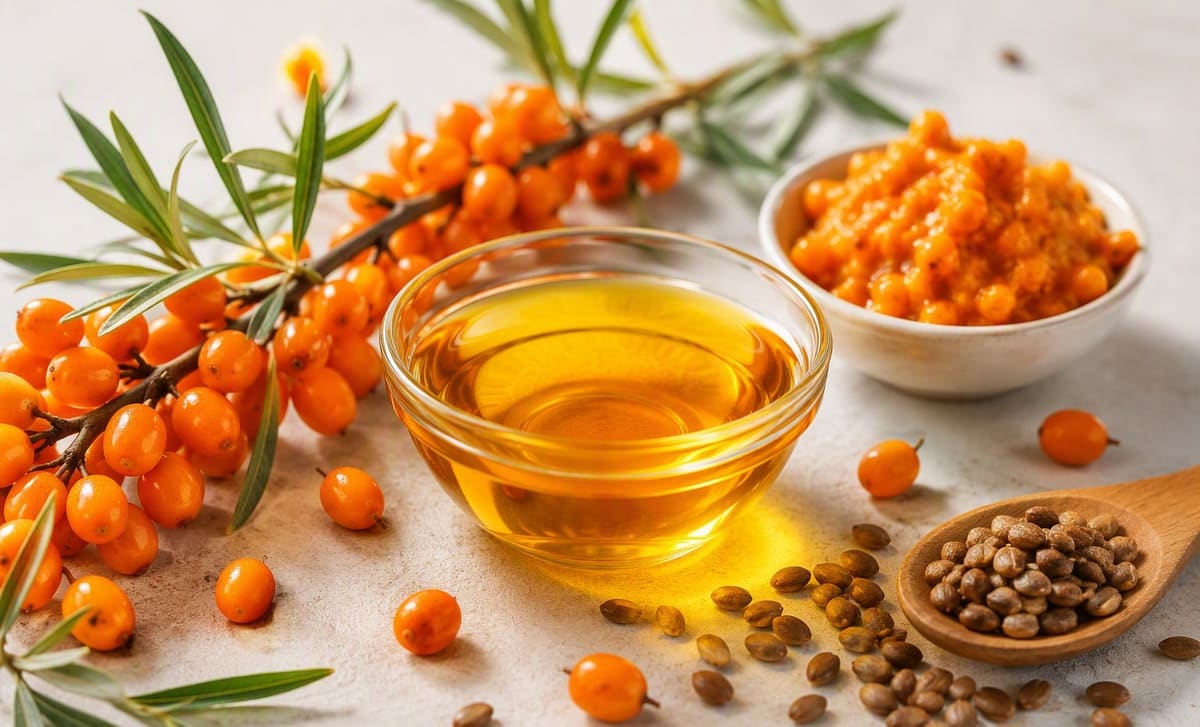
Beyond its fatty acids, sea buckthorn oil carries three passengers: carotenoids (the orange, including pro-vitamin A beta-carotene), vitamin E family compounds, and phytosterols. Berry oil is among the richest plant sources of the carotenoid group. One level teaspoon holds about 4.5 grams of oil, and everything in it is fat-soluble, so it belongs with a meal.
The three passengers
Carotenoids. The reason berry oil looks like liquid pumpkin. Beta-carotene leads, with lycopene and zeaxanthin alongside, and the berry oil ranks among the richest plant sources of the family. Beta-carotene is pro-vitamin A: your body converts it to retinol on demand and throttles conversion when stores are full, which is why carotenoid oils do not carry the vitamin A overdose risk that preformed retinol does. The visible side effect is cosmetic: enough berry oil, on skin or in a bottle, tints everything it touches.
Tocopherols and tocotrienols. The vitamin E family. Both oils carry them, and the seed oil carries more. Inside the bottle, vitamin E works as a bodyguard for the fragile unsaturated fats. In your routine it adds antioxidant chemistry on top, and the nutrition hub covers each passenger in its own entry.
Phytosterols. Plant sterols with a structural resemblance to cholesterol, present at meaningful levels in the berry oil. They are part of why researchers look at this oil for lipid questions in the first place.
What the oil does not contain: vitamin C. It is water-soluble and stays in the juice when the berry is pressed, as the vitamin C page details. An oil capsule is the wrong product for that goal.
The per-teaspoon reality check
Labels talk in grams, kitchens talk in spoons, so here is the conversion. One level teaspoon of oil is about 4.5 grams, roughly nine 500 mg softgels in one pour. The human trials used 1 to 3 grams daily, which means a level teaspoon meets or exceeds the studied range and a heaping one overshoots it. The dosage page maps grams to softgels for every studied use.
Absorption closes the loop. Carotenoids, vitamin E, and the fatty acids themselves are all fat-soluble, so the oil absorbs best alongside a meal that contains some fat. The dry-eye trial dosed twice daily with meals for exactly this reason. A teaspoon on an empty stomach wastes part of what you paid for.
The capsule math
A standard softgel holds about 500 milligrams of oil, so the studied 1 to 3 grams daily means two to six softgels, and a level teaspoon of liquid, about 4.5 grams, matches roughly nine. That conversion decides real purchases: a bottle suggesting one capsule a day is selling a third of the lowest studied dose, and matching the research with such a product means tripling the label’s serving, which triples the monthly cost. Do that arithmetic before checkout, not after. The dosage page maps grams to softgels for every studied use, and the storage guide keeps whatever you buy from degrading before the bottle empties.
What processing does to the passengers
The three passengers board or miss the bottle at the factory. Gentle extraction (supercritical CO2 or cold pressing) keeps carotenoids and vitamin E intact, while aggressive refining strips them along with the color. Storage keeps charging rent: light fades carotenoids visibly, which is why dark glass is standard, and heat and air oxidize the unsaturated fats vitamin E is trying to protect. A fresh, gently made, dark-bottled oil is chemically a different product from a tired clear one, at the same label claim.
Common misreadings
- “The oil contains the berry’s vitamin C.” Vitamin C is water-soluble and stays in the juice fraction, full stop. An oil with a vitamin C claim on the front label is a red flag.
- “Orange means vitamin A danger.” Beta-carotene converts on demand with a throttle, unlike the preformed retinol in liver and cod liver oil, a contrast the cod liver oil comparison draws in full.
- “Seed oil is the diluted one.” It is a different pressing from a different part, paler because it lacks carotenoids, richer in vitamin E, and balanced in omegas. Not a downgrade, a different product.
Cooking with it, or rather not
High heat is the enemy of everything this oil is bought for. The unsaturated fats oxidize, the carotenoids degrade, and the vitamin E sacrifices itself doing damage control. Use it as a finishing oil: over salads, into yogurt, off the heat entirely. The price alone argues against the frying pan, since no one fries in an oil that costs this much per teaspoon, but the chemistry is the firmer argument. Treat the bottle like a supplement that happens to taste interesting, and let cheaper, sturdier oils take the heat.
Berry oil vs seed oil, one more time
These passengers are not evenly split. Carotenoids concentrate in the berry oil (seed oil stays pale), vitamin E leans toward the seed oil, and the fatty acids split as mapped on the fatty acid profile page and the seed vs berry breakdown. Products whose labels say which oil they sell are scored in our oil guide.
Frequently asked questions
Does sea buckthorn oil contain vitamins?
Yes, the fat-soluble ones. The oil carries carotenoids (including beta-carotene, which the body converts to vitamin A as needed) and vitamin E family compounds, with seed oil especially rich in vitamin E. It does not contain vitamin C, which is water-soluble and stays in the berry's juice fraction. For vitamin C, you want the berries, juice, or powder.
How much sea buckthorn oil is in a teaspoon?
About 4.5 grams per level teaspoon, which is roughly nine 500 mg softgels worth of oil. The human trials used 1 to 3 grams daily, so one level teaspoon meets or exceeds the studied range. Everything in the oil is fat-soluble, so take it with a meal that contains some fat for proper absorption.
Does sea buckthorn oil need refrigeration?
Cool, dark, and sealed is the rule, and the fridge is a reasonable upgrade after opening, especially for seed oil with its fragile polyunsaturated fats. Berry oil is somewhat hardier thanks to its more saturated base, but its carotenoids still fade in light, which is why good bottles come in dark glass. A bottle that smells paint-like or off has oxidized and belongs in the bin.