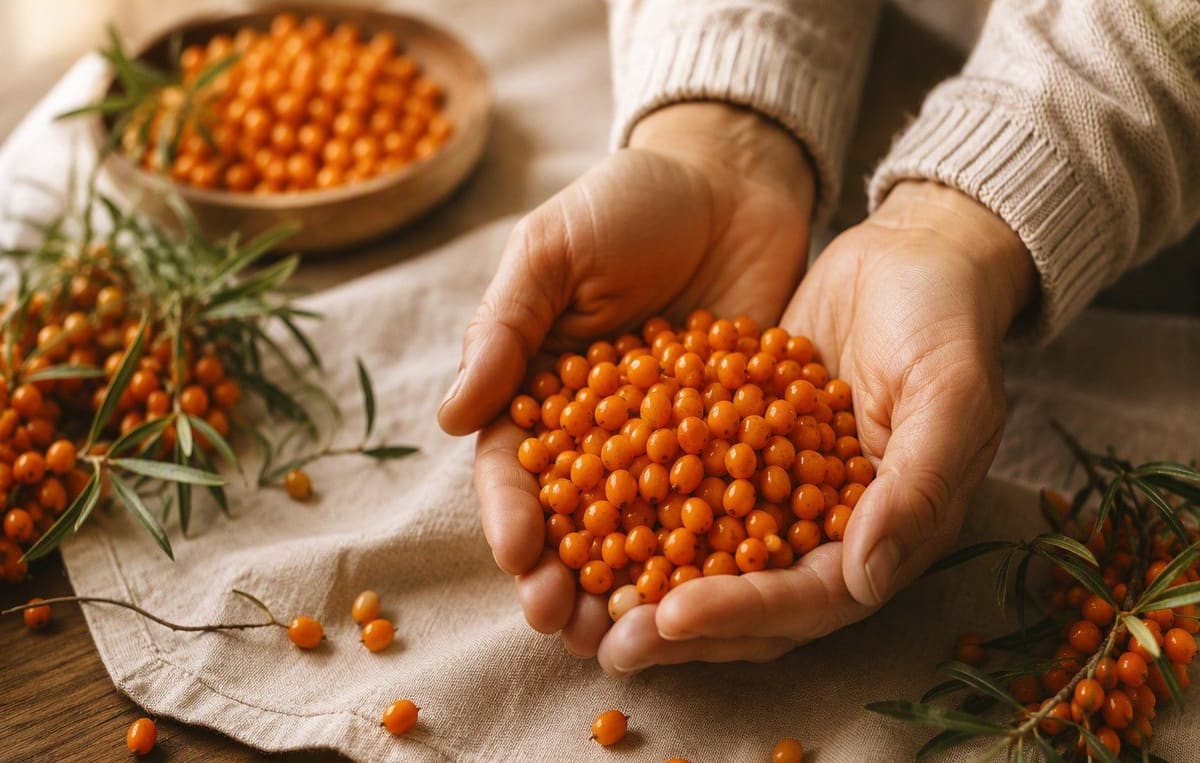
Carotenoids are fat-soluble orange, red, and yellow pigments, and sea buckthorn berry oil is among the richest plant sources of them. They are why the oil glows, why it stains your pillowcase, and part of why the plant attracts research interest at all.
What they are
A family of plant pigments that includes beta-carotene, lycopene, and zeaxanthin. Plants make them to handle light. In sea buckthorn they concentrate in the orange flesh, so the berry oil carries them densely while the pale seed oil carries far fewer, as the seed vs berry comparison shows. The glossary hub defines the neighboring terms.
How they show up on labels and skin
On labels, “rich in carotenoids” is the honest reason a good berry oil looks deep orange, and a pale berry oil is a quality question worth asking. On skin, they tint: overapply berry oil and you go temporarily orange, fade within hours on skin, permanently on fabric. Beta-carotene also converts to vitamin A as your body needs it, which links this family to the nutrition side.
Reading the orange on a label
“Rich in carotenoids” on a berry oil is a claim you can partly check with your eyes: real carotenoid density stains the oil deep orange-red. A juice or powder label saying “with beta-carotene” works the same way in lighter shades. What you will almost never see is a number. Carotenoid content in milligrams rarely appears on labels, so color plus plant part is the working signal, not a printed figure.
Concrete example: a bottle of deep-orange berry oil next to a pale yellow one. If both say sea buckthorn, the pale bottle is either seed oil or a berry oil that has seen heat, age, or heavy processing. The color does not measure carotenoids, but it votes.
The honest caveat
Deep orange proves pigment, not dose: color intensity varies with subspecies and processing, so it is a quality cue, not a measurement. And while carotenoids act as antioxidants chemically, antioxidant chemistry in a test tube is not a health guarantee, as the antioxidants entry explains. The numbers live on the carotenoids nutrition page, with flavonoids and tocopherols defined in their own entries.
The second thing labels do not tell you: carotenoid content swings with subspecies, harvest, and storage, so even an honest “rich in” claim describes a range, not a constant. Light, heat, and time in storage all degrade them, which is why a dark bottle and a recent harvest date matter more for this family than a bold front-label claim.
Where you meet it on this site
The vitamin A page follows the beta-carotene branch into nutrition, and the orange stain page covers the cosmetic side effect everyone asks about. The berry oil buying guide uses color as one of its real-bottle checks.
Related terms: tocopherols, antioxidants, flavonoids.
Frequently asked questions
Do carotenoids turn into vitamin A?
One of them can: beta-carotene converts to vitamin A in the body, and your body regulates that conversion based on need. The others, like lycopene and zeaxanthin, stay as they are and do their own jobs. Excess carotenoids tint skin orange rather than overdose vitamin A.
Why is my sea buckthorn oil pale instead of orange?
Most likely it is seed oil, which is naturally pale and low in carotenoids, so check the plant part on the label. If the bottle says berry oil and looks pale yellow, suspect age, heat, or heavy processing, because real berry oil carries dense orange pigment.