Sea buckthorn really does contain omega-3, 6, 7, and 9, but never in one bottle. The seed oil carries the omega-3 and 6. The berry oil carries the omega-7 and 9. Marketing that says “all the omegas in one plant” is technically true and practically misleading, because the plant makes two different oils and you buy them separately. Here is the honest map, and the nutrition hub holds the rest of the composition file.
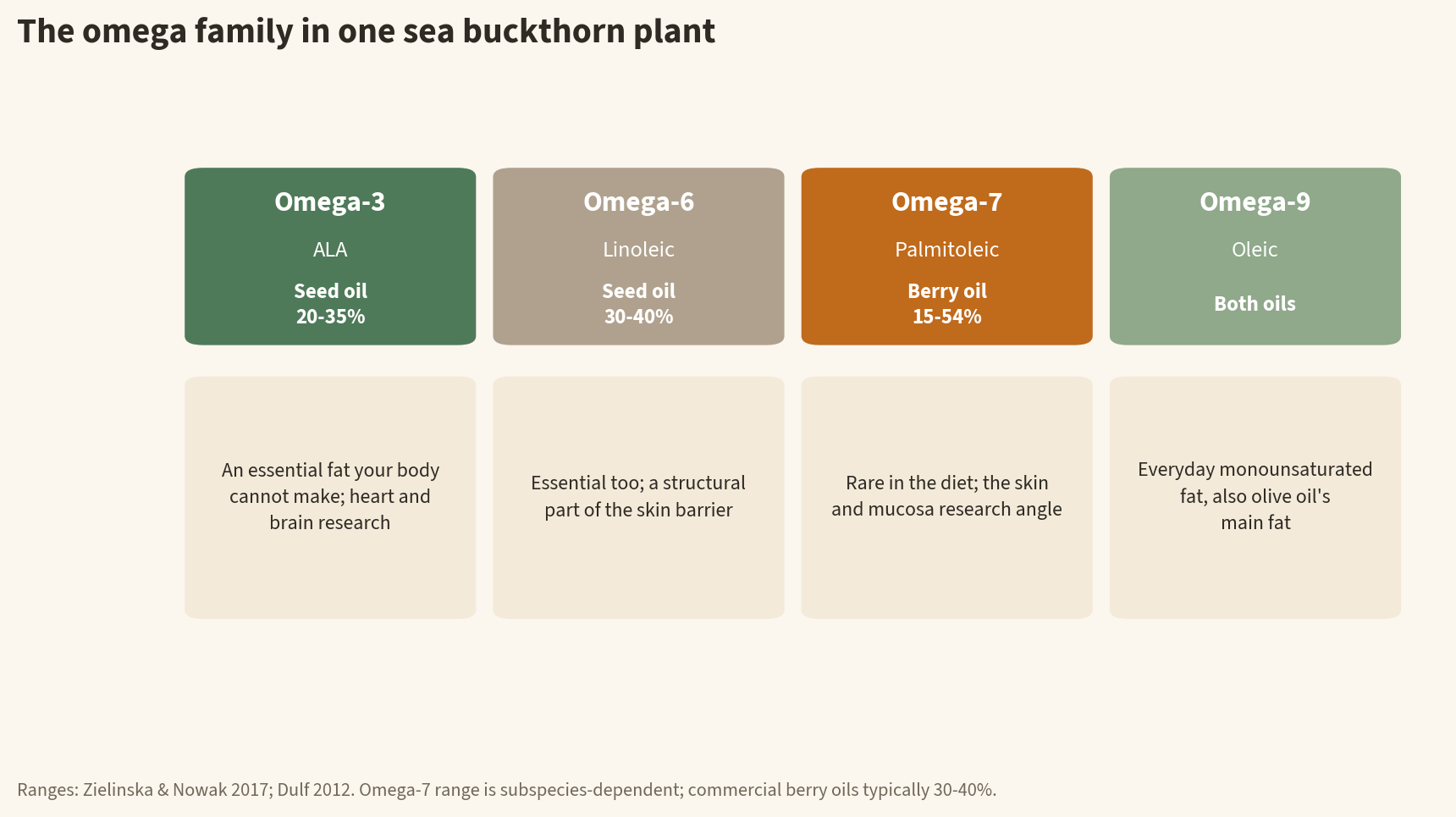
See the data behind this chart
| Omega | Found in | Typical share | Role |
|---|---|---|---|
| Omega-3 (ALA) | Seed oil | 20-35% | Essential fat; heart and brain research |
| Omega-6 (linoleic) | Seed oil | 30-40% | Essential; skin barrier structure |
| Omega-7 (palmitoleic) | Berry oil | 15-54% | Rare in diet; skin and mucosa research |
| Omega-9 (oleic) | Both oils | meaningful share | Everyday monounsaturated fat |
The map in one view
| Omega | Fatty acid | Berry (pulp) oil | Seed oil |
|---|---|---|---|
| Omega-3 | Alpha-linolenic (ALA) | 1 to 3% | 20 to 35% |
| Omega-6 | Linoleic | 2 to 10% | 30 to 40% |
| Omega-7 | Palmitoleic | 15 to 54% (typical 30-40%) | Trace |
| Omega-9 | Oleic | 15 to 25% | 15 to 25% |
Two conclusions fall straight out of that table. All the omega-7 lives in the berry oil. All the omega-3 lives in the seed oil. A capsule of one cannot deliver the other, which is why the seed oil vs berry oil breakdown is the most important page in this cluster.
Where the “all the omegas” claim goes wrong
The claim borrows a truth about the plant to sell you a product made from one part of it. A whole berry contains seeds and pulp, so a whole-berry powder does touch all four omegas in small amounts. But an oil capsule is pressed from one fraction, and the numbers above decide what is inside.
Blended seed-plus-berry oils do exist, and most of the human trials (dry eyes, skin, vaginal dryness) used blends. That is the honest version of the claim: a blend, labeled with its ratio. A bottle of seed oil marketed as “rich in omega-7” is simply wrong.
The ratio question, in plain language
Omega ratio talk usually means omega-6 versus omega-3. Modern diets run heavy on omega-6, so the ratio gets attention. Sea buckthorn seed oil is unusual here: its omega-3 and omega-6 sit close to 1:1, a balance few plant oils manage. Flax wins on omega-3 alone, but seed oil is one of the more balanced options on the shelf.
One caveat belongs to every plant omega-3: ALA converts to the marine forms (EPA and DHA) poorly. Seed oil is a good plant omega-3 source, never a fish oil replacement. We untangle that in sea buckthorn vs fish oil.
Omega-7 and omega-9 sit outside the ratio debate entirely. Omega-9 (oleic acid) is the olive-oil fat, common and uncontroversial. Omega-7 is the rare one, and it is the fat most sea buckthorn research actually tests.
The teaspoon math, by omega
A level teaspoon of oil is about 4.5 grams, and the table’s percentages turn into grams quickly. Berry oil at a typical 30 to 40 percent palmitoleic delivers roughly 1.4 to 1.8 grams of omega-7 per teaspoon, meeting or exceeding the total oil dose of most human trials in one pour. Seed oil at 20 to 35 percent alpha-linolenic delivers roughly 0.9 to 1.6 grams of plant omega-3 per teaspoon, alongside a similar amount of omega-6. The flaxseed oil comparison shows how that seed-oil payload stacks against the shelf’s ALA champion: flax wins on omega-3 alone, sea buckthorn seed oil wins on ratio balance.
What the trials actually dosed
The human trials behind the omega-7 research mostly used blends of berry and seed oil, at 1 to 3 grams of total oil daily for 8 to 12 weeks. Two practical consequences follow. First, the studied form is closer to a blend than to either single oil, so a labeled blend matches the research most directly. Second, the doses are small: a teaspoon of liquid or two to six standard softgels covers the entire studied range, and the study dosages page tabulates the amounts trial by trial. The omega family glossary keeps the numbered fats straight for readers new to the naming.
Common misreadings
- “All four omegas in one capsule.” Only if the capsule holds a blend, and the label says so with a ratio. A single-fraction oil carries its own omegas, not the plant’s whole set.
- “Omega-3 means fish-grade omega-3.” ALA converts to EPA and DHA poorly. Seed oil is a good plant source, never a marine replacement.
- “Ratio panic.” The omega-6 to omega-3 ratio matters at the diet level, and a few grams of seed oil with a 1:1 ratio is a rounding error in either direction. Diet patterns decide ratios, not softgels.
The omega-9 footnote
Omega-9 gets no marketing because the body makes its own, yet oleic acid is a real share of both oils, roughly 15 to 25 percent in berry oil. It is the same monounsaturated fat that carries olive oil’s reputation, and here it arrives as a quiet passenger next to the numbered stars. It needs no supplement logic at all, but it does mean the teaspoon is not just the omega-7 story: a fifth of the pour is the most familiar fat in the Mediterranean diet.
What this means at the shelf
- Decide which omega you want. Mucosal dryness and skin research point at omega-7, meaning berry oil or a blend.
- Read the plant part on the label. Berry, pulp, fruit, or seed. No part named means no purchase.
- Check the ratio on blends. A blend that is 90 percent seed oil is a seed oil with better marketing.
The full fatty acid table for both oils lives on the fatty acid profile page, and products whose labels pass these checks are scored in our oil guide.
Frequently asked questions
Does sea buckthorn contain omega-3?
Yes, but only in the seed oil. Alpha-linolenic acid (the plant omega-3) makes up roughly 20 to 35 percent of seed oil's fatty acids. The berry oil carries very little, around 1 to 3 percent. If omega-3 is your goal, seed oil is the bottle, and even then it cannot replace marine EPA and DHA.
Which sea buckthorn oil has the omega-7?
The berry oil, also labeled pulp or fruit oil. Palmitoleic acid (omega-7) runs roughly 15 to 54 percent of its fatty acids depending on subspecies, with typical commercial oils at 30 to 40 percent. Seed oil has only trace amounts. Labels that just say sea buckthorn oil without naming the plant part are asking you to guess.
Is a seed-plus-berry blend better than buying one oil?
It is more convenient, not more powerful. Most human trials used blends, so a labeled blend matches the studied form in one bottle. Buying the two oils separately gives you control of the ratio and usually a clearer label. Either route beats a mystery bottle, and the label should tell you the blend ratio or the plant part, no exceptions.