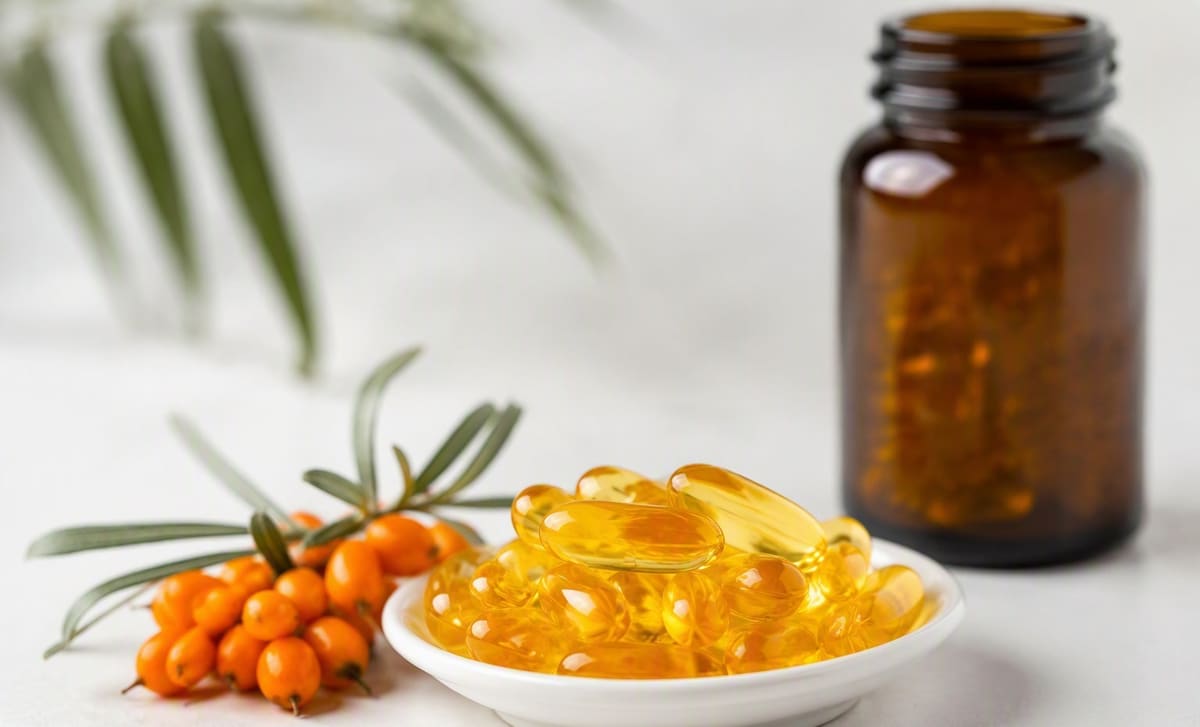
The best sea buckthorn capsule for most people is SeabuckWonders Omega-7 Complete: a certified-organic 800/200 berry-seed blend with the omega-7 percentage printed on the label, at $0.75 a day. Vegans should look at Barlowe’s Omegia SeaBerry. Whatever you pick, count the dose: most studies used 2 to 3 grams of oil a day, and one capsule is not that. Shopping for the best sea buckthorn supplement more broadly, capsules are the form ranked here, and liquid oil delivers the same grams cheaper if the pill count deters you.
Prices checked against retailer listings in July 2026. Confirm at checkout. Research-based reviews: scores come from verified label data and certifications per our editorial policy.
The picks at a glance
| Product | Best for | Oil inside | Cost per day* | Our score |
|---|---|---|---|---|
| SeabuckWonders Omega-7 Complete (120 ct) | Best overall | 800/200 berry-seed blend | $0.75 | 9.0 |
| Barlowe's Omegia SeaBerry (60 ct) | Best vegan | Puredia Tibetan blend | about $0.60 to $0.80 | 8.4 |
| SIBU Omega-7 Support (180 ct) | Premium pick | Himalayan blend | higher, check current price | 8.6 |
| Puredia Omegia Beauty Softgel | Skin-focused | Omegia standardized oil | varies by seller | 8.0 |
1. SeabuckWonders Omega-7 Complete: best overall
SeabuckWonders Omega-7 Complete, 120 softgels
Best overallWhy it wins. The supplement facts panel reads the way every label should: 800 mg organic berry oil at 32 to 38% palmitoleic acid plus 200 mg organic seed oil per 1,000 mg serving, supercritical CO2 extracted, kosher certified. You can verify the omega-7 claim instead of trusting it. The 120-count bottle at $0.75 a day is the best verified value in the category.
What we do not love. Beef-gelatin softgels rule out vegans, and 2 softgels a day is 1 gram of oil, below the 2 grams used in the dry-eye trial. Matching that study means 4 softgels, or $1.50 a day.
Best for: most people, most goals. This is the default recommendation.
We may earn a commission at no cost to you.
2. Barlowe’s Omegia SeaBerry: best vegan capsule
Barlowe's Herbal Elixirs Omegia SeaBerry, 60 veggie caps
Best veganWhy it made the list. A vegan cellulose capsule, glass bottle, no stearates or fillers, and a per-capsule breakdown printed on the label: 20 mg omega-3, 15 mg omega-6, 47.5 mg omega-7, 27.5 mg omega-9. The oil is Puredia’s Omegia from the Tibetan Plateau, the same oil family used in the 2024 placebo-controlled skin trial (that study was brand-funded, so read it with some salt, as we note in our research standards).
What we do not love. At 47.5 mg of omega-7 per capsule, hitting study-level omega-7 intake takes more capsules than the blend above. Availability also bounces between sellers.
We may earn a commission at no cost to you.
3. SIBU Omega-7 Support: premium pick
SIBU Omega-7 Support, 180 softgels
Premium pickWhy it made the list. SIBU’s sourcing and organic certification are the best documented in this market, and the 180-count bottle is the bulk-buy option for committed daily users. If you already trust the brand from our oil guide, this is the capsule equivalent.
What we do not love. You pay for that pedigree. Gram for gram it costs more than SeabuckWonders for a similar label story, and one retailer we checked had it at roughly double our winner’s cost per day. Great product, weaker math.
We may earn a commission at no cost to you.
4. Puredia Omegia Beauty Softgel: skin-focused pick
Puredia Omegia Beauty Softgel, 60 softgels
Skin-focusedWhy it made the list. Omegia is standardized (omega-7 at 30% or more, vitamin E at 450 mg per 100 g or more) and produced in an NSF GMP facility with USDA, EU, and China organic certifications. It is also the exact oil used in the 2024 skin trial, which measured hydration up 8% and collagen density up 10% over 12 weeks. Small study, brand-funded, but placebo-controlled.
What we do not love. Retail availability in the US is patchy, often through third-party sellers, which makes price and freshness harder to verify.
We may earn a commission at no cost to you.
The one we would skip
Any sea buckthorn capsule that does not state the oil split. If the label says “sea buckthorn oil 500 mg” with no berry/seed breakdown and no omega-7 percentage, you cannot know what you are buying, and neither can we. That is an automatic fail on our transparency criterion, and it is more common than you would hope.
Dose math that actually matters
The dry-eye study used 2 grams a day. The skin studies used 2 grams. The vaginal-health study used 3 grams. One 500 mg softgel a day is a quarter of the lowest studied dose, and a lot of disappointed reviewers took exactly that. Budget for the real dose before you buy, or consider liquid oil, which makes 2 grams a day cheaper. And read our safety notes if you take blood thinners. High-dose berry oil has a mild antiplatelet signal.
Reading a capsule label, line by line
Start with the serving-size trick: if the panel’s numbers are “per serving” and a serving is two softgels, every figure doubles what one softgel delivers, and your cost math should use the serving, not the count. Next, the oil split: berry, seed, or a stated ratio, because that decides the omega-7 story. The omega-7 line itself should be a percentage of the oil, not milligrams of the whole capsule padded with shell weight. Then the shell: beef gelatin, fish gelatin, or cellulose, which settles the vegan question in one word. Finally the extras: sunflower or olive oil listed after sea buckthorn means a diluted fill, and “proprietary blend” means the ratio is invisible by design. The oil nutrition page shows what a full panel should add up to.
The 60-second decision path
- Want the default answer: the overall pick above, 2 to 4 a day with food.
- Vegan: the cellulose pick, and double-check the shell word on whatever arrives.
- Already trust a brand from the oil aisle: its capsule equivalent, accepting the brand premium.
- Comparing two bottles: cost per gram of stated oil wins. If the label hides the grams, the bottle loses by default.
Who should skip capsules
Skip this form if cost per day drives the decision, because liquid oil undercuts every softgel by a wide margin at the same grams. Skip it if swallowing four to six softgels a day sounds miserable, because the full studied dose asks exactly that of most products. Skip it if you want the berry’s vitamin C, because the oil in a capsule carries none, and the vitamin C page points to the right forms. And skip any single product, whatever its reviews, whose label will not show the oil split and the omega-7 number.
Storage and travel
Softgels are sturdier than liquid oil and still lose to heat. A cool, dry cabinet is home. A bathroom is steam and a parked car is an oven that can fuse a bottle of softgels into one expensive brick. Pill organizers are fine for a week, kept out of light, not for a month. For travel, decant a few days into a small opaque container, keep it in the carry-on rather than a hot trunk, and run the smell test after any trip that involved real heat. The dosage page maps grams to softgel counts for every studied use, which also tells you how many days a travel container needs to hold.
Frequently asked questions
What are the best sea buckthorn capsules?
We rate SeabuckWonders Omega-7 Complete highest overall for its verified 800/200 berry-seed blend and $0.75 daily cost. Barlowe's Omegia SeaBerry is the best vegan capsule, and SIBU Omega-7 Support is the premium pick.
How many sea buckthorn capsules should I take a day?
Match the studies: 2 to 3 grams of oil daily, which for most 500 mg softgels means 4 to 6 capsules, or 2 larger 1,000 mg servings. Taking one capsule a day is under most studied doses.
Are sea buckthorn capsules as good as the oil?
The oil inside is the same. You are paying for convenience and taste avoidance. Per gram, capsules cost roughly 25 to 50 percent more than liquid oil.
Do sea buckthorn softgels expire?
Yes, and faster once the bottle is open. Keep them in a cool, dry cabinet, respect the best-by date, and trust your nose: a softgel that smells like crayons holds oxidized oil. Heat is the enemy, so bathrooms and cars are the worst storage spots.