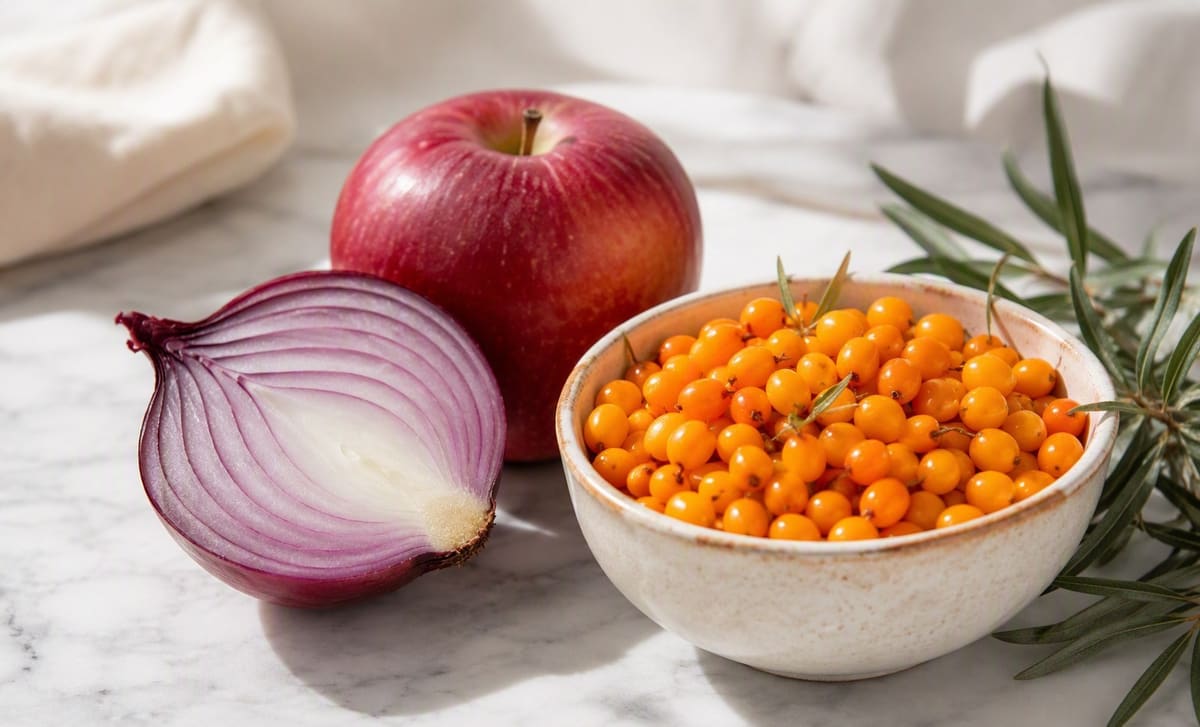
Quercetin is the most ordinary member of sea buckthorn’s flavonoid trio: the same compound that made onions and apples famous. The berries carry it mainly as glycosides, and its reputation comes from laboratory biology, where it does interesting things at concentrations human digestion rarely delivers.
Content and company
Phytochemical analyses confirm quercetin glycosides across sea buckthorn cultivars, with levels that swing by variety and growing conditions. The leaves carry it too, which is part of why leaf tea has its own flavonoid story. What the berry does not offer is exclusivity: a red onion or a handful of capers delivers quercetin just as reliably. Sea buckthorn’s distinct contribution is the company quercetin keeps, especially isorhamnetin, the rarer methylated form.
The glycoside form, and why it matters
The “glycosides” in the analyses are not a footnote. A glycoside is the compound with a small sugar molecule attached, the plant’s packaging for storage. That packaging shapes what happens next: your gut has to strip the sugar before absorbing anything, different glycosides absorb at different rates, and gut microbes handle whatever your enzymes miss. The quercetin on a composition table and the quercetin products in your blood are related, not identical. This holds for every plant source, which is why no food, berry or onion, acts like a quercetin capsule.
The absorption ceiling
Here is the number that disciplines every quercetin headline. The compound absorbs poorly, and blood levels after eating quercetin-rich food land far below the concentrations used in cell studies. A mast cell in a dish bathed in quercetin behaves differently from one in your body after lunch. This is why the allergies page refuses to turn the mast-cell lab story into a hay fever claim, and why isolated quercetin supplements, dosed far above food levels, still show thin and mixed human results.
The dose ladder
Picture three rungs. Food: a serving of quercetin-rich plants delivers milligrams, and blood levels nudge upward accordingly. Supplements: capsules dose hundreds of milligrams, an order of magnitude above food, and blood levels rise more, though still modestly against the capsule size. Cell studies: researchers bathe cells in concentrations beyond what supplementation reaches. Every confident headline you have read lives on the top rung. Every meal you will ever eat lives on the bottom one. The ladder is why “quercetin does X” keeps failing to become “eating quercetin does X.”
What the supplement trials found
The middle rung has been tested, which is the awkward part for the marketing. Isolated quercetin supplements, dosed far above any diet, have run through human trials for blood pressure, exercise performance, and allergy relief, and the results are thin and mixed: occasional small effects, frequent nulls, no settled benefit at any dose. That record is why this site files quercetin under “interesting compound, unproven supplement”, and why the immunity hub refuses to build claims on it.
Reading a quercetin label
If you shop the supplement aisle anyway, read with the ladder in mind. Milligrams per capsule sounds impressive until you compare it with the blood levels the trials actually reached. “Enhanced absorption” formulas, often paired with bromelain or wrapped in phytosome technology, exist precisely because plain quercetin absorbs so poorly, and their own evidence is a work in progress. There is no daily value for quercetin, because no deficiency state exists. Any label implying you need a daily top-up is inventing a requirement.
A sensible way to get it
Eat the whole-berry forms. Berries and powder carry the flavonoid fraction with the fiber and vitamin C alongside, juice keeps part of it, and the oil keeps almost none. That pattern holds for the whole polyphenol family, and the flavonoids page maps the trio quercetin leads. For products that preserve the most of it, the powder guide is the practical stop, and the nutrition hub frames the full nutrient cast.
The kaempferol sibling
Quercetin does not lead alone. Kaempferol, the third member of the berry’s flavonoid trio, appears in the same analyses in the same glycoside packaging, with the same absorption ceiling disciplining its headlines. Its lab record is quieter than quercetin’s, which is the only reason you hear less about it. The flavonoids page maps all three leads together, and the trio is the honest unit of account here: no food delivers one flavonoid in isolation, and no trial has tested the berry’s trio separately from the berry.
Eating the mix
The wider strategy is boring on purpose. Eat quercetin the way it comes: in whole plants, alongside the fiber, vitamin C, and companion flavonoids that nature packaged with it. Sea buckthorn berries and powder contribute their share, as the vitamin C page and the antioxidants page show from their own angles, and onions, apples, and capers contribute theirs. Variety across sources is the strategy with the evidence pattern behind it. Chasing any single flavonoid in isolation is the strategy with the marketing behind it.
Frequently asked questions
Is sea buckthorn a good source of quercetin?
It is a reasonable one among many. The berries carry quercetin mainly as glycosides, with levels varying by cultivar, and the leaves carry it too. Onions, apples, and capers supply quercetin just as reliably. What sea buckthorn adds is its own flavonoid mix, including the less common isorhamnetin, rather than a uniquely high quercetin dose.
Should I take a quercetin supplement instead?
That is a different product from sea buckthorn entirely. Isolated quercetin supplements dose far above food levels, and their human trial results remain thin and mixed, which is why this site does not recommend chasing the compound in isolation. Food sources, sea buckthorn berries included, deliver quercetin alongside the fiber and companion compounds that supplement capsules strip away.