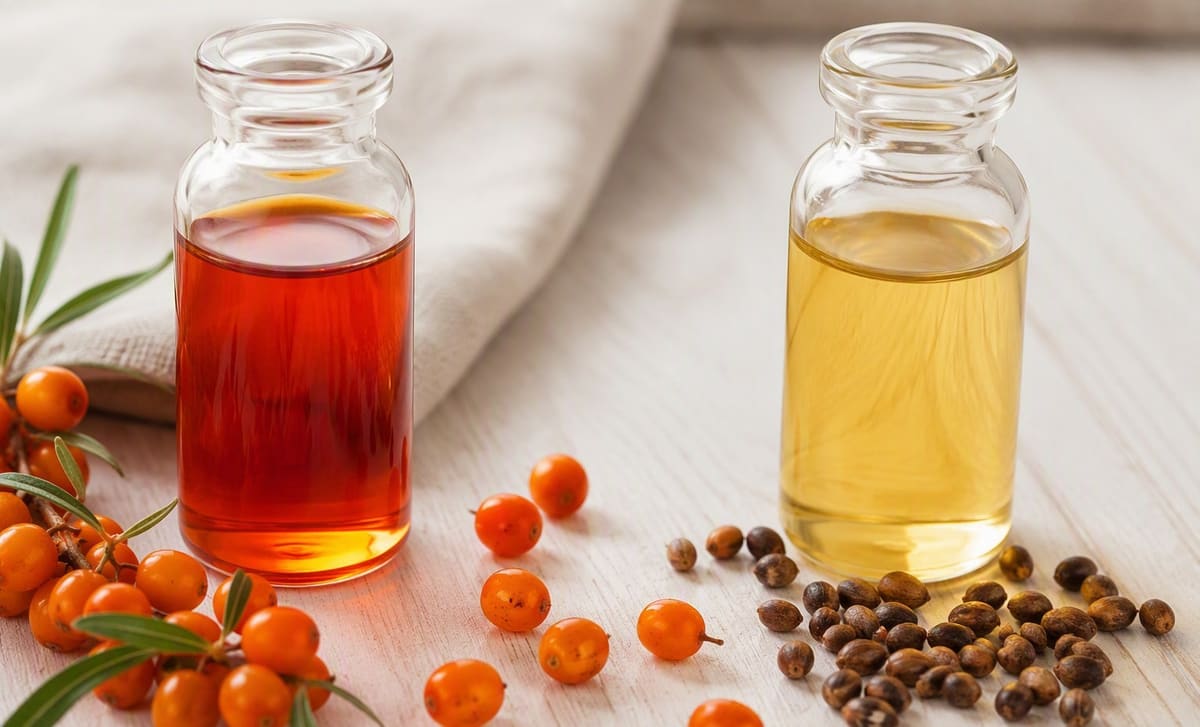
Seed oil and berry oil come from the same plant but they are different products. Berry (pulp) oil is where the famous omega-7 lives, along with the carotenoids that turn it deep orange. Seed oil has almost no omega-7 and is instead rich in omega-3 and omega-6. If a label just says “sea buckthorn oil” without telling you which part, ask before you buy.
Walk into any supplement shop and you will find bottles labeled sea buckthorn oil with no hint of which oil is inside. That is a problem, because the two oils barely overlap. One is pressed from the soft orange pulp of the berry. The other is pressed from the small dark seeds. They look different, they cost different amounts to make, and the research behind them points at different things.
What is actually in each oil
The numbers below come from composition studies and a 2017 review in Lipids in Health and Disease. Treat them as ranges, because the species, the subspecies, and even the harvest year move them around.
| Fatty acid / compound | Berry (pulp) oil | Seed oil |
|---|---|---|
| Palmitoleic acid (omega-7) | 15 to 54% of fatty acids | Trace amounts |
| Palmitic acid | Around 25 to 35% | 7 to 10% |
| Oleic acid (omega-9) | 15 to 25% | 15 to 25% |
| Linoleic acid (omega-6) | 2 to 10% | 30 to 40% |
| Alpha-linolenic acid (omega-3) | 1 to 3% | 20 to 35% |
| Carotenoids | Very high (that deep orange color) | Low |
| Vitamin E | Moderate | Higher |
Two things jump out of that table. First, all the omega-7 is in the berry oil. That is the fatty acid behind most of the dry eye and skin research, and it is the reason sea buckthorn is famous at all. Second, seed oil is a respectable oil in its own right, just a completely different one. Its profile looks closer to a good flax or hemp oil than to its sibling. The two seed oils go head to head in sea buckthorn vs hemp oil.
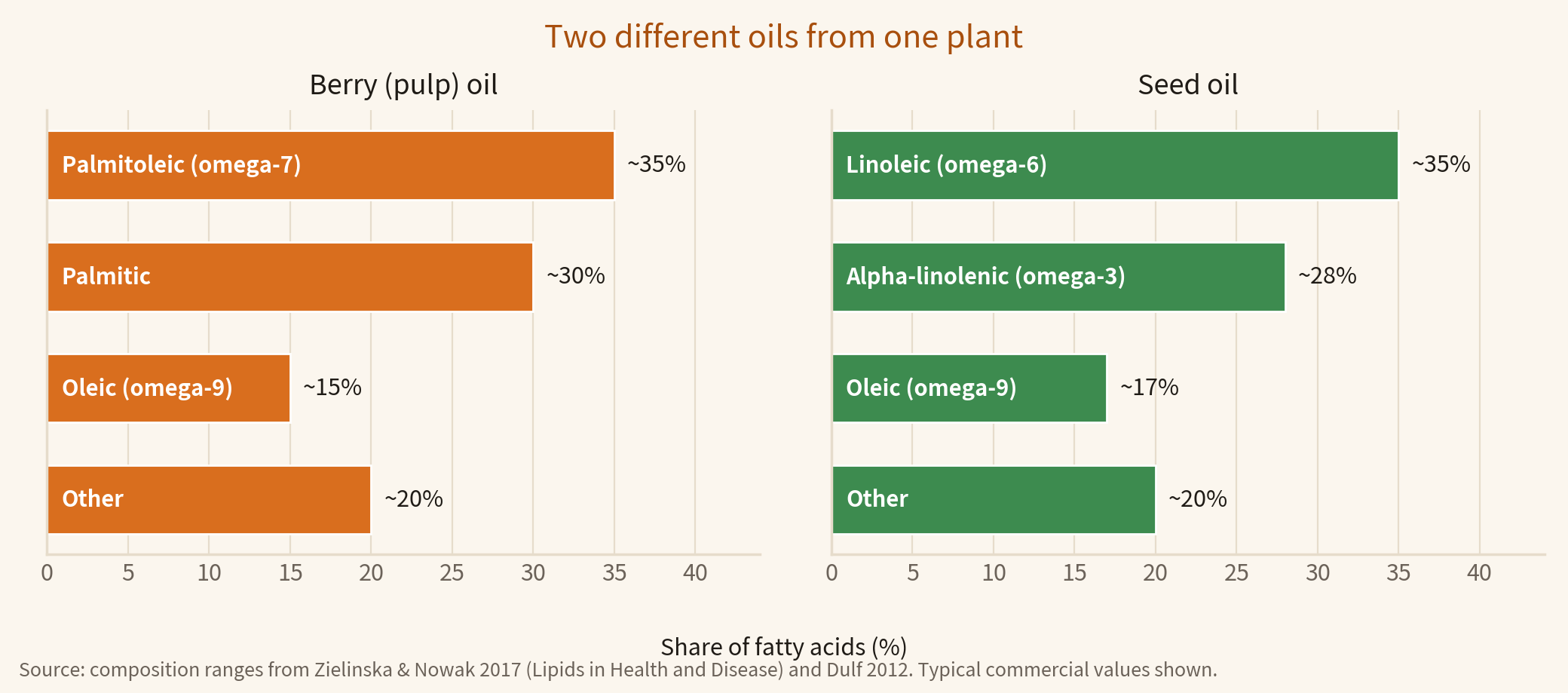
See the data behind this chart
| Fatty acid | Berry (pulp) oil | Seed oil |
|---|---|---|
| Palmitoleic (omega-7) | ~35% | trace |
| Palmitic | ~30% | low |
| Linoleic (omega-6) | low | ~35% |
| Alpha-linolenic (omega-3) | low | ~28% |
| Oleic (omega-9) | ~15% | ~17% |
The per-teaspoon comparison
Put a level teaspoon on the scale and the difference gets concrete. At about 4.5 grams per spoon, pure berry oil at 30 to 40% palmitoleic acid delivers roughly 1.4 to 1.8 grams of omega-7. The same spoon of seed oil delivers roughly 1.3 to 1.8 grams of omega-6 and 0.9 to 1.6 grams of omega-3, with essentially no omega-7. One spoon, two completely different supplements. The fatty acid profile page has the full numbers for both oils, and the omega-7 page converts them into softgel math.
Why the color tells you the truth
Berry oil is thick and so orange it stains everything it touches. That color is carotenoids, the same family that colors carrots, and the pulp carries far more of them than the seeds do. Seed oil is pale yellow and light. If your capsule or dropper bottle is pale, you are holding seed oil or a blend that is mostly seed. If it looks like liquid pumpkin, berry oil is doing the coloring.
Which one does the research support?
The headline human trials mostly used a blend of both, or berry oil specifically. The dry eye trial everyone cites gave 2 grams a day of combined seed and berry oil for three months and found milder symptoms and a smaller rise in tear film osmolarity compared with placebo. The skin hydration study used a blended oil too. For vaginal dryness, it was the blended oil again at 3 grams a day.
So the honest answer is that most human evidence sits on the blend, with the omega-7-rich berry fraction suspected of doing the heavy lifting for mucosal dryness. Seed oil alone has less human research, though its omega-3 and 6 content makes it a reasonable pick for general skin support.
Why blends dominate the trial record
Look closer at what the trials actually dosed. The dry-eye trial gave 2 grams daily of combined seed and berry oil. The vaginal dryness trial gave 3 grams daily of the blended oil. The skin trials used blends too. Seed oil alone has almost no file at all. It was tested on its own in hypertensive patients with cardiovascular risk markers as the target, and that trial was retracted in 2026. The practical read: the mucosal-dryness evidence belongs to blends with the berry fraction suspected of leading, and seed oil has no standing solo trial to set against them. The dry eyes guide carries the exact doses if you want to replicate the studied regimens.
The price tells
Berry oil costs more to make: the pulp has to be separated from the seed, the yield is lower, and the carotenoid-rich result is the scarce fraction. Seed oil presses cheaper and yields more. That gap explains most label mysteries. A bottle priced like seed oil but colored like berry oil is a blend with good lighting, and a “berry oil” priced like a commodity is probably not one. Price will not certify anything, but in this category it rarely lies.
Which one should you buy?
- For dry eyes, dry mouth, or vaginal dryness: berry oil or a seed-plus-berry blend, because those are the forms the trials used. Check our dry eyes guide for the exact doses studied.
- For everyday skin nutrition and a vegan omega-3 source: seed oil works and usually costs less.
- If you want both: blends exist, but read the ratio. A blend that is 90 percent seed oil is a seed oil with better marketing.
Whatever you choose, the label should name the part of the plant (berry, pulp, fruit, or seed), the species (Hippophae rhamnoides), and ideally the extraction method. Supercritical CO2 extraction avoids solvent residues, and cold pressing is the other clean option. If none of that is on the label, you are being asked to trust a mystery.
The bottom line
Sea buckthorn oil is not one product. Berry oil brings the omega-7 and the color, seed oil brings the omega-3 and 6, and the research leans on blends of the two. Once you know which is which, the supplement aisle gets a lot easier to read. When you are ready to compare actual products, our sea buckthorn oil buying guide scores the labels against these exact criteria, and the capsules guide does the same for softgels.
Frequently asked questions
Is sea buckthorn berry oil the same as seed oil?
No. Berry oil (also called pulp or fruit oil) is pressed from the soft part of the berry and is rich in omega-7 and carotenoids. Seed oil is pressed from the seeds and is rich in omega-3 and omega-6. They are different products with different uses.
Which oil has the omega-7?
The berry oil. Palmitoleic acid (omega-7) makes up roughly 15 to 54 percent of the fatty acids in sea buckthorn pulp oil depending on the subspecies. Seed oil contains very little.
Can I take both seed oil and berry oil?
Yes, and some products blend them. Studies on dry eyes and skin used blended seed and berry oil. If you want omega-7 specifically, check that the label lists berry, pulp, or fruit oil, not just sea buckthorn oil.
Why do so many labels not say which oil is inside?
Because the distinction costs money. Berry oil is more expensive to produce than seed oil, and a label that just says sea buckthorn oil can be either, or a blend of mostly the cheaper one. Reputable producers name the plant part, the species, and the extraction method. Silence on those three is a pricing strategy, not an oversight.