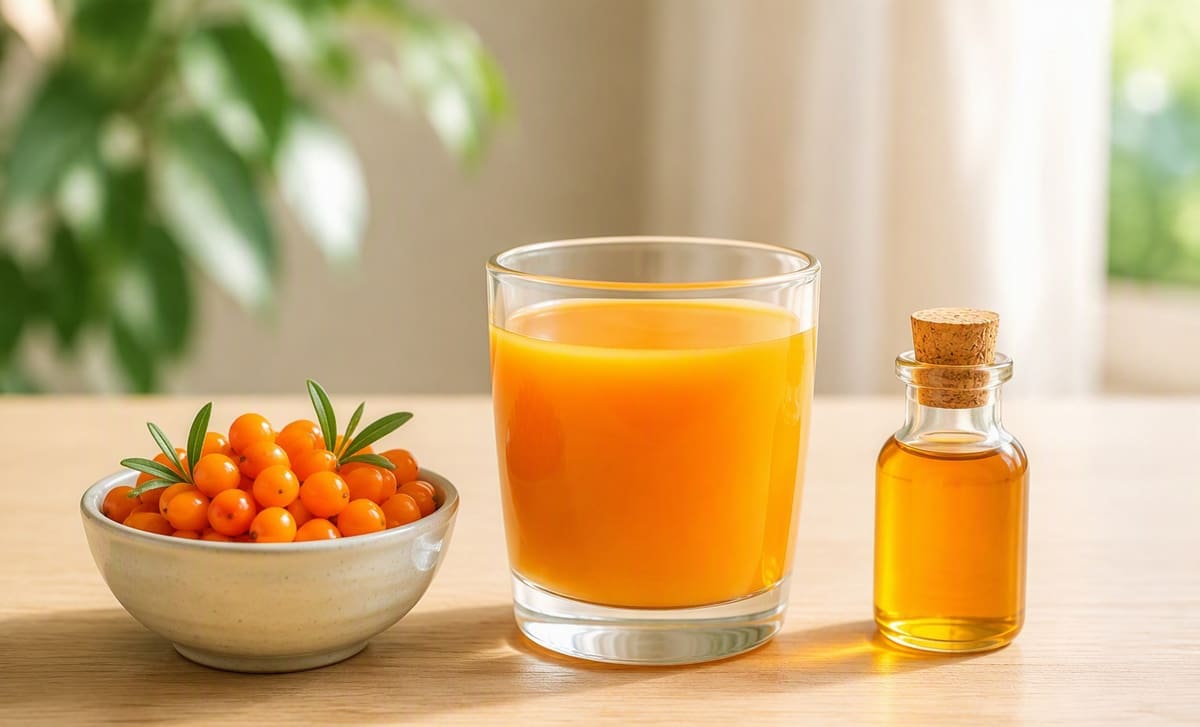
Sea buckthorn is a berry with real but narrow evidence behind it. The strongest finding is better blood lipids. The moderate ones are dry eye, skin hydration, vaginal comfort after menopause, and, newly, constipation. The trials used 1 to 3 grams of oil a day with food. Before you buy, check one thing above all: which part of the plant the oil came from, because berry oil and seed oil are different products sold under the same name. This guide covers the forms, the real doses, what the evidence does not support, the safety rules, and how to shop without overpaying.
Opens your browser's print dialog. Choose "Save as PDF" to keep an offline copy.
What sea buckthorn actually is
Sea buckthorn is a thorny shrub, Hippophae rhamnoides, that grows across the cold edges of Europe and Asia and drops small, intensely orange berries in autumn. People have used those berries in Tibetan, Mongolian, and Chinese medicine for centuries, mostly for wounds, coughs, and stomach trouble. The berries carry vitamin C at roughly 200 to 600 mg per 100 grams, which is well above an orange, along with carotenoids that give the orange color, tocopherols, phytosterols, and an unusual fat called palmitoleic acid, better known as omega-7. Two different oils come from the plant. One is pressed from the berry flesh, and a separate one comes from the seeds. That split matters more than any marketing claim, and it is where this guide really starts. For the longer version, see what sea buckthorn is.
Which form for which goal
Sea buckthorn is sold as oil, capsules, juice, powder, and skincare. They are not interchangeable, because the research was done on specific forms and the nutrients differ from one to the next.
| Form | What it is | Best for | Watch for |
|---|---|---|---|
| Berry oil (pulp or fruit oil) | Oil pressed from the berry flesh. Deep orange, richest in omega-7 (about 30 to 40% of its fatty acids) and carotenoids | The oral studies on dry eye, skin, vaginal comfort, and blood lipids all used this | It stains skin and cloth orange. “Sea buckthorn oil” alone does not tell you it is berry oil |
| Seed oil | Oil from the seeds only. Pale gold, higher in omega-3 and omega-6, low in omega-7 | A balanced plant omega source. Popular in skincare | Often sold as if identical to berry oil. It is not the oil most trials used |
| Capsules or softgels | Oil in a swallowable shell, usually 500 mg each | Convenience and an exact daily dose | The shell hides the oil, so the label must state berry or seed and the milligrams |
| Juice | Pressed whole-berry juice, often blended | A food source of vitamin C and polyphenols | Very acidic. Dilute it, and it is a grocery, not a studied supplement dose |
| Powder | Freeze-dried or spray-dried berry | Smoothies and baking, adds fiber | Heat and drying cut vitamin C. Check whether it is whole berry or a pomace leftover |
| Face oil or skincare | Berry or seed oil for the skin, sometimes diluted | Topical routines | Patch test first, and expect the orange tint. See oil on the face |
The one distinction that trips everyone up: berry oil vs seed oil
If you remember nothing else, remember this. Berry oil (pulp or fruit oil) and seed oil are two different oils from the same plant, and the label often blurs them into one word. Berry oil is the orange, omega-7 rich oil that the dry-eye, skin, and vaginal trials actually used. Seed oil is paler, carries more omega-3 and omega-6, and holds much less omega-7. Neither is fake or worse in general. They are simply different tools, and a bottle that says only “sea buckthorn oil” has told you almost nothing. We wrote a whole page on the berry oil vs seed oil difference, and the nutrition breakdown shows the fatty acids side by side.
The doses the trials actually used
Labels suggest doses that sell bottles. The studies used something more specific. Every number below is tied to the trial it came from, with the evidence grade the site assigns it. All oral doses were taken with food, and no trial ran longer than three months.
| Goal | Dose the trial used | Trial | Evidence grade |
|---|---|---|---|
| Blood lipids (lower LDL and triglycerides, higher HDL) | About 1.5 to 3 g/day of oil across trials | Geng 2022 meta-analysis of 15 RCTs (PMID 36043374), backed by Guo 2017 | Strong ●●●● |
| Dry eye symptoms | 2 g/day of oil, split as 1 g twice daily with meals, for 3 months (n=100) | Larmo 2010 (PMID 20554904) | Moderate ●●●○ |
| Vaginal atrophy after menopause | 3 g/day of oil for 3 months (n=116) | Larmo 2014 (PMID 25104582) | Moderate ●●●○ |
| Skin hydration and elasticity | 1 g/day for 12 weeks (placebo-controlled), and an older study used 2 g/day for 3 months without a placebo | Chan 2024 (1 g), Yang 2009 (2 g) | Moderate ●●●○ |
| Constipation | 500 mg/day of a concentrated fruit extract for 28 days (n=90) | Morone 2026 (PMID 41829976), brand-funded | Moderate ●●●○ |
| After-meal insulin (not blood sugar) | Sea buckthorn puree eaten with one sugary meal, single test (n=18 men) | Mortensen 2018 (PMID 29022100) | Preliminary ●●○○ |
Two honest notes on that table. The constipation trial used a concentrated fruit extract, not the oil most shoppers buy, so its 500 mg does not translate into an oil dose and it does not make the oil a laxative. And the vaginal-atrophy result held in the main analysis but slipped below significance in the compliant-only analysis, so read it as a modest, non-hormonal option rather than a sure thing. The full trial-by-trial dosage table maps every amount, and the how much daily guide turns grams into softgels.
What the evidence does not support
This is the section most sea buckthorn pages skip, and it is the reason to trust the rest. The same 2022 meta-analysis that gives us the blood-lipid win also tested three things sea buckthorn is often sold for and found nothing:
- Blood pressure. No significant effect across 15 trials. See the blood pressure page.
- Blood sugar. No effect on fasting glucose. A separate single-meal study did lower after-meal insulin, but blood sugar itself did not move, so this is not blood-sugar control. See blood sugar.
- Body weight. No effect on BMI. There is no weight-loss claim here.
Colds are another one. The single trial that tested whole berries for infections found no drop in cold or infection rates, though it did nudge one inflammation marker down (Larmo 2008, PMID 17593932). And sea buckthorn does not cure or treat any disease. Lab dishes are not people, and in-vitro results are a starting line, not a finding.
A worked example: the retracted blood-pressure study
Here is why grading matters, told through one paper. For years the strongest sign that sea buckthorn lowers blood pressure was a 2017 trial of seed oil in people with hypertension (Vashishtha 2017). It was the most-cited study in the whole niche. In 2026 the journal Clinical Nutrition retracted it after image duplication turned up across its figures that the authors could not explain.
A retracted study is not weak evidence. It is no evidence at all. We did not quietly delete it. We flagged it as retracted everywhere it appears, including the source list on this page, because the retraction is now the useful fact. With that paper gone, the meta-analysis finding of no blood-pressure effect stands unopposed, and that is our stated position. That single correction rippled across many pages on this site, which is exactly what a grading system is for. The how we research page tells the longer story, and the research hub keeps every graded study on the shelf.
How we grade the evidence
Every health claim on this site carries one of four grades, shown before you read the claim. If a page says sea buckthorn helps with something, the badge tells you how much weight that actually deserves.
- Strong human evidence
Several human trials, or a meta-analysis, pointing the same way.
Example on this site: Blood lipids
- Moderate human evidence
One decent human trial, or a few small ones. Promising, not settled.
Example on this site: Dry eye, skin hydration
- Preliminary evidence (animal or lab research)
Animal or laboratory work only. Nothing tested in people yet.
Example on this site: Most cancer claims
- Traditional use (no clinical trials yet)
Centuries of use behind it, no clinical trial in front of it.
Example on this site: Wound care, digestion
The full method, including what disqualifies a study, is onhow we research.
Safety and interactions checklist
At food amounts, berries, juice, and culinary oil carry centuries of ordinary use and no documented bleeding problem. The caution belongs to a specific combination: concentrated oil at supplement doses, taken with a blood thinner, or before an operation. Work through this list before you start.
- Blood thinners and antiplatelet drugs. In one small controlled study, 5 grams a day of berry oil measurably reduced platelet clumping, the first step of clotting (Johansson 2000). Stacked with warfarin, aspirin, clopidogrel, or the newer direct anticoagulants, that could add to bleeding risk. Clear it with your doctor first. Full detail on the blood thinners page.
- Read the seed-extract lab studies carefully. Two recent papers found that extracts of sea buckthorn seeds reduced platelet activation in the test tube, and the 2024 one inhibited COX-1, the enzyme aspirin blocks. Here is the part that matters, and it is easy to get wrong. The researchers stripped the fat out of the seeds with hexane first and tested the phenolic extract left behind. That defatted seed extract is not the pressed seed oil people buy in capsules. So these studies broaden the platelet caution to seed plant material, but they do not show that seed oil thins blood, and nobody should read them that way.
- Surgery. Stop concentrated oil supplements about two weeks before any planned procedure, dental extractions included, and tell your surgical team. Do not assume seed oil is the safer swap, since no trial compared the two oils on platelet function. See surgery.
- Pregnancy and breastfeeding. Berries as food are fine. No human trial has ever tested concentrated oil supplements in pregnant or nursing women, so the standard position is to avoid them and ask your doctor. See pregnancy.
- Juice is acidic. Undiluted juice can erode tooth enamel and upset an empty stomach. Dilute it, and rinse your mouth after.
- Not sure it is for you? The who should avoid it page and the is it safe verdict cover the edge cases, and drug interactions goes wider than blood thinners.
A buyer’s checklist
Once you know what you want, three checks separate a fair product from a marked-up or mislabeled one.
- The plant part is named on the label. Berry, pulp, or fruit oil for the omega-7 and the studied benefits. Seed oil if you specifically want the omega-3 and omega-6 balance. If the label just says “sea buckthorn oil” and will not commit, treat that as a red flag. Our how to choose guide walks the full label, and spotting fake oil shows the tells.
- The extraction method is stated. Supercritical CO2 extraction and cold pressing both keep the fragile nutrients better than heat and solvents. The cold-pressed vs CO2 page explains the trade-off.
- The price per day is fair. Judge cost per studied day, not bottle price. Fair pricing lands around $0.60 to $1.50 a day at a 2-gram dose, roughly $0.60 to $1.20 for liquid oil and $0.75 to $1.50 for softgels, and seed oil should clearly undercut berry oil. Juice, powder, and tea are groceries and should be priced like them. The price guide has the cost-per-gram math, and the best products hub compares what we track.
Where to go next
You now have the map: the forms, the real doses, the honest nulls, the safety rules, and the shopping checks. From here, the benefits hub grades each claimed use, the research hub holds every study, and the glossary translates the label jargon.
And if you want one short email a week that reads new sea buckthorn studies for you, grades them honestly, and flags real price moves on the products we track, that is exactly what our newsletter does. It is free, and leaving is one click.
Frequently asked questions
What is the single most important thing to know before buying sea buckthorn?
Which part of the plant the oil came from. Berry oil, also called pulp or fruit oil, is the omega-7 rich orange oil used in the dry-eye, skin, and vaginal trials. Seed oil is a different, paler oil higher in omega-3 and omega-6. Most confusion and most of the marketing games start here. If a label will not tell you the plant part, do not buy it.
How much sea buckthorn did the studies actually use?
The human oil trials dosed 1 to 3 grams a day, always with food, for up to three months. The dry-eye trial used 2 grams a day, the vaginal-atrophy trial used 3 grams, and the lipid trials ran roughly 1.5 to 3 grams. The one constipation trial used 500 mg of a concentrated fruit extract, which does not convert to an oil dose. The highest amount ever tested was 5 grams of berry oil for four weeks, and it measurably reduced platelet clumping, which is why 3 grams is the practical ceiling.
Does sea buckthorn lower blood pressure or blood sugar?
No, on the current evidence. A 2022 meta-analysis of 15 randomized trials found sea buckthorn improved blood lipids but had no effect on fasting blood sugar, blood pressure, or body weight. The one human trial that once pointed to a blood-pressure benefit was retracted in 2026 over image problems, so the no-effect finding now stands unopposed.