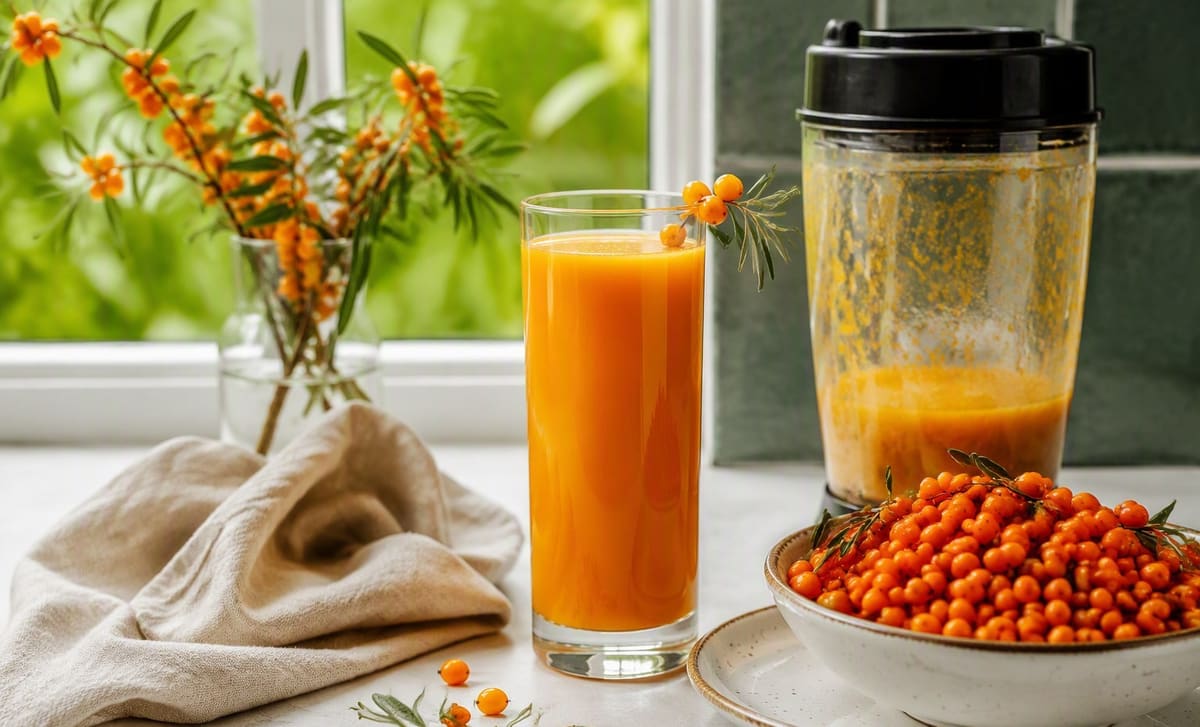
Homemade sea buckthorn juice takes six steps: wash, destem, crush, strain, dilute, and chill. The two things beginners learn the hard way: the berries and the juice stain everything orange, and the undiluted result is acidic enough to hurt, so the 1:3 dilution rule is not a suggestion.
Of everything on the how-to-use hub, this is the messiest job and the most satisfying.
The method
- Wash and destem. Rinse the berries gently in a colander and pick out stems and leaves. They bruise and burst easily, so handle them less than you want to.
- Protect your workspace. Cutting board you do not love, apron you do not love, no white anything. The juice stains on contact.
- Crush or blend. Mash with a potato masher or pulse briefly in a blender with a splash of water. You want broken berries, not a puree of pulverized seeds.
- Strain. Press through a fine sieve or cheesecloth. Squeeze well, since much of the juice clings to the pulp. The leftover pulp still holds the berry’s oil, so freezing it for smoothies wastes nothing.
- Dilute 1:3. One part juice to three parts water is the drinkable starting point. Taste, then adjust. Sweeten lightly if you must, honey handles the sourness better than sugar.
- Store cold. Sealed bottle in the fridge for three to four days, or freeze in ice cube trays for single portions that drop straight into water.
The rules that protect you
The acidity is the whole story. Undiluted juice carries malic, quinic, and citric acids at levels that erode enamel and grumble stomachs, which is why the same rules appear on our safety page: dilute, drink alongside food rather than on an empty stomach, and rinse your mouth with plain water afterward. Skip the brush for thirty minutes after drinking, since acid softens enamel before scrubbing.
What homemade does better, and what it does not do
You control the dilution, the sweetness, and the freshness, and fresh juice keeps more vitamin C than anything that sat on a shelf. What it does not become is a supplement: the studied oil benefits came from the berry’s oil fraction in gram doses, and juice is the water-soluble side of the fruit. The vitamin C page covers what survives into the glass, and the recipes hub has more ways to use a berry haul.
No berries of your own? The store-bought options are covered on our juice page, and the best juice picks are scored for you.
The quantities, scaled
A kilogram of fresh berries yields roughly 500 to 600 ml of pure juice, enough for about 2 liters diluted. A single 500-gram bag of frozen berries makes a liter of drinkable juice at the 1:3 ratio, which is a week of small daily glasses. Juice what you will drink in a few days and freeze the rest of the berries whole, because whole frozen berries keep far better than pressed juice. The storage page has the full clock for every form.
The frozen-berry route
Frozen berries juice as well as fresh, sometimes better, because freezing ruptures cell walls and releases more liquid. Thaw them completely first, then follow the same six steps. Skip refreezing the pressed juice in large blocks: ice cube trays give you portions, and a cube dropped into a glass of water is the fastest weekday version of this entire page.
Mistakes that ruin a batch
- Boiling it. Heat flattens flavor and costs vitamin C. If you want a warm drink, warm the diluted glass, never the stored juice.
- Pulverizing the seeds. Long blending cracks the seeds and adds bitterness. Short pulses, just enough to break the skins.
- Under-straining. Gritty juice is a straining problem. Press the pulp hard, then press it again with a splash of water.
- Drinking it straight for the benefits. The acid load is the same whether or not you meant well. Dilute, every time.
If the sourness wins anyway
Some batches defeat every sweetener, usually under-ripe berries. Blend the juice with apple or grape juice at half and half rather than chasing it with sugar. The result drinks like a tart cider and wastes nothing.
Beyond the glass
One batch covers more than drinking. A splash replaces vinegar in salad dressing. Simmered gently with sugar it becomes syrup or glaze. A shot of it turns sparkling water into a spritz, per the mocktail page. The pulp you strained out still holds the oil: freeze it in a bag and spoon it into smoothies, where it disappears completely.
The enamel rules, one more time
Dilute, drink with food, rinse with plain water after, and wait thirty minutes before brushing. Acid softens enamel briefly, and brushing inside that window scrubs it away. Four habits, zero cost, and your dentist never learns about your new hobby. Your future self, enamel fully intact, says thanks.
Frequently asked questions
Do you have to dilute sea buckthorn juice?
Yes. Undiluted juice is highly acidic from malic, quinic, and citric acids, enough to bother tooth enamel and an empty stomach. Dilute about one part juice to three parts water, drink it with food, and rinse your mouth with plain water afterward.
How long does homemade sea buckthorn juice keep?
Three to four days in the refrigerator in a sealed container. For longer storage, freeze it in portions. Vitamin C degrades with time, light, and heat, so fresher is genuinely better rather than just nicer.