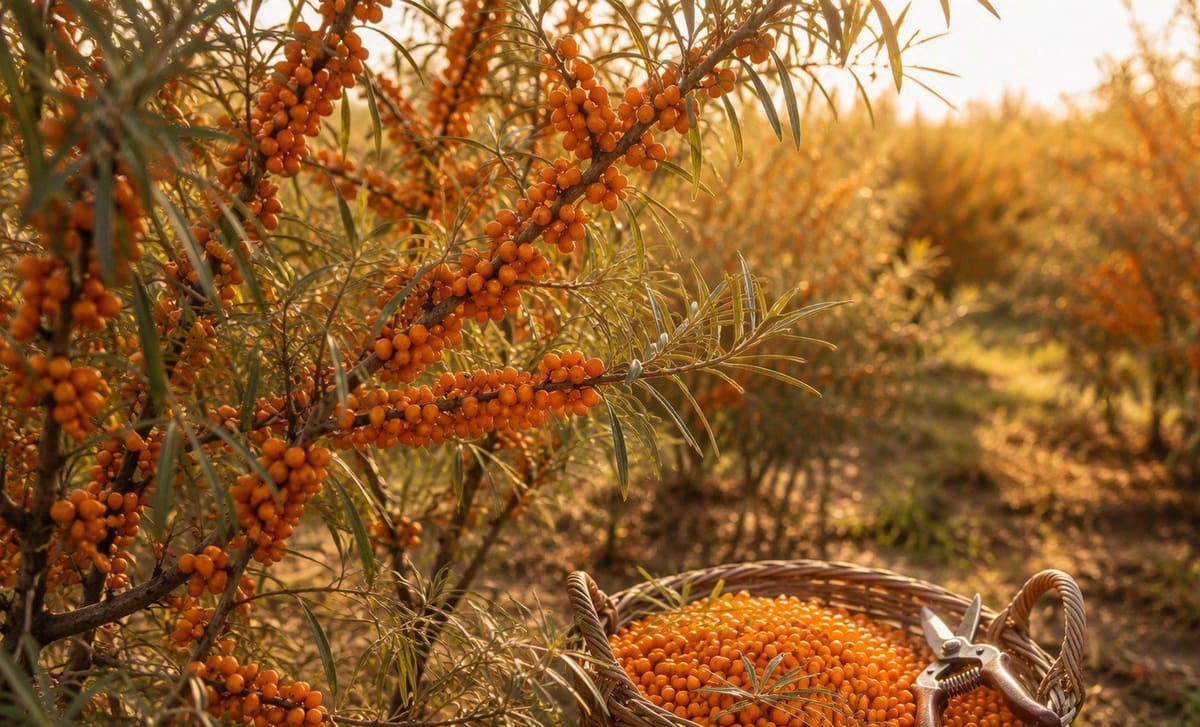
Sea buckthorn is one of the toughest fruiting shrubs you can plant: hardy through severe winters, happy in poor soil, drought tolerant, and nitrogen-fixing. The catches are real though. It has thorns, it spreads by underground suckers, you need male and female plants for berries, and harvest is genuinely fiddly. This hub covers the honest picture.
Garden catalogs sell the romance. This page sells the reality, which is still pretty good if you plant with your eyes open.
Where it thrives
The shrub evolved on Himalayan slopes, Siberian riverbanks, and Baltic coasts, which tells you what it can handle: brutal cold, thin soil, wind, and salt spray. Full sun is the one non-negotiable. Shade means few berries and a sulky plant. Our regions hub maps where it grows wild and farmed.
Soil and feeding
It fixes its own nitrogen through root bacteria, so it feeds itself and even improves the ground around it. Sandy or gravelly soil is fine. Heavy waterlogged clay is the one real killer. If your soil holds water, plant on a ridge or pick a different shrub.
The male-female rule
Sea buckthorn is dioecious: plants are male or female, and only females fruit. One male pollinates roughly five to eight females. Buy named cultivars or sexed plants, because seedlings take years to reveal their sex, usually after you have fallen in love with all of them.
The two warnings nobody gives
Thorns. Proper, draw-blood thorns. Plant away from paths, and keep thick gloves by the door.
Suckers. The roots send up new stems meters from the parent. Mowing around the plant keeps them in check. Planting it next to a tidy flower bed is a slow regret.
Harvest, the hard part
The berries are soft, grow tight against thorny branches, and resist every lazy picking method. Options: snip whole fruiting branches, freeze the branch then knock berries off, or accept stained fingers and low hourly rates. Many home growers decide the bottled oil is fairly priced after their first harvest.
The growing guides
Getting started. The full picture first, then the planting guide, the soil page, and the climate check.
Propagation. From seed, from cuttings, and the male-female ratio that decides whether you ever see berries.
Care through the year. Watering, fertilizer, pruning, winter care, pests and diseases, containers, and companion planting.
Harvest. Harvesting and the equipment that makes it less painful.
Commercial. Commercial farming and yield per acre, with the honest math.
More on the plant itself, including identification and botany, lives in the plant hub.
The five decisions in order
Every success in this cluster traces to five day-one calls, and most failures trace to skipping one:
- Site: full sun, drained ground, away from paths and tidy beds.
- Stock: named, sexed cultivars over anonymous seedlings, per the varieties page.
- The ratio: one male for every 6 to 8 females, within about 30 meters.
- Layout: room to mow around it, because suckers respect only the mower.
- Harvest plan: know how you will pick before the berries arrive, because they arrive all at once.
What the years look like
Year one is roots and watering. Years two and three are framework and almost no work. First berries land year 3 to 5, and from there the shrub crops for decades with one annual prune and one annual harvest negotiation with the birds. The lifespan page documents how long the payoff runs. This is an orchard shrub, and it rewards orchard patience.
The questions this cluster answers
Whether your winters suit it (climate), whether your ground drains well enough (soil), how to get plants (seed, cuttings, or the nursery), and how to keep them (watering, feeding, pruning). The two specialist anxieties, container growing and what to plant nearby, each get their own page.
The honest bottom line
Plant sexed shrubs in sun and drainage, keep one male in range, mow the sucker strip, and net against birds. Do those five things and sea buckthorn is the lowest-maintenance fruit you will grow. Skip any one of them and the shrub still lives. It just declines to fruit, which is its entire negotiating position. For the botany underneath all of it, the plant hub keeps the science, and the thorns page explains the glove bill.
Frequently asked questions
Is sea buckthorn easy to grow?
Growing it is easy: it tolerates cold winters, poor soil, and drought once established, and it fixes its own nitrogen. The hard parts are the thorns, the aggressive suckering roots, and harvesting the soft berries without crushing them. You also need at least one male plant for every few females to get fruit.
What is the single most important decision when growing sea buckthorn?
The site, because everything else can be corrected later. Full sun and drained soil decide whether the shrub fruits generously or merely survives. Plants can be replaced, males can be added, and pruning fixes shape, but a shady or waterlogged spot loses quietly every year. Choose the spot as if the shrub will be there for decades, because it will.