
Sea buckthorn research includes real randomized human trials, but they cluster around a few outcomes: dry eyes, skin hydration, lipids, and platelet function. Everything else is earlier-stage science. This hub is the library: the trials that anchor our claims, what each one actually found, and the grading system we apply before any claim reaches a page.
We built this site because most sea buckthorn content quotes studies it never read. Here, claims trace to named trials with named limitations.
The landmark human trials
- Dry eyes (Larmo 2010). 100 adults, 2 g/day of seed-plus-berry oil, 3 months, randomized and placebo-controlled. Tear film osmolarity rose less than placebo, and the worst redness and burning days dropped. Full breakdown on the dry-eye page.
- Skin (Yang 2009). 60 women, 30 of them in the oral arm at 2 g/day for 3 months. Hydration up about 49%, elasticity up about 26%. The oral arm was compared against a topical cream rather than a placebo, so treat the size of the effect with care.
- Skin (Chan 2024). 40 women, 1 g/day standardized oil, 12 weeks, placebo-controlled. Hydration up 8%, collagen density up 10%. Smaller effects, stronger design, brand-funded.
- Vaginal dryness (Larmo 2014). 3 g/day, 3 months, randomized versus placebo in postmenopausal women. Positive, and still a single trial.
- Platelets (Johansson 2000). 12 healthy men, 5 g/day berry oil, 4 weeks, double-blind crossover. Measurably reduced platelet aggregation. Small, but it drives our blood-thinner caution.
- Lipids (meta-analyses). Pooled small trials show cholesterol improvements concentrated in people with abnormal baseline levels.
- Berries and colds (Larmo 2008). About 250 adults took 28 g of berry puree daily for 3 months. No effect on catching colds or their severity, though CRP, an inflammation marker, decreased. The negative result that keeps this site honest. Source: PubMed.
- Blood pressure (Vashishtha 2017), RETRACTED. Hypertensive adults took 0.75 ml of seed oil daily for 30 days, and the paper reported blood pressure and lipids improving. Clinical Nutrition retracted it in 2026 over duplicated images across its figures. It supports nothing now, which leaves the pooled 15-trial null on blood pressure unopposed. Source: PubMed, tagged a retracted publication.
The deep dives
Clinical trials: the complete catalog
Every human trial in one table: design, dose, duration, findings, and the limitation column most sites crop off.
The cholesterol meta-analysis, dissected
Geng 2022 under the microscope: which subgroups drove the lipid effects, and the glucose, blood pressure, and BMI nulls in equal weight.
The dry-eye trial, dissected
The 100-person flagship study: the osmolarity nuance, the 6% vs 36% redness result, 23 null symptoms, and the follow-up that complicated the mechanism.
Skin studies: both trials, dissected
Yang 2009’s big uncontrolled numbers against Chan 2024’s smaller placebo-controlled ones, and what a definitive trial would need.
Omega-7 research, audited
The human trials used whole oils, never isolated omega-7. How marketing splices two truths into an untested third claim.
Study dosages: the reference table
Every trial’s exact dose, form, split, and duration, from the 1-gram skin trial to the 5-gram ceiling.
Safety: what the trials say, synthesized
The dose and duration fence, the platelet signal, the adverse-event record, and the groups never studied.
Cancer research, honestly framed
Lab and animal findings only, why cell studies cannot support human claims, and a word for patients.
Liver studies: the honest file
Traditional liver use and animal data exist, no verified human liver trial does, and detox framing is the red flag to watch for.
Mechanisms: how the oil might work
The proposed pathways behind the observed effects, from mucosal fatty acids to flavonoid signaling, each labeled as proposal rather than proof.
Traditional use vs trial evidence
The map between four centuries-deep traditions and the modern trial file: what got confirmed, what got refuted, and what nobody has tested.
How to read a sea buckthorn study
Six checks with real examples: placebo arms, sample size, funding lines, journal indexing, and dose realism, so you can grade any study yourself.
Choose your door by the question you actually have
- Is it proven? Start with the clinical trials catalog, where every claim sits next to its limitation.
- What dose was tested? The study dosages reference tabulates every trial’s exact grams and splits.
- Is it safe? The safety review holds the dose fence, the platelet signal, and the never-studied groups.
- A claim sounds too good. Run it through the six checks on how to read a study before you believe it.
- What about cancer? The cancer research page explains why the honest answer is lab-only.
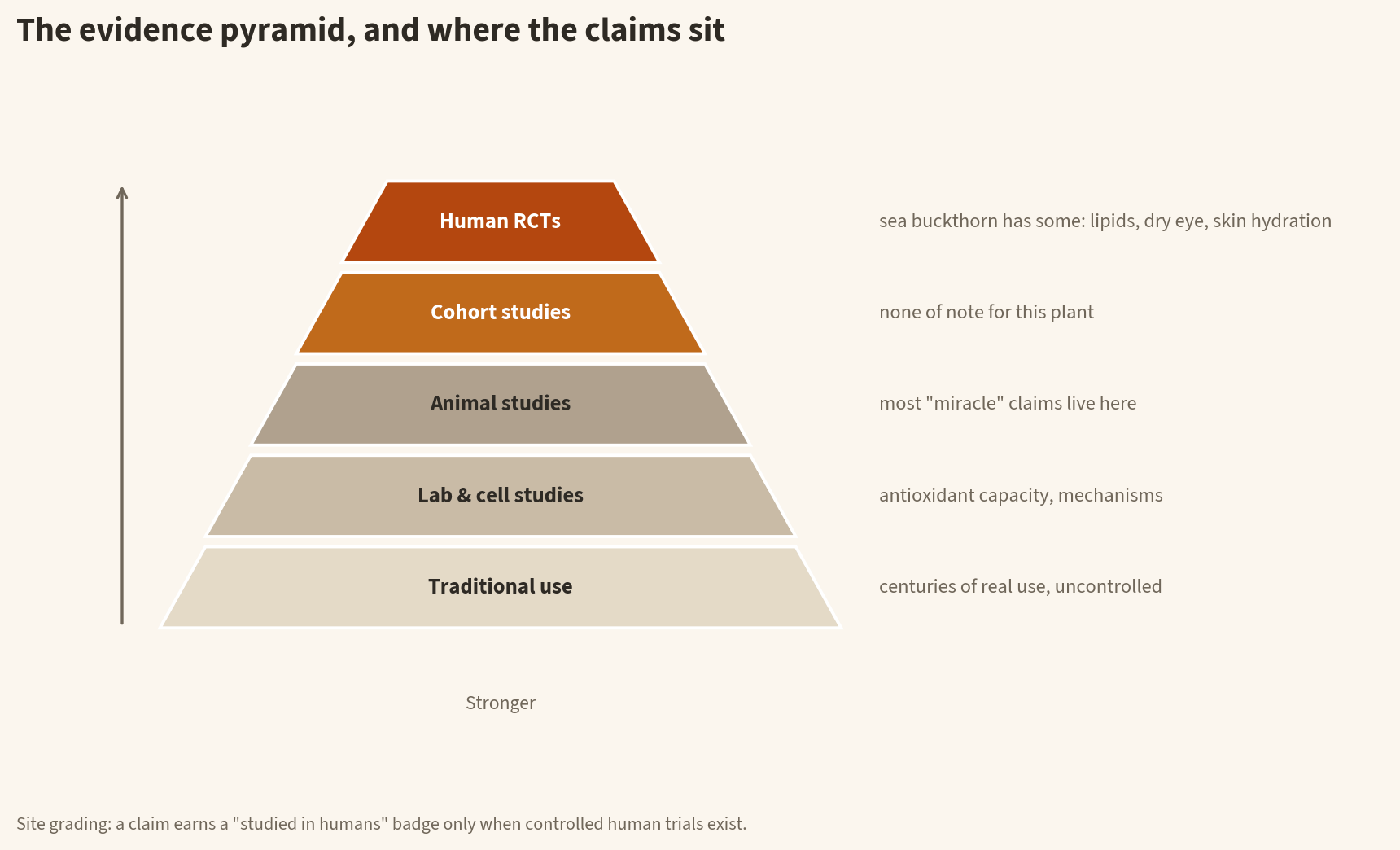
Our grading scale
- Strong: replicated randomized human trials.
- Moderate: a single solid human trial, or several weaker ones.
- Preliminary: animal or cell research only.
- Traditional: centuries of use, no trials.
Our badges: 4 dots means Strong (multiple human trials), 3 means Moderate, 2 means Preliminary, 1 means Traditional or early. Every claim page states its grade. The full method, including how we handle brand-funded studies, is documented in how we research.
What we have not verified
Our verification queue holds papers we could not clear: a small fatty-liver trial from a journal we grade as low quality, an older atopic-dermatitis study, a burn-wound trial, and a Sjögren’s pilot. None has been replicated by a group we trust, so none of their findings appears anywhere on this site. When one clears, it will show up here with its grade attached. The research finder tool searches everything that has cleared so far.
What we reject
Testimonials dressed as data, rodent studies sold as human proof, and any paper we cannot trace to a journal. If a claim on this site ever outruns its evidence, the editorial policy tells you how to call us on it.
Frequently asked questions
Is sea buckthorn scientifically proven?
Parts of it are. Dry-eye relief and improved skin hydration from oral oil have randomized human trials behind them. Most other claims rely on lab or animal research. We publish the grade of evidence next to every claim so you can see exactly which is which.
Why do some sites claim sea buckthorn is proven for everything?
Because quoting a study costs nothing and reading it takes time. The same dozen trials get recycled across thousands of pages, usually with the limitation column cropped off and the nulls left out. A claim that sounds universal is a claim nobody checked against the actual trial file, which is why we publish grades next to every claim and keep the refuted results visible.