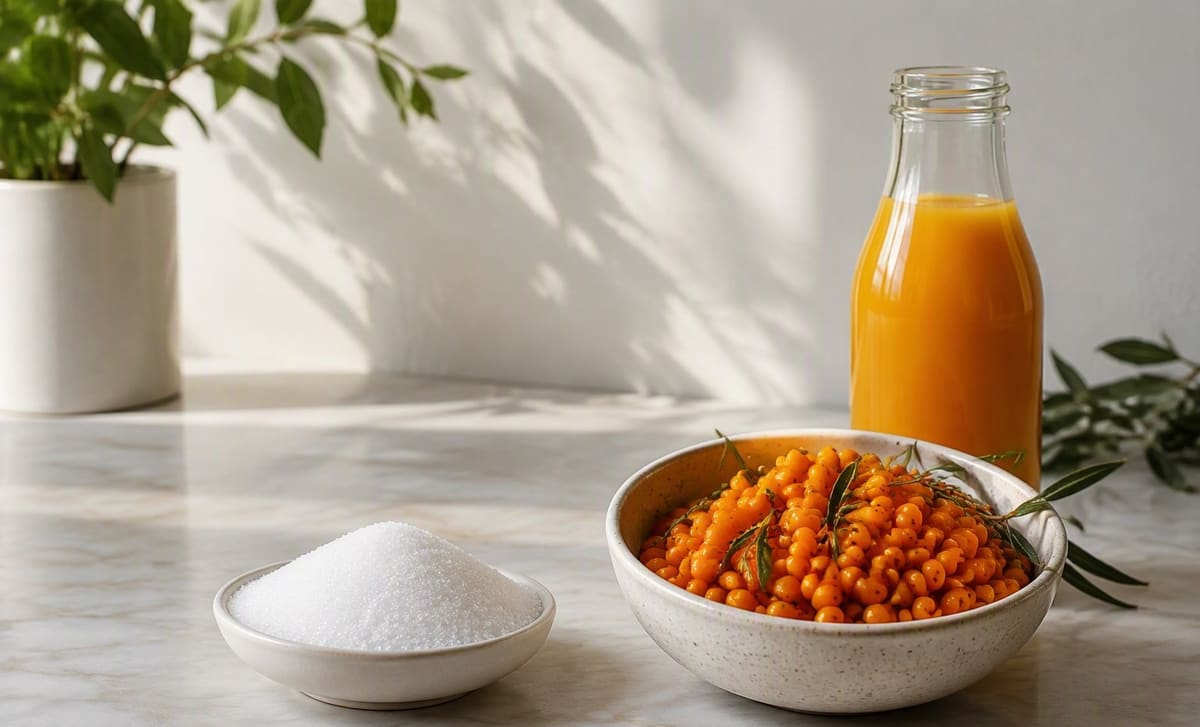
The fresh berry is a low-sugar food: composition studies put it at a few grams of sugar per 100 g, far less than grapes or bananas, with acid doing the talking instead. The sugar problem lives downstream, in juice blends, jams, syrups, and sweetened dried berries. If sugar is your concern, the berry is innocent and the product shelf needs interrogation.
The berry itself: sour, not sweet
Taste one fresh sea buckthorn berry and the question answers itself. The experience is a burst of acid (malic, quinic, and citric, the acids detailed on our juice nutrition page), with sweetness nowhere in the lead. Composition analyses agree: sugar sits at a few grams per 100 g of fresh berries, against far higher acid levels.
That profile puts sea buckthorn in cranberry territory, not grape territory. It is why traditional use always paired the berry with honey or sugar, and why “sea buckthorn” on a sweet product’s label tells you nothing about what else is in the jar. The nutrition hub holds the rest of the composition numbers behind that claim.
Where the sugar actually lives
- Juice blends. Pure sea buckthorn juice is punishingly acidic, so most bottles blend it with apple, grape, or pear juice. The base juice decides the sugar per glass, and it usually dwarfs the sea buckthorn share. Our juice guide reads these labels one by one.
- Jams and syrups. Sugar is the preservative here by design. Fine as a condiment, misleading as a health product.
- Sweetened dried berries. Drying already concentrates the berry’s own sugar (less water, same sugar per bag), and many brands add more on top. Unsweetened dried berries are a different, far tarter product, covered in the fresh vs dried vs powder comparison.
- Softgels and liquid oil. No sugar at all. Oil is fat, full stop.
The per-serving math
Run the forms against an actual serving. A 100 g bowl of fresh berries carries a few grams of sugar, cranberry territory. A 30 ml shot of pure juice carries proportionally little, since the serving is small. A 250 ml glass of blend is where the number climbs, and the base juice, apple, grape, or pear, decides how high, not the sea buckthorn. A spoon of jam is sugar by construction. A small bag of dried berries concentrates the berry’s own sugar as the water left, and sweetened versions stack added sugar on top. Same plant, five exposures, one rule: the further from the fresh berry, the more the sugar is the product’s, not the plant’s.
The glycemic question
People asking about sugar usually mean blood sugar, and the honest answer has two parts. No published glycemic index measurement exists for sea buckthorn, so anyone quoting one is inventing it, and the glycemic index page explains what composition can and cannot predict. The plain berry’s profile, low sugar, high acid, some fiber, points low-glycemic as compositions go. The blends inherit the base juice’s profile instead. Two different answers, depending entirely on the form.
A worked label example
Two bottles, same shelf. Bottle one reads “sea buckthorn juice” and lists one ingredient. Bottle two reads “juice drink with sea buckthorn” and lists apple juice first, water second, sea buckthorn third. Bottle one is sour, potent, and low in sugar per shot. Bottle two is apple juice with a marketing budget, and its sugar per glass is apple juice’s sugar. The front of the bottle charges you for the berry. The ingredient list tells you who actually owns the sugar. Ten seconds, every time.
The cranberry parallel
If this profile sounds familiar, you have met it before. Cranberry is the same story: a berry too sour to eat plain, forever paired with sugar, sold dried mostly in sweetened form, and blended into juices where it plays supporting actor to apple or grape. The lesson transfers intact. With both berries, “the fruit is healthy” and “the product is sweet” are simultaneously true, and only the ingredient list separates the claims.
The label checks that take ten seconds
- Ingredients before claims. If apple juice or sugar outranks sea buckthorn on the list, the product is sweetened first and healthy second.
- “No added sugar” is not “low sugar.” Juice concentrates and blends can hit that claim while still pouring like soda.
- Serving size honesty. A 30 ml shot of pure juice and a 250 ml glass of blend are different exposures wearing similar labels.
Applying those three checks to a shelf is most of the work, and our juice buying guide already did it for the bottles worth naming, all of which are unsweetened.
One more anchor for context: pooled human trial data found no significant sea buckthorn effect on fasting blood glucose, in either direction. The metabolic health page lays out that null honestly, so neither fear nor hope about this berry and blood sugar should run ahead of it. For anyone managing blood sugar with their clinician, the plain berry forms are the easy conversation, and the blends belong in the same budget as any sweet juice.
Frequently asked questions
Are sea buckthorn berries high in sugar?
No. Composition studies put fresh sea buckthorn berries at a few grams of sugar per 100 g, far less than sweet fruits like grapes or bananas. What the berry has instead is acid: malic, quinic, and citric acids that make it intensely sour. Nobody eats these berries by the sweet handful.
Is sea buckthorn juice high in sugar?
Pure sea buckthorn juice carries only the berry's own modest sugar, but it is so acidic that most products blend it. Blends typically use apple or grape juice as the base, which raises the sugar per glass well past the sea buckthorn contribution. Jams, syrups, and sweetened dried berries are sugar products with sea buckthorn in them. Read the ingredient list before the marketing.
Are dried sea buckthorn berries high in sugar?
Unsweetened dried berries carry the berry's own modest sugar in concentrated form, because drying removes water while the sugar stays put, so gram for gram the number climbs even though nothing was added. Sweetened versions are a different story, with extra sugar added on top of that. The ingredient list separates the two in one glance.