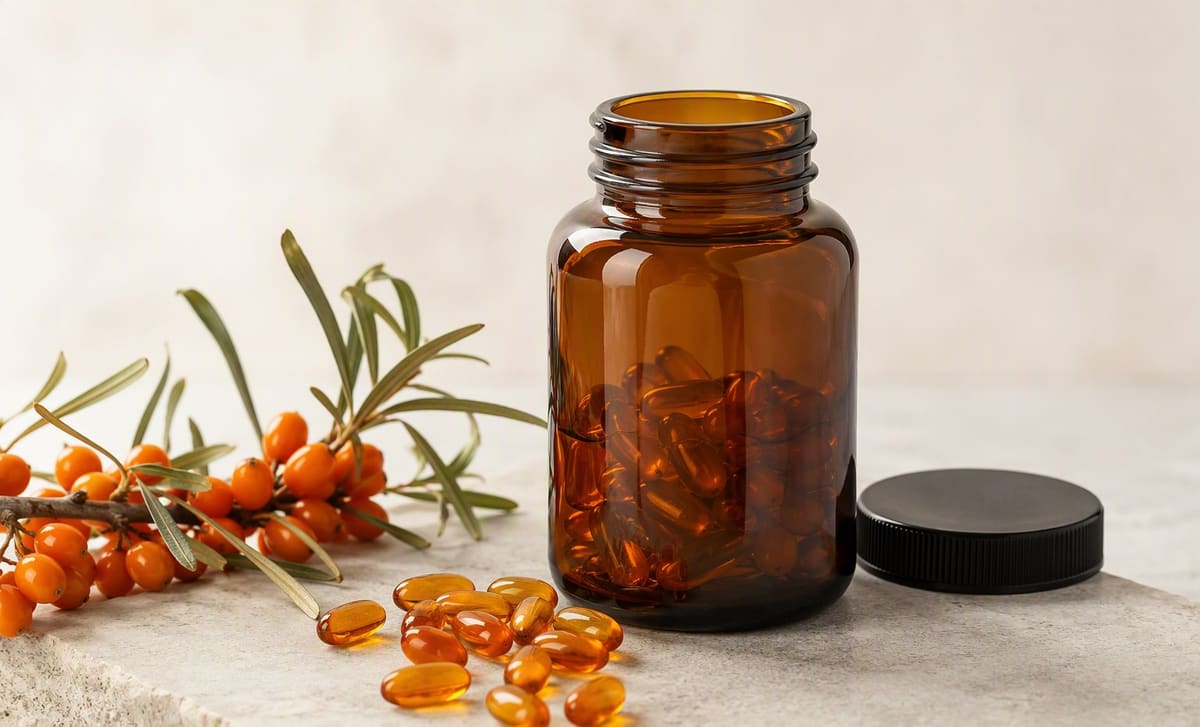
Sea buckthorn capsules are simply the oil in a softgel: same fatty acids, same evidence, no taste, no orange stains. You pay 25 to 50% more per gram for that convenience, and the most common failure is dose: one capsule a day is a quarter of the lowest studied amount. Get the math right and capsules work exactly as the oil does.
What is inside the shell
Sea buckthorn oil capsules are the oil in a shell and nothing more, so there are two things to check. First, which oil: berry, seed, or a blend, in the same proportions discussion as liquid oil (see the oil explainer). Berry softgels get sold as omega 7 sea buckthorn oil, because the pulp oil is where that fatty acid concentrates, while seed softgels lean to omega 3 and 6. Second, how much: 500 mg and 1,000 mg softgels are both common, and the difference decides whether your daily dose is two capsules or four.
The shell itself is usually gelatin (beef or fish), with vegan cellulose options existing at a small premium. A softgel is a delivery choice, not a different plant, and our guide to every other format puts it beside the alternatives.
One naming note, since it trips up shoppers in India especially. Plenty of listings call these sea buckthorn tablets, but a true pressed tablet of this oil is rare, because the oil wants a sealed soft shell around it. What you almost always get, whatever the listing says, is a softgel. So read “tablets” as “capsules” here, and check the milligrams of oil either way, because that number is what decides your dose.
The dose math, once and for all
The human trials used 2 to 3 grams of oil daily. That is:
- 500 mg softgels: 4 to 6 per day
- 1,000 mg softgels: 2 to 3 per day
One capsule daily, the dose many people actually take, delivers a quarter to a half of the lowest studied amount. Under-dosing, not the plant, explains most “it did nothing” reviews. The sea buckthorn capsules benefits people are chasing, the lipid and skin results, are the oil’s benefits, so they track the milligrams and not the label’s promises. The dosage page maps every studied dose, and the tools page has the converter.
Capsules versus liquid, honestly
Capsules win on convenience, travel, taste, and stain avoidance. Liquid wins on cost per gram and dose flexibility. Absorption is equivalent. The full head-to-head with real prices is on the forms compared page.
When you are ready to buy, the capsules buying guide scores the verified options, including the best vegan pick and the cost per studied day for each.
What to watch
One trial at 5 grams daily saw reduced platelet aggregation. If you take blood thinners or have surgery planned, skip capsules until your doctor clears them. More in our side effects guide.
What the shell does and does not do
The gelatin or cellulose shell does three honest jobs: it seals the oil away from oxygen, it hides an earthy taste many people quit over, and it pre-measures every dose. What it does not do is change the oil or its absorption. The same fatty acids reach your gut either way, which is why the liquid-versus-capsule question is logistics, not chemistry.
Reading a softgel label
Four lines decide a softgel’s honesty:
- Milligrams of oil per softgel, and softgels per serving. A “1,000 mg per serving” banner with two capsules per serving means 500 mg each, which changes your daily count.
- 100% sea buckthorn oil or a carrier blend. Some capsules cut the oil with MCT or olive oil, which dilutes the omega-7 per capsule. Honest labels name the carrier on the panel.
- The plant part: berry, seed, or blend, same as liquid oil.
- Shell material: gelatin (beef or fish) or cellulose for the vegan lane, plus antioxidants like vitamin E, which are a good sign, not filler.
- A lot number and a date. Oils are perishable, and a brand that tracks batches is telling you it expects to be checked.
The studied doses those milligrams have to reach are collected on the study dosages page.
The bottle math nobody prints
Here is the arithmetic that reframes the shelf. Sixty 500 mg softgels hold 30 grams of oil. At the studied 2 grams a day, that bottle is 15 days. At 3 grams, 10 days. A label calling itself a two-month supply is assuming one capsule a day, a quarter of the lowest studied dose. The forms comparison puts the cost at roughly $0.75 to $1.50 per studied day in capsules versus $0.60 to $1.20 in liquid, and the cost per day tool runs your actual bottle.
The adherence question, answered honestly
The best capsule is the one you still take in week twelve, because every positive trial ran that long. If the four-to-six-a-day count annoys you on day three, it will own you by week three, so choose the 1,000 mg size and split morning and evening. If even that sounds like work, be honest now and buy the liquid, because a full bottle abandoned in a cupboard has a cost per benefit of infinity. The how long to work page sets the week-by-week expectations.
Capsules on the road
Travel is where capsules pay their premium back. No measuring, no stained hotel towels, no bottle to leak in a bag. Keep them in the original container so the label travels with the dose, and out of a hot parked car, because softened shells fuse into one expensive lump. For flights, a softgel bottle in carry-on raises no liquid questions at all. A weekly pill organizer earns its keep too: pre-count the daily capsules, and the dose stops depending on willpower at a hotel breakfast.
Storage, and who should skip
Capsules ask less than oil but not nothing: a cool, dry cupboard, never a hot car or a sunny windowsill, and the bin if the shells turn sticky or melted. They suit travelers, commuters, the taste-averse, and routine people. Skip them, or pause and ask a doctor, if you take blood thinners or have surgery scheduled. Skip them for a different reason if you know you will never take four to six a day, because then liquid oil is the honest form. Vegans should buy cellulose shells explicitly. Timing is simple: with meals, per the best time page.
Frequently asked questions
Are sea buckthorn capsules effective?
Yes, when dosed properly: the oil inside capsules is the same oil used in trials, and several studies dosed it in softgel form. The catch is quantity. Studied doses of 2 to 3 grams mean 4 to 6 standard 500 mg softgels daily, and many disappointed users took just one.
When is the best time to take sea buckthorn capsules?
With meals, because the fat-soluble compounds absorb alongside dietary fat. At studied doses of 2 to 3 grams, splitting across two meals is easier than one large handful, and the daily habit matters more than the clock time.