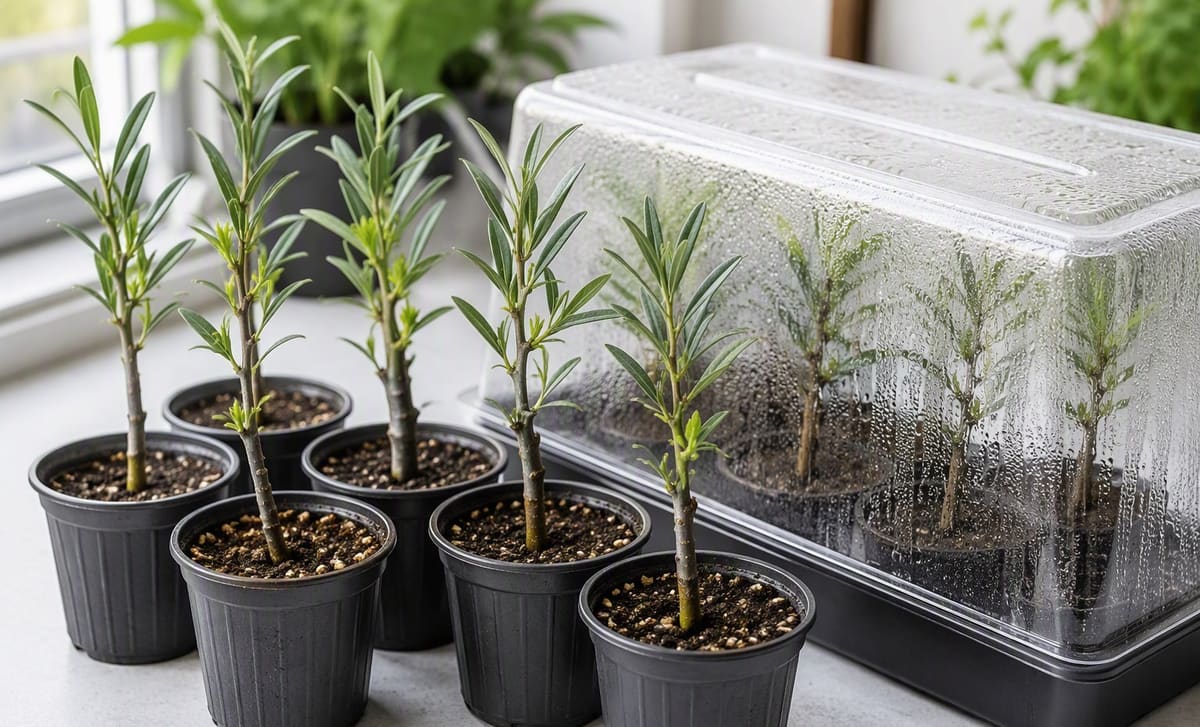
Cuttings are the smart way to propagate sea buckthorn for fruit. A cutting is a clone: it keeps the parent plant’s sex, its berry size, and its flavor, and it fruits a year or two sooner than a seedling. Softwood cuttings taken in summer with rooting hormone root reasonably reliably. Seed is the gamble, cuttings are the copy machine.
The method that works
- Timing: early to mid summer, when new growth is soft but no longer floppy. That is softwood.
- Take the cutting: 10 to 15 cm of healthy new shoot, cut below a leaf node, lower leaves stripped.
- Rooting hormone: dip the cut end. Sea buckthorn roots without it sometimes, but hormone raises the odds meaningfully.
- Rooting medium: a sharp, free-draining mix (perlite and peat or similar), kept moist and humid. A bag or propagator lid holds the humidity that softwood demands.
- Light, not sun: bright shade until rooted, then harden off slowly. Roots typically take 4 to 8 weeks.
Expect a success rate well under 100 percent even done well, so take several. Root suckers dug from an established plant are the cheat code: already rooted, free, and true to the parent. The growing hub maps the whole cluster this step feeds into.
Why clones win for fruit
Because only females fruit and seed cannot tell you which is which for years, a cutting from a known, heavy-cropping female is the shortest path to berries. Take one cutting from a good male at the same time and your pollination question is answered too, per the male-female ratio page. The male vs female page shows how to tell the sexes apart at bloom.
Aftercare
Pot rooted cuttings up, grow them on for a full season before planting out, and protect their first winter with mulch in cold zones. The planting guide covers the move to the ground, from seed covers the alternative route.
Hardwood cuttings and the sucker shortcut
Softwood is the reliable route, but two others deserve mention. Dormant hardwood cuttings, taken in late winter and stuck in a cold frame or sheltered bed, root at lower rates but ask almost nothing of you. Dug suckers are better still: an established shrub produces ready-made, already-rooted offspring every year, true to the parent’s sex. Slice the connecting root, lift with soil, and you have a plant that skips the entire propagation chapter. The planting guide takes it from there.
The first season after rooting
Rooted cuttings are not finished plants. Pot them up individually once roots fill the medium, feed nothing, and grow them on in bright light for a full season. Plant out the following spring or autumn, water weekly through their first year in the ground, and mulch wide. A cutting that fruits in year two or three instead of year four or five has repaid the whole effort, and named cultivars taken from heavy croppers make the odds even kinder.
Keeping track of what you took
Label every cutting the day you take it, with the parent plant and its sex. A tray of identical green sticks becomes a mystery within a week, and a mystery female sold to yourself as a male is a pollination failure discovered years later. The male vs female page shows what the labels are protecting, and the varieties page explains why cultivar names are worth recording too.
How many to take
One healthy shrub donates a dozen softwood cuttings without noticing. That is enough for a hedge, a windbreak, and spares for friends, all clones of a plant you already know performs in your garden. Propagation from your own best plant is the quiet advantage of having waited for it to mature.
Common cutting failures
- Letting softwood wilt. Minutes of dry air undo the cutting. Work fast, and keep everything shaded and humid until roots form.
- A soggy medium. Humidity is for the air, not the roots. A waterlogged mix rots stems at the soil line, the classic post-mortem finding.
- Tugging to check. Every pull breaks new roots. Wait for fresh top growth as the signal instead.
- Too few cuttings. Even good technique loses some, so take five where you want two.
Cuttings versus buying
Honest arithmetic: a bought cultivar fruits on the nursery’s timeline, while a cutting adds a year or two of growing on. Take cuttings when you have a proven plant to copy, time to spare, and more spots to fill than budget. Buy when you want the named variety now. Most gardens end up doing both, which is also the correct answer.
Frequently asked questions
Can you grow sea buckthorn from cuttings?
Yes, and it is the recommended route for fruit growers. Softwood cuttings taken in early to mid summer, dipped in rooting hormone, and kept humid root reasonably reliably. A cutting is a clone, so it keeps the parent plant's sex and berry quality, and it typically fruits a year or two sooner than a seedling.
When is the best time to take sea buckthorn cuttings?
Early to mid summer for softwood cuttings, when new growth is firm but still flexible. That timing, plus rooting hormone and high humidity, gives the best strike rate, with roots in about 4 to 8 weeks. Dormant hardwood cuttings in late winter are the lower-effort, lower-success alternative.