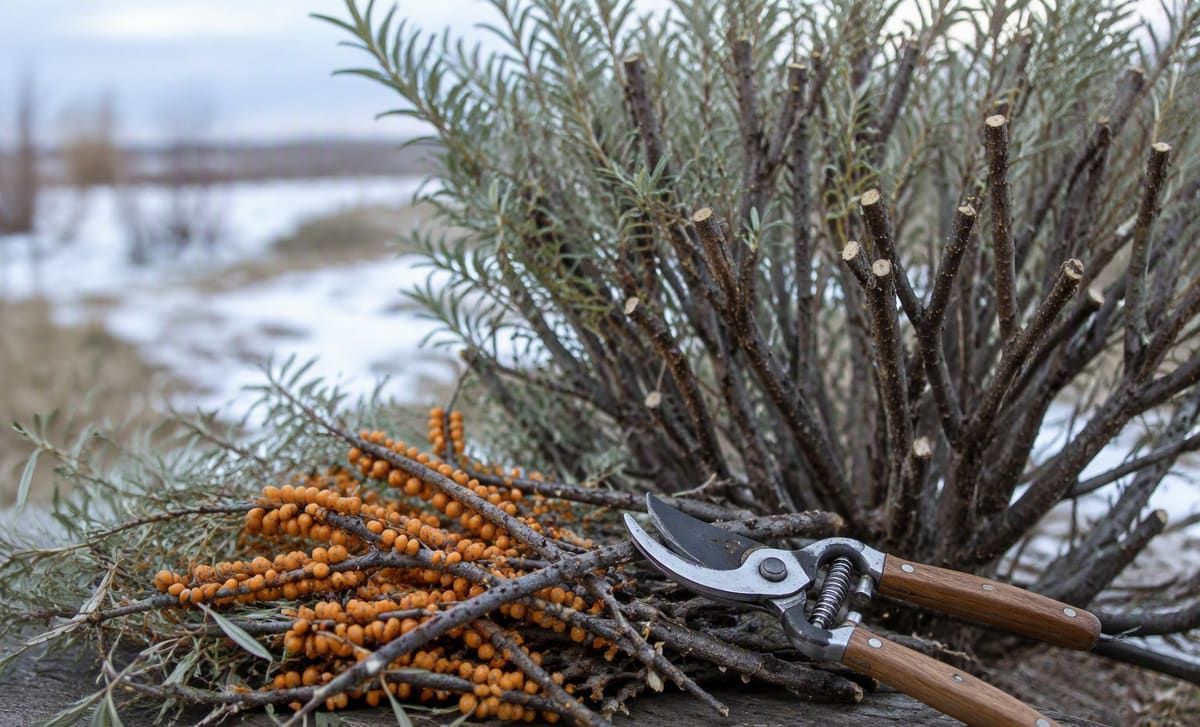
Prune sea buckthorn lightly once a year in late winter: take out dead and crossing wood, open the center to light, and keep the shrub at a height you can actually harvest. The rest of pruning season is sucker control, which is less a cut and more a lifestyle.
The annual late-winter cut
Work while the shrub is dormant, when the branch framework is easy to read. Remove anything dead, damaged, or rubbing. Then thin the center so light reaches the interior wood, because berries ripen where the sun lands. Sea buckthorn fruits on older wood, so this is a thinning job, not a hard renovation. Hack everything back and you cut away next year’s crop.
Height is a harvest decision
Left alone, the shrub climbs past picking reach and the best berries end up feeding birds. Heading back the tallest leaders keeps fruit where ladders are unnecessary. Every cut you make at the top is a berry you can still reach in autumn. The harvesting page explains why reach matters more than yield on paper.
Suckers: the other pruning
The roots send up new stems meters from the parent. Mow them, spade them out, or accept a slowly expanding thicket. Around lawns, mowing handles it. Near beds, dig suckers out with root attached or they return promptly. A mowing strip around the shrub is the single smartest layout choice for a tidy garden.
Two warnings before you start
Thorns. These are draw-blood thorns, and pruning means working inside the thicket. Thick gloves, sleeves, and eye protection are not optional.
Do not prune out your male. That one quiet non-fruiting shrub is the reason the others carry berries. Mark it with a tag or ribbon before you ever pick up loppers. The male-female ratio page explains what is at stake.
Winter timing details live on the winter care page, and the growing hub links every season.
Tools and technique
Secateurs for stems, loppers for branches, and leather gauntlets for everything. Cut just above an outward-facing bud or back to a main stem, and keep cuts clean. Take out a little often instead of a lot rarely: removing more than about a third of the canopy in one winter shocks the shrub into a thicket of soft, fruitless water sprouts. Clean the blades after diseased wood, which the pests page puts in context.
What you are pruning toward
The target shape is an open goblet: a few main stems, daylight in the middle, fruiting wood you can reach without a ladder. Every cut serves one of three goals: light in, height down, dead wood out. If a cut serves none of them, put the loppers down and walk around the shrub once more. Restraint is a pruning technique.
Renovating an old, tangled shrub
Inherited thickets respond to patience, not heroics. Spread the work over two or three winters: each year remove a few of the oldest, woodiest stems at the base and thin what remains. Expect the crop to dip during renovation and return stronger, because the shrub replaces old fruiting wood with vigorous new wood that carries berries within a couple of seasons. A hard all-at-once cutback works too, since the roots are nearly unkillable, but it costs you several years of fruit.
Timing across climates
Late winter means the dormant window, which shifts with your zone: later in zone 3, earlier in zone 7, always before buds swell. The climate page frames your winter, and the winter care page schedules the rest of the season’s short list.
Common pruning failures
- The annual buzz cut. Shearing the whole shrub removes the older wood that fruits and invites a dense, shaded thicket.
- Pruning after bud break. Cuts made into spring growth cost you flowers, and flowers are the crop.
- Cutting out the male. Unmarked, unproductive-looking, essential. Tag him before winter, as the male-female ratio page pleads.
- Ignoring the suckers. They are pruning too, just at ground level, and the mower is the tool.
The after-care
Cuts this size need nothing: no wound paint, no sealant, no fuss. The shrub calluses over cleanly on its own, and coating cuts mostly makes the gardener feel better. What does matter is clearing the thorny offcuts the same day, because they hide in grass remarkably well and find bare feet in summer.
Frequently asked questions
When should I prune sea buckthorn?
Late winter, while the shrub is still dormant and before buds swell. The framework is visible, cuts heal fast as growth starts, and you avoid disturbing the spring bloom that becomes your berries. Wear serious gloves regardless of season, because the thorns do not sleep.
Can I cut sea buckthorn back hard?
It survives hard cutting readily. The roots are nearly unkillable. What it costs is fruit, because berries form on older wood and a hacked shrub needs a few seasons to rebuild it. Better to renovate over two or three winters, removing a few of the oldest stems each year, unless losing the crop is fine.