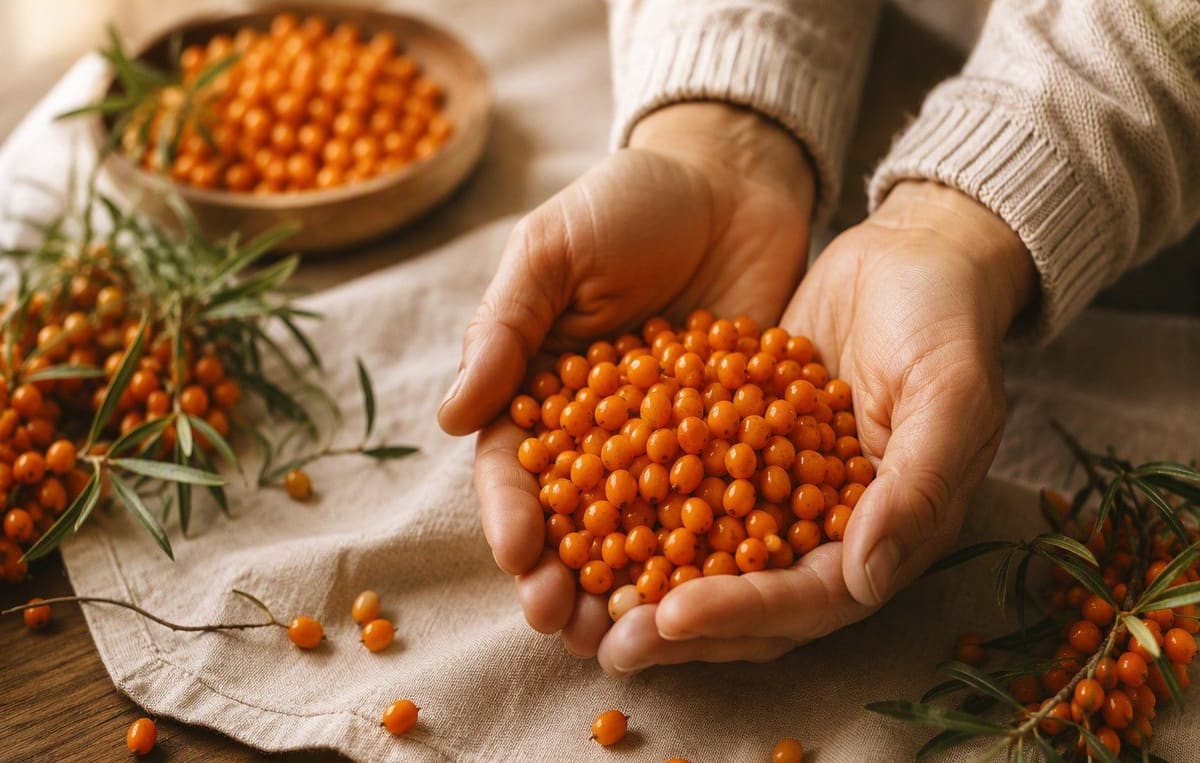
Hippophae is the genus name for sea buckthorn, built from the Greek words for horse and shine. The traditional account says ancient observers fed the leaves to horses and admired the glossy coats that followed. It makes a good story, and on modern labels the name does quieter, more useful work.
The name and its story
Hippos (horse) plus phaos (shine or light) gives Hippophae, and the usual translation is “shining horse.” The etymology traces to ancient Greek and Roman sources and comes down to us as the traditional account rather than a documented experiment, so enjoy it as history-flavored lore. The full version is on the name origin page, and the glossary hub defines the label words that travel with the name.
The genus and its family
Hippophae sits in the Elaeagnaceae family, and Hippophae rhamnoides is the species behind nearly every product on the market. The plant profile covers the botany. Subspecies vary, which is part of why omega-7 content swings so widely between oils from different regions.
How it shows up on labels
“Hippophae rhamnoides” in the supplement facts or the INCI list is your confirmation that the right plant is in the bottle, and its position in the ingredient order tells you roughly how much. One limit to know: the genus name does not tell you the plant part, and berry oil versus seed oil remains the bigger question, as the seed vs berry comparison explains. The compounds inside, from omega-7 to carotenoids, all have their own entries.
Reading it on the two kinds of labels
On supplements, the name appears in the facts panel as Hippophae rhamnoides, ideally followed by the plant part in brackets. On skincare, the INCI list gets more specific: Hippophae Rhamnoides Fruit Oil means berry, Hippophae Rhamnoides Seed Oil means seed. That last word is the one worth reading, because the two oils are different products.
A complete label example: “Hippophae Rhamnoides Fruit Oil” high in an INCI list, or “sea buckthorn berry oil (Hippophae rhamnoides), 500 mg” in a supplement panel. Both name the genus, the species, and the part. A label that stops at “sea buckthorn” names none of them.
The honest caveat
The genus name confirms the plant, and nothing beyond it. It does not certify the subspecies or the origin, and those shift the chemistry: composition swings like the omega-7 range live underneath one species name. It does not certify the plant part, the dose, or the freshness either. The Latin gets you into the right aisle. The printed percentages decide between the bottles, and our guide to choosing a sea buckthorn oil walks through which numbers matter most.
Where you meet it on this site
The species page maps the genus beyond rhamnoides, the regions hub explains why origin shifts the chemistry under one species name, and the fatty acid profile page shows the numbers that matter more than the Latin.
Related terms: omega-7, carotenoids, tocopherols.
Frequently asked questions
How do you pronounce Hippophae?
Most English speakers say hip-OFF-ah-ee. It is the genus name for sea buckthorn, from Greek roots, and you will see it on every properly labeled sea buckthorn product as Hippophae rhamnoides.
Are all sea buckthorn products made from Hippophae rhamnoides?
Nearly all of them are, since rhamnoides dominates cultivation and wild harvest worldwide. Other Hippophae species exist, especially in Himalayan material, and their chemistry differs, which is one more reason origin and printed percentages matter more than the genus name alone.