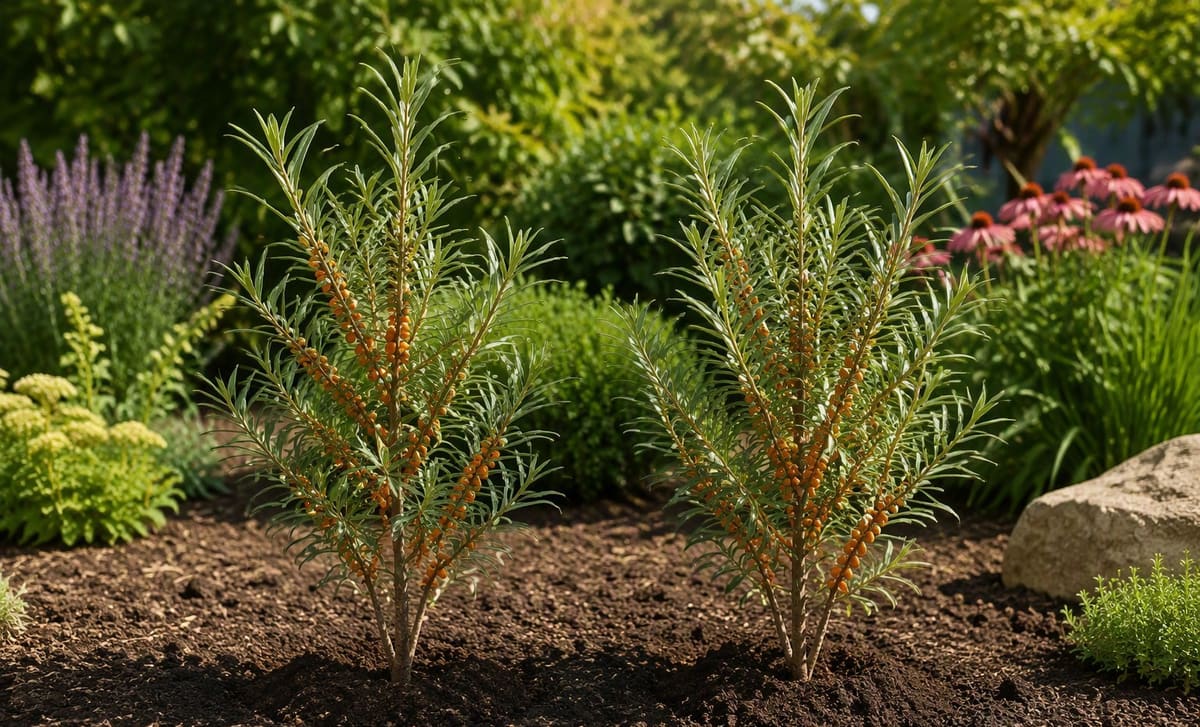
Sea buckthorn plants are male or female, and only females carry berries. The working rule: one male for every 6 to 8 females, planted within about 30 meters, with bloom times that overlap. Wind does the pollinating, so placement matters more than bees.
The dioecious rule
Dioecious means each plant is one sex. Females flower and fruit. Males flower, release pollen, and look like freeloaders the rest of the year. Both sexes grow with equal vigor, and you cannot tell them apart by leaf or thorn. The male vs female page shows what to look for at bloom, which is the only reliable moment, and the growing hub ties the ratio into the full planting plan.
The ratio and the distance
Wind pollination sets the math. One male covers roughly 6 to 8 females when they sit within about 30 meters of him, and upwind of the group is ideal since pollen travels on spring air. Orchards scatter males through the rows on this ratio. Home growers with two or three shrubs need one male in the mix, full stop.
Bloom timing matters too
Male and female flowers must be open at the same time for pollen to land. Named cultivars are bred in matched pairs for this reason, which is one more argument for buying known varieties over anonymous seedlings. The plants-for-sale guide shows how to order a sexed male and female from a nursery that labels both, and the flowers and pollination page covers the spring sequence.
The seedling gamble
Seed-grown plants hide their sex until first bloom, which can take 3 to 5 years. You could raise five shrubs and get five males. Vegetative propagation sidesteps this completely: a cutting is a clone with known sex. The from-seed page and from-cuttings page compare both paths honestly.
Telling them apart at bloom
Bloom is the one honest moment. Male flowers form in obvious clustered buds that swell and dust pollen. Female flowers are smaller, greener, and carry a tiny stigma where a berry will later sit. Before bloom, and on young plants that have never bloomed, there is no reliable tell. Leaf shape, thorn size, and vigor all lie. The male vs female page has the visual details, and the flowers and pollination page covers the timing, which runs a short spring window.
Planning the layout
Placement is wind engineering. Put the male upwind of the females so spring air carries pollen across them, or in the center of a ring if your wind has no loyalty. In a hedge, every seventh or eighth plant male keeps the ratio honest. In a small garden, one male tucked behind the females does the job without taking the sunny spot. Distance is the constraint: within about 30 meters, and closer is better for a heavy set.
Why the ratio is so lopsided
Pollen is cheap and berries are expensive, biologically speaking. One male produces enough wind-borne pollen for a whole block, so evolution and orchard design arrived at the same answer: few males, many females. Commercial plantings run the same 1 to 6 or 8 ratio at scale, scattered so every female sits within pollen range, as the commercial farming page notes. The home garden just miniaturizes the logic.
When the mix is already wrong
It happens constantly: a lone female, inherited with the house, flowers hopefully every spring. The options, in order of effort. Ask around: a neighbor’s male within range may already be pollinating yours, which explains surprise fruit. Add a potted or planted male anywhere within distance. Or take cuttings from a known male and plant one, which the from cuttings page makes easy.
Common ratio failures
- The all-female purchase. Sold as a trio of fruiting plants, with pollination mentioned nowhere.
- The unmarked male. The quiet shrub gets pruned out as unproductive, and the females stop fruiting the following year. Tag him.
- The dead male nobody noticed. Males die too. If cropping stops suddenly, check the male before blaming the weather.
- Mismatched bloom. Rare with named pairs, common with random seedlings. Flowers open days apart and the pollen lands on nothing.
If you want zero males
Then you want zero berries, which is a legitimate plan for a windbreak or a thorn hedge. Male-only plantings never fruit and never feed birds, and some municipal plantings choose exactly that. Everyone else needs the boy, so mark him, keep him healthy, and forgive him for looking decorative eleven months a year.
Frequently asked questions
Do I need two sea buckthorn plants to get berries?
Yes, at minimum one male and one female, and the male does all its work invisibly in spring. One male pollinates about 6 to 8 females if planted within roughly 30 meters. A lone female flowers every year and sets nothing. If a neighbor grows sea buckthorn, you might already be covered.
Can I tell male and female sea buckthorn apart before they flower?
Not reliably. Leaf, thorn, and growth habit look identical on both sexes, and young plants give no hint until first bloom, which can take 3 to 5 years from seed. That is why named, sexed cultivars are worth the price: the label does the telling years before the plant would.