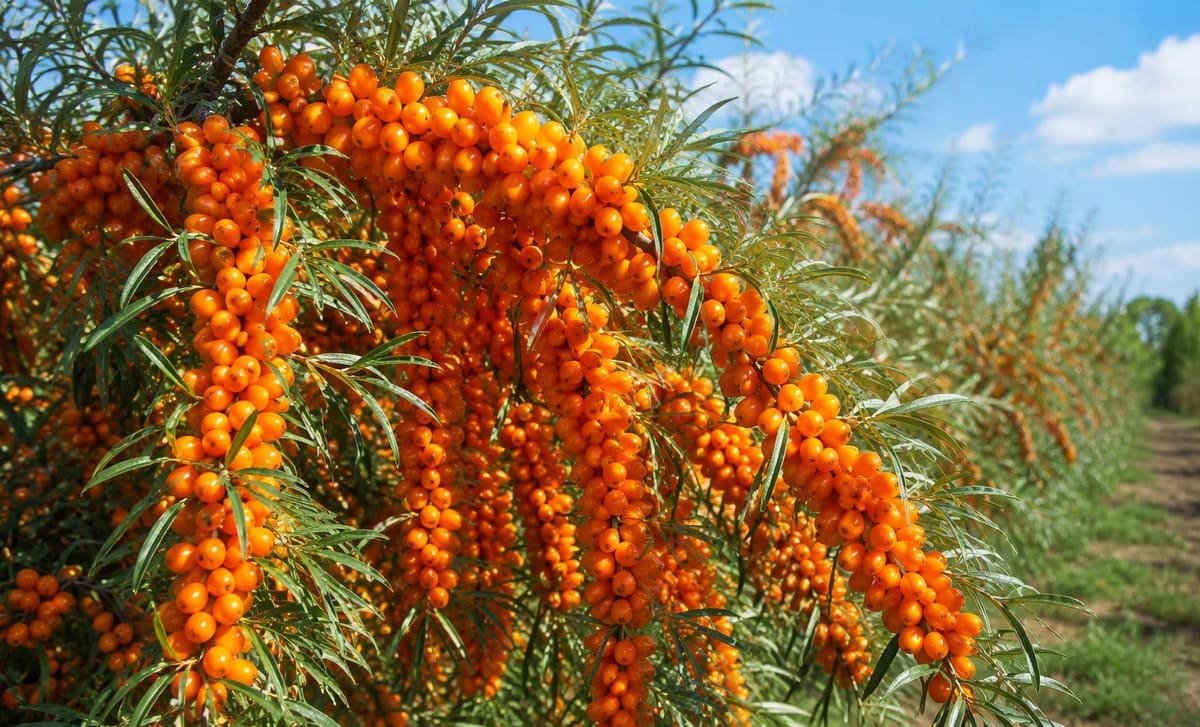
Every number on this page is an estimate, because sea buckthorn yields swing widely with variety, plant age, climate, and harvest losses. As a rough frame: mature bushes carry a few kilograms of berries each in average years and over ten in good ones, and per-acre figures range from about a tonne to several tonnes at maturity. Anyone quoting you a single precise number is selling something.
Why the ranges are so wide
Variety. Bred cultivars out-yield wild-type seedlings substantially, sometimes several-fold.
Age. Bushes give almost nothing until year 3 to 5, build through their first decade, and hold for many years after. An orchard’s early books look terrible by design.
Climate and site. Sun, drainage, and winter fit set the ceiling. The shrub survives poor sites but fruits generously only on good ones, and the growing hub has a page for each of those decisions.
From per-bush to per-acre
So what does an acre actually hold? Orchard spacing of two to three meters in rows several meters apart works out to a few hundred bushes. Multiply by per-bush estimates and you land anywhere from around a tonne to several tonnes per acre at maturity, which is exactly as vague as the honest literature. Young orchards produce a fraction of that, and budgeting for years one through four means budgeting near zero.
The harvest-loss discount
Here’s the number nobody puts in the brochure. Biological yield is not picked yield. Soft berries on thorny wood mean a real share of every crop stays on the bush or gets crushed on the way off. Hand picking leaves more. Aggressive mechanical shaking leaves less but damages berries. Planning should discount headline yields accordingly, and the equipment page explains the trade-offs.
A worked example, labeled as arithmetic
Take a middle-of-the-road layout: 2.5 meters between bushes in the row, 4 meters between rows for machinery. That’s 10 square meters a bush, roughly 400 bushes per acre. At a modest mature average of 3 kilograms a bush, the acre carries about 1.2 tonnes. At a strong 8 kilograms, about 3.2 tonnes. Same acre, same math, three-fold spread, which is why this page quotes ranges and distrusts decimals.
What moves a bush up the range
- Variety. Bred cultivars outcrop wild seedlings several-fold, the single biggest lever, and the varieties page explains why.
- Light. Full sun and an open, thinned canopy put fruiting wood to work. The pruning page is yield management by another name.
- Pollination. A well-placed male on the 1 to 6 or 8 ratio raises fruit set across the block, per the male-female ratio page.
- Water at fruit swell. Established shrubs survive drought but size berries with moisture, as the watering page notes.
Every lever on that list is a growing decision, not a harvest one.
Longevity is the hidden yield
Annual crops replant yearly. This shrub crops for decades once established, and the lifespan page frames how long. Spread across twenty or thirty cropping years, even mediocre per-acre averages compare well with most specialty fruit on cumulative return, provided the early lean years were budgeted honestly. The orchards that fail are the ones that expected year three to look like year ten.
The home-garden translation
One mature bush in a good year gives a household a freezer drawer of berries, which is usually the sensible target. Planting ten bushes for a family of four isn’t self-sufficiency. It’s a processing hobby with a freezer shortage. Scale the planting to the kitchen, not the fantasy.
Common yield disappointments
- Judging year two. Near zero is the design. Cropping builds toward the end of the decade.
- Seedling orchards. Variable genetics give variable yields forever, the false economy at planting time.
- The bird discount. Unnetted blocks can lose a large share of the crop in days, per the pests page.
- Counting biological yield. What the bush grows is not what the crate holds, and the harvest-loss section above shows where the crop goes.
For the full economic picture, costs in and product out, the commercial farming page is the companion read, and the harvesting page shows where per-bush potential becomes per-crate reality.
Frequently asked questions
How many berries does one sea buckthorn bush produce?
Estimates only: a mature bush in a good year can carry from a few kilograms to over ten, depending heavily on variety and age. Young bushes give little until year four or five. Home growers should also subtract what birds take and what gets left on the thorniest branches, because biological yield and picked yield are different numbers.
How long until a sea buckthorn orchard reaches full yield?
Budget a decade of building. Bushes give almost nothing until year 3 to 5, climb through the rest of the decade, and hold at mature levels for many years after. The early books look terrible by design, so operations that survive plan for the lean years rather than being surprised by them.