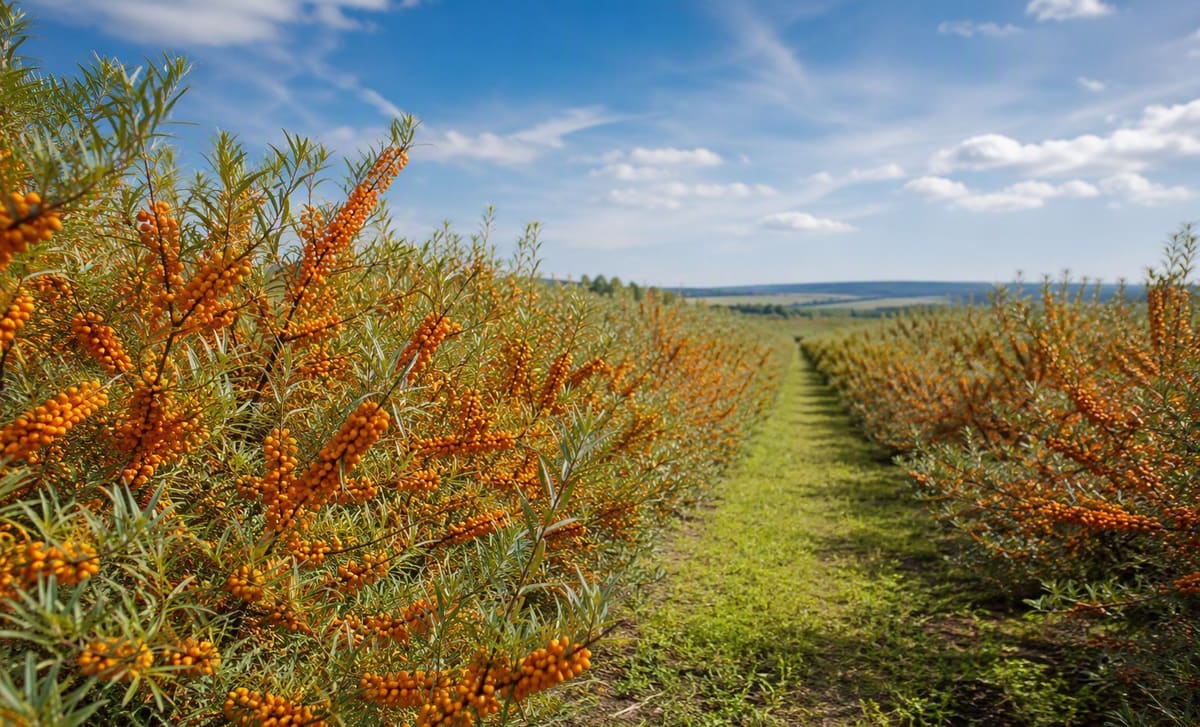
Commercial sea buckthorn is a real industry, dominated by China, and its economics hinge on one problem: the berries are easy to grow and hard to pick. Orchards are designed around the male-female ratio and whatever harvest method the budget allows. Fresh fruit rarely pays. Processed juice and oil usually do.
The global picture
China grows the large majority of the world’s sea buckthorn, with orchards planted at scale for decades, partly for fruit and partly for erosion control on difficult land. Smaller commercial plantings exist across Europe, Russia, and Canada. The shrub’s hardness is why it works commercially at all: it crops on land too cold, poor, or dry for most fruit.
Orchard design
The planting math from home gardens scales directly. Rows sit wide enough for machinery, typically several meters apart, with shrubs spaced two to three meters in the row. Males go in at roughly one per 6 to 8 females, scattered through the block so wind carries pollen everywhere, as the male-female ratio page details. Cultivar blocks keep harvest timing uniform.
Harvest is the cost center
Everything else about the crop is cheap, and harvest is not. Berries are soft, clustered on thorny wood, and they resist clean mechanical picking. Farms choose between whole-branch cutting, mechanical shaking, and hand crews, and each trades money for berry damage differently. The equipment page walks through the options.
The honest economics
Treat any projection you read, including this one, as an estimate. Reported yields vary enormously with variety, age, and region, and the yield per acre page gives the ranges with their caveats. What consistent operations share: a processing plan for juice or oil, since fresh berries travel badly, and realistic labor budgets. The shrub forgives everything except optimism about picking costs.
The growing hub anchors the smaller-scale version of all this.
Why China dominates
Scale, and a head start measured in decades. Chinese plantings cover huge areas, much of it established for erosion control and later harvested for fruit, so the country grows the large majority of world supply almost as a by-product. The China page and the cultivation history page trace how that happened. Everyone else, from Canada to Germany, operates as a specialty crop beside that volume, which is why smaller producers lean on processed products and direct sales rather than commodity fruit.
The labor question, stated plainly
Most fruit crops mechanized decades ago. Sea buckthorn resisted, because the fruit is soft, the wood is thorny, and the berries cling. That single fact shapes everything: orchard layout, variety choice, pricing, and which countries can grow it profitably. Where labor is expensive, the crop only makes sense processed and priced as a specialty product. Where labor is cheap, hand harvest competes with machines and often wins on berry quality. Anyone modeling this crop on apple economics is modeling the wrong fruit.
The processing decision comes first
Fresh sea buckthorn barely travels. The berries crush, weep, and spoil fast, so an orchard without a processing plan is an orchard with a spoilage problem. Juice is the forgiving route: press, pasteurize, bottle. Oil is the valuable route: it needs separation equipment and quality control, and it sells for far more per kilo of fruit. Dried berries and powders sit between the two. The product forms page shows what the fruit becomes, and serious operations decide which form they sell before they decide which variety to plant.
A realistic timeline
Years one through four are costs dressed as an orchard: plants, fencing, irrigation setup, and almost no fruit. Cropping builds through the rest of the decade toward mature yields, and the yield per acre page keeps those numbers honest. The operations that survive the early years share two traits: a buyer or product lined up before the first big harvest, and a harvest labor plan that assumes picking is slow, because it is.
Common commercial failures
- Planting unsexed seedlings. Cheap stock of unknown sex and unknown quality turns an orchard into a lottery that takes years to reveal itself.
- Underestimating harvest labor. The budget line that kills the business plan is picking, every time.
- Growing fruit with no buyer. Berries are not a commodity you can warehouse while you find a market. Sell the juice before you grow it.
Frequently asked questions
Is sea buckthorn farming profitable?
It can be, but the honest answer is that harvest labor decides it. The shrub itself is cheap to grow: hardy, self-feeding, long-lived. Berries are the expense, because they resist mechanical harvest and crush easily. Operations that sell processed products like juice and oil, rather than fresh fruit, have the stronger track record.
How long before a sea buckthorn orchard pays for itself?
Plan on years, plural. Fruit is near zero until year four or five, builds through the rest of the decade, and the payback clock only starts once yields mature. Operations with a processing plan and a lined-up buyer recover fastest. Anyone promising quick returns on a fresh planting is selling plants, not math.