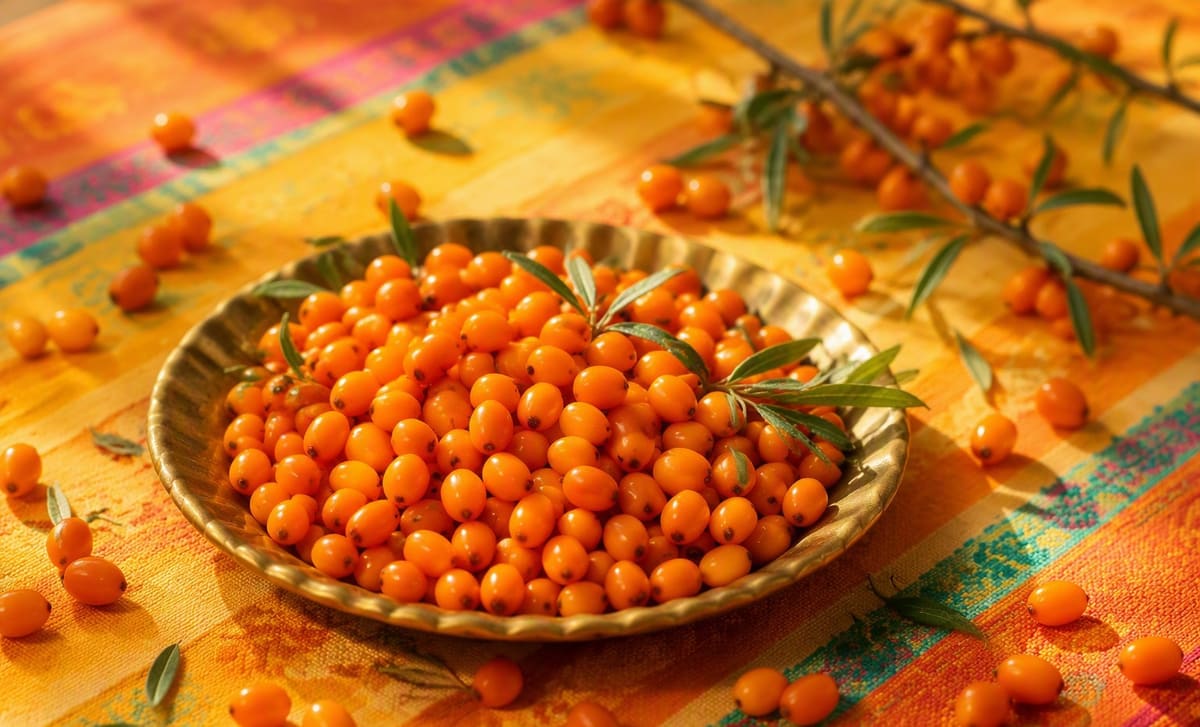
Sea buckthorn has no old Hindi name, and that is the honest answer most pages dodge. The plant grows only in India’s high cold mountains, far from the Hindi-speaking plains, so the language never made a word for a shrub it never met. Indians call it three borrowed things instead: Leh berry, its trade name, sea buckthorn, its English name, and Hippophae rhamnoides, its botanical name. The one genuinely local name is Ladakhi, tsermang for the plant and tsestalulu for the fruit.
Why there is no Hindi word
Names follow plants. A fruit that grows in your fields for a thousand years picks up a name in your language, the way aam did for mango. Sea buckthorn never grew where Hindi is spoken. It lives in the cold desert of Ladakh, in the high valleys of Himachal’s Lahaul-Spiti, and in the far mountains of Sikkim and Arunachal, at altitudes the plains cannot touch. So the plains languages had nothing to name. That is the real reason your search for a Hindi word keeps coming up empty, and it is worth knowing before a shopping site sells you a made-up one.
The searches arrive in a dozen spellings and hit the same wall. Sea buckthorn hindi name and plain sea buckthorn hindi go looking for a word that was never coined. Sea buckthorn kya hai asks what the thing even is. Sea buckthorn berry in hindi and sea buckthorn fruit in hindi want the fruit by a homegrown word, and there isn’t one. What waits at the other end is a borrowed name, every time.
The India page tells the growing story, and the India buying guide covers the domestic brands and the label mark to check.
The names Indians actually use
Four names, one orange berry. Each says something different, and none of them is Hindi.
| Name | Where it comes from | What it is |
|---|---|---|
| Leh berry | Indian trade name, from Leh in Ladakh | The everyday word Indians search and buy under. A trade name, not a language word |
| Sea buckthorn | The global English common name | The name on most international products, tied to the species |
| Hippophae rhamnoides | Botanical Latin, the species name | The scientific anchor that confirms the exact plant on any label |
| Tsermang, tsestalulu | Ladakhi, the local plant and fruit names | The one genuinely native Indian name, spoken around Leh but rare on a label |
The trade name has a real story behind it. A high-altitude research laboratory in Leh worked out a sea buckthorn drink that would not freeze in the sub-zero cold, then handed the method to local groups, and the bottle that followed made Leh berry a household word. The Leh berry explainer unpacks what that name does and does not tell you about quality, and the Leh Berry brand review scores the specific product.
What about Gujarati, Marathi, Telugu, Bengali, Kannada?
People search sea buckthorn in gujarati, sea buckthorn in marathi, sea buckthorn in telugu, sea buckthorn in bengali, and sea buckthorn in kannada by the thousand, and the answer is the same tired truth in every one of them. There is no traditional native word. The shrub is not native to Gujarat, Maharashtra, the Telugu or Bengali or Kannada country, and most people there have never seen the fresh fruit. So in each language it is called sea buckthorn or Leh berry, the borrowed names, not a word handed down through kitchens and grandmothers. If a page hands you a confident regional translation, treat it the way you would treat a confident stranger: check who told you and why.
Sea buckthorn ke fayde, the benefits question
A big share of these searches are really asking about health, in phrases like sea buckthorn benefits in hindi, sea buckthorn benefits hindi, sea buckthorn ke fayde in hindi, and plain sea buckthorn ke fayde. A few ask sea buckthorn use in hindi, meaning what it is actually good for. Ke fayde just means the benefits, so let me answer it straight, in the same graded way we answer it everywhere else on this site. Being from the Himalaya buys the berry a good story, not better medicine.
The best-supported benefit is blood lipids, graded ●●●● Strong. A 2022 meta-analysis of 15 randomized controlled trials found sea buckthorn significantly lowered triglycerides, total cholesterol, and LDL cholesterol, and raised HDL, with the biggest effect in people whose lipids were already high. The honest nulls are graded just as strongly. That same analysis found no effect on fasting blood sugar, no effect on blood pressure, and no effect on body weight. Everything else, skin and dry eyes included, sits on lighter evidence from smaller trials, and a lot of the rest is traditional use.
One catch runs under all of it. Every human trial dosed the oil at 1 to 3 grams a day, not a splash of juice, so a Leh berry juice is a pleasant vitamin C food and the studied benefits belong to the concentrated oil. The benefits hub grades each claim one at a time, and the Leh berry page walks through the evidence without the altitude halo.
Do not confuse it with plain “buckthorn”
One more trap, because it costs people money. Drop the “sea” and you land on buckthorn in hindi, and that points at a different plant entirely. True buckthorns are Rhamnus, an unrelated group of shrubs with dark berries and none of sea buckthorn’s chemistry. If a label or an article means the orange Himalayan berry, the Latin will read Hippophae rhamnoides. Anything else is a lookalike, and the lookalikes page sorts the confusion out in full.
The one line to remember
Ask for it by the name that works. In a shop or a search bar anywhere in India, Leh berry finds the product and sea buckthorn finds the science, while a hunt for a pure Hindi word finds mostly guesses. The plant is real, Indian, and genuinely worth knowing. It just never picked up a plains name on the way down from the mountains.
Frequently asked questions
What is sea buckthorn called in Hindi?
There is no old, settled Hindi word for it, because the plant does not grow in the Hindi-speaking plains. It grows only in India's high cold mountains. Indians call it by its trade name Leh berry, by its English name sea buckthorn, and by its botanical name Hippophae rhamnoides. The genuine local names are mountain-language names, like tsermang in Ladakhi.
What is sea buckthorn in Gujarati, Marathi, Telugu, Bengali, or Kannada?
The same honest answer holds in every one of those languages: there is no traditional native word, because the shrub is not native to those regions and most people there never see it fresh. In each language it is called sea buckthorn or Leh berry, the borrowed names, not a word passed down.
What does sea buckthorn ke fayde mean?
Ke fayde is Hindi for the benefits, so sea buckthorn ke fayde just means sea buckthorn benefits. The honest short version: the oil lowers blood lipids on strong evidence, and it does nothing for blood sugar, blood pressure, or weight. The Ladakh origin changes none of that.
Is Leh berry the Hindi name for sea buckthorn?
Leh berry is the Indian trade name, not a Hindi-language word. It comes from Leh in Ladakh, where the fruit grows, and a Leh-made juice put the term into shops across the country. It is the phrase most Indians actually search and buy under, with sea buckthorn as the botanical backup.