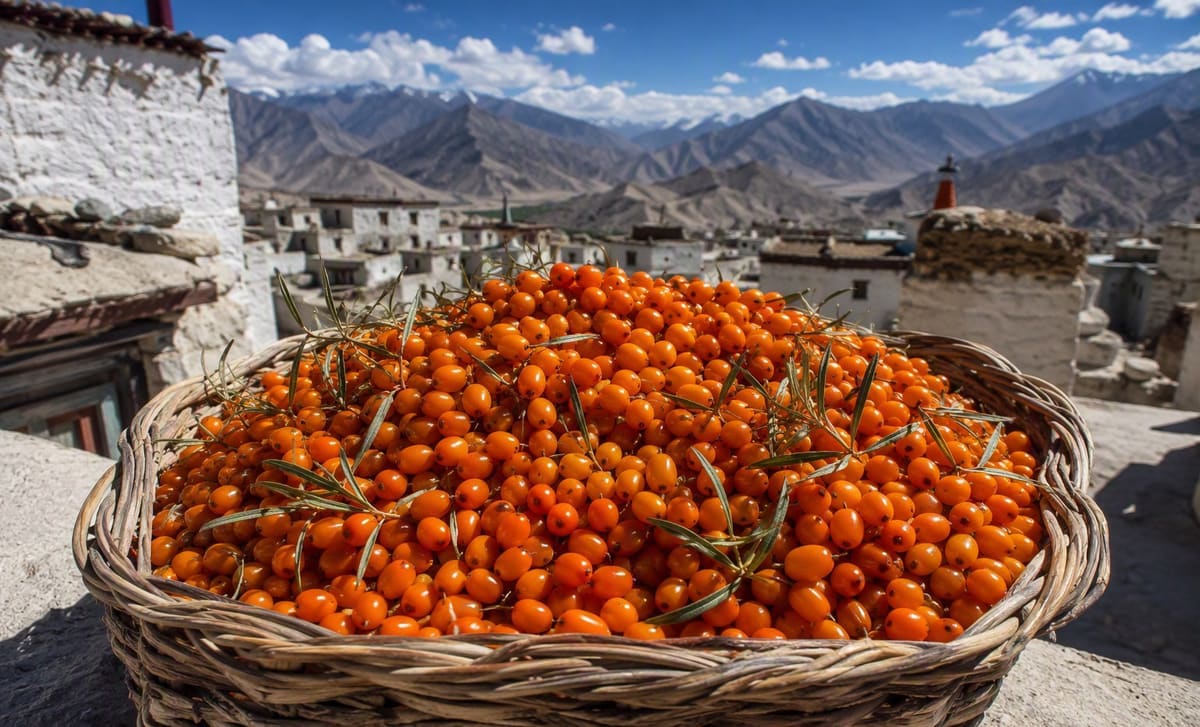
India’s sea buckthorn story is a Himalayan story. The shrub grows wild and cultivated across the high mountain belt, with Ladakh as the famous heartland, and Indian consumers meet it as local juices, oils, and dried berries from mountain cooperatives and brands. If your bottle says Himalayan, there is a fair chance the berries started on an Indian mountainside.
Ladakh, the heartland
Ladakh’s cold desert is nearly perfect sea buckthorn country: high altitude, brutal winters, intense sun, thin soil, and river valleys the shrub can anchor. The berry has been part of local life for generations, gathered from wild stands along those valleys, and in recent decades it became a cash crop as well, with local cooperatives and small companies turning the harvest into juice, oil, jam, and dried berries, some of it sold nationally under the Leh berry name. Around Leh and the surrounding villages, the berry is simply local fruit, sold in season the way apricots are. The regions hub sets Ladakh beside the other growing countries.
The same Himalayan conditions that make farming hard make the berry interesting to brands: harsh UV and temperature swings push dense pigmentation and rich fatty acid profiles, which is why “Himalayan” carries weight on labels far beyond India.
How Indian consumers encounter it
Inside India, sea buckthorn shows up in three main forms. First, mountain products: juices, squashes, and oils sold in Ladakh itself and in hill-state markets, often from local cooperatives. Second, Ayurveda-adjacent and wellness retail, where the oil appears in capsules and skincare with varying label quality. Third, imported international brands through online marketplaces, where the Himalayan origin story comes full circle back to Indian buyers.
Buying notes for India
- Origin cuts both ways. A Ladakh product bought near the source is as fresh as this category gets. A “Himalayan” label on a marketplace listing with no company behind it is just a word.
- The plant part still decides. Berry oil for omega-7, seed oil for omega-3 and 6, and labels that say neither are asking you to guess. Our seed vs berry page is the decoder.
- Juice is juice. Locally pressed juice is a tart food, not a studied supplement. Enjoy it as one, dilute it, and mind the acidity rules on the safety page.
- Freshness travels badly. Oil bought far from the source should come from a seller with real turnover, per the where to buy guide.
The growing hub covers cultivating the shrub yourself if your winters cooperate.
Why altitude shows up on the label
The Ladakh recipe is high UV, hard winters, thin air, and huge day-night swings, and plants answer stress with chemistry: dense pigments, rich fatty acid profiles, concentrated flavor. That is the mechanism behind the Himalayan premium, and it is real. What it is not is magic, because the same stress simply yields smaller berries that are harder to pick.
For the Himalayan traveler
Visit in autumn and the story tells itself: fresh berries in the markets around Leh, juice and squash in the shops, apricots alongside in the same season. This is the rare place where a buyer can taste the raw material of a global industry at the source, for the price of breakfast. Altitude and thorns both apply if you head toward the wild stands.
The cooperative question
Much of the Ladakhi harvest moves through local cooperatives and small companies, and that structure matters to buyers: a cooperative label means the picking communities share the margin, and it usually means traceable origin. The Himachal page maps the neighboring valleys that work the same way, and the ayurveda page places the berry in the subcontinent’s older medical tradition.
Frequently asked questions
Where does sea buckthorn grow in India?
In the high Himalayan belt, with Ladakh as the best-known growing region, plus other cold mountain areas of the trans-Himalaya. The shrub thrives at altitude in poor soil and cold winters, conditions the lowland Indian climate does not offer, which is why production stays in the mountains.
Is Himalayan sea buckthorn better?
The terrain is genuinely demanding, and stressed plants concentrate pigments and fatty acids, so the raw material can be excellent. But Himalayan on a label is only a claim until a producer stands behind it. A named Ladakhi cooperative beats an anonymous Himalayan listing every time.