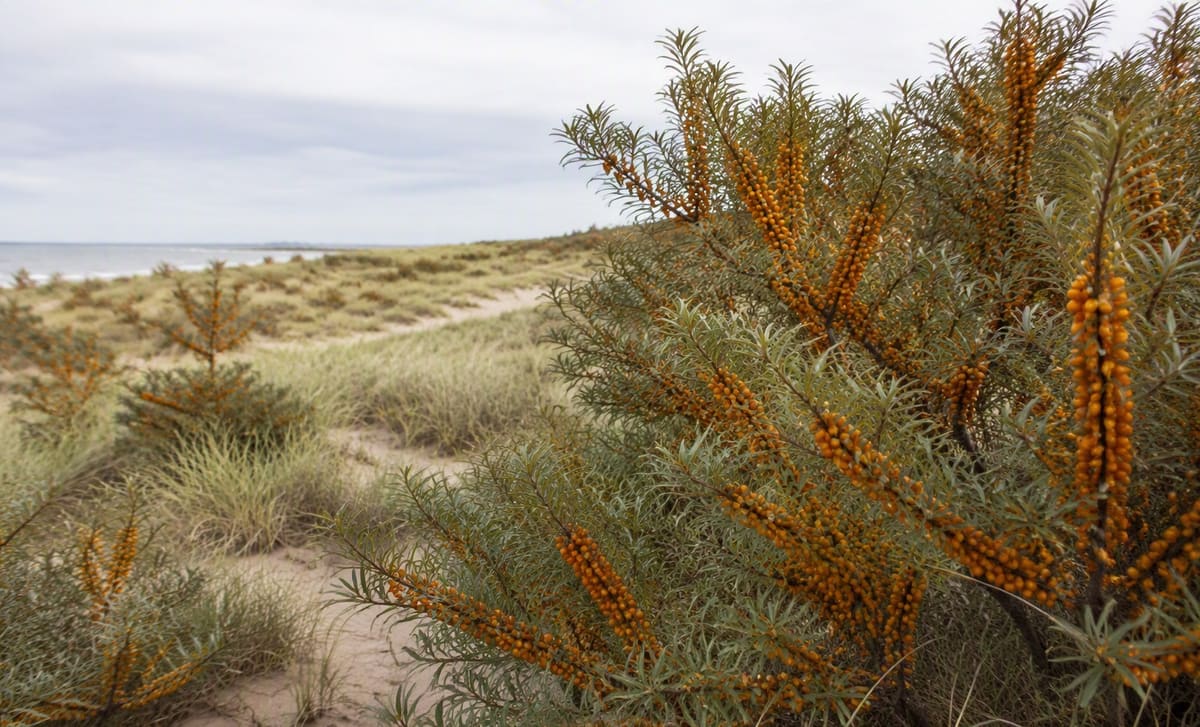
Sea buckthorn is native across temperate Europe and Asia, with its stronghold in the Himalayas and on the Tibetan Plateau. It grows where other shrubs fail: deep cold, poor soil, salt wind, and drought, thanks to roots that fix their own nitrogen. That toughness is also why governments plant it by the hectare to reclaim damaged land.
The native range
The species’ natural range is a broad belt across Eurasia. It runs from coastal and riverbank Europe through Russia and Central Asia, all the way into China, Mongolia, and the Himalayan region. The Himalayas and the Tibetan Plateau are the famous heartland. Wild stands grow at high altitude there, and they supply the berries behind most premium supplement brands. What does an origin actually mean for oil quality and price? The regions hub compares the major ones side by side, and the plant hub covers identification in the wild.
What it tolerates
The short answer is almost everything except shade.
- Cold: deep continental winters that kill lesser shrubs.
- Poor soil: sand, gravel, and riverbanks work, because Frankia bacteria in its root nodules pull nitrogen from the air and feed the plant.
- Salt and wind: coastal dunes are classic sea buckthorn territory, which is how the plant earned the first half of its English name.
- Sun: it insists on it. Shade is about the only condition that reliably defeats it.
Where it has naturalized
Planted beyond its native belt for windbreaks and erosion control, sea buckthorn has naturalized in places including parts of Britain and North America, where it now fruits wild along coasts and prairies. In a few areas it spreads so assertively that it’s managed as an invader. That’s the price of a pioneer that suckers freely. For foragers, that spread is an opportunity: wild stands on public land often go unharvested, and the berry page covers what you’re picking.
Why governments plant it
Land reclamation is the plant’s second career, and it’s good at the job. A shrub that grows on barren slopes, stabilizes soil with spreading roots, enriches that soil with nitrogen, and survives neglect is exactly what eroded hillsides need. China has planted it on millions of hectares for that job, and the berries became a rural industry on top of the erosion control. Want the same toughness on a garden scale? Start with the growing hub.
Reading the ground for it
Wild stands announce themselves by habitat before you see a leaf. On coasts, scan the back of the dunes where the sand first stabilizes. Inland, work the riverbanks and gravel bars, the raw ground that floods keep clearing. In the mountains, look to south-facing slopes and valley floors above the flood line. The companion plants confirm it. Willows and poplars along the rivers, dune grasses on the coast, and very little taller than the shrub itself anywhere it leads.
The altitude story, honestly
The Himalayan stronghold grows at serious altitude, and premium brands lean hard on that fact. Here’s the honest reading. High-altitude plants do face harsher sun and cold, and stress shapes chemistry. But how reliably altitude improves any given bottle is less certain than the marketing suggests, which is the same question we put to the price tags in our look at what a premium bottle actually buys. What altitude does guarantee is remoteness, and the Indian Himalayan and Nepal pages describe the harvest reality up there: wild stands, hand picking, and long carries.
Finding it beyond the native belt
Outside Eurasia, the map is a record of plantings. North American stands trace back to shelterbelts and trial orchards, detailed on the US and Canada pages, and some have naturalized along the way. Britain’s naturalized colonies, on the UK page, fruit along stretches of coast. Each of these is findable with the field marks on the identification guide, and each falls under the rules on the foraging page. So yes, you can probably find it closer to home than you’d think.
Frequently asked questions
Where does sea buckthorn grow best?
Open, sunny ground in temperate climates, on soil other plants reject. It tolerates deep cold, wind, salt spray, drought, and poor sandy or gravelly soil, and its nitrogen-fixing roots let it feed itself on barren land. Its stronghold is the Himalayan region and the Tibetan Plateau, but it grows from European coasts to northern Asia.
Can I find wild sea buckthorn near me?
Depends on your continent. Across temperate Europe and Asia, check coasts, dunes, and riverbanks. In North America and Britain, look for naturalized plantings rather than truly wild stands, often near old shelterbelts or along certain coasts. The regions pages map it area by area.