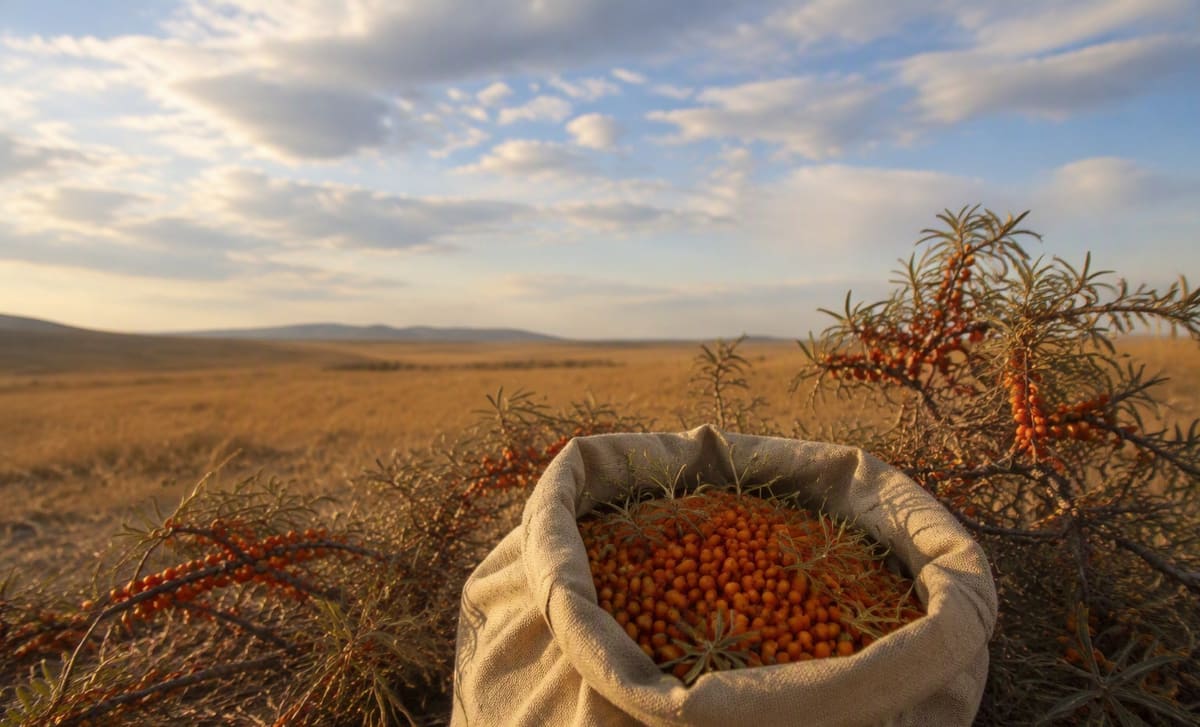
Mongolia meets sea buckthorn the old way. The shrub grows wild across the country’s harsh interior, along rivers and in mountain valleys, and the harvest is a gathering tradition rather than an orchard industry. Short summers and brutal winters shape a small, tough berry with a long local history.
Gathered, not farmed
Mongolia is a herding culture, and sea buckthorn fits that pattern: families gather the berries in autumn from stands nobody planted, for juice, for drying, and for the oil used in traditional remedies. Cold that kills lesser fruit is normal here, so the shrub thrives with zero help. The where it grows page explains why this terrain suits it so well.
The modern turn
Mongolian berries now travel. Small processors turn the wild harvest into juice and oil for export, and the wild-gathered story is exactly what makes them interesting to buyers abroad. Volumes stay modest by design: you cannot scale a harvest that depends on what the mountains produce. Neighboring China shows the opposite model, planting at industrial scale, while Russia to the north shares the same wild stands and added breeding.
Buying notes
A “wild-harvested Mongolian” claim is structurally plausible, since gathering really is the industry model. The usual questions still apply: a named producer, the plant part in the bottle, and honest handling of a berry that spoils fast after picking. Wild origin also means season-to-season variation, so expect it.
The same hand-gathered pattern runs through the Himalayan belt, as the Nepal page shows, and the regions hub has the full map.
The steppe terroir
Mongolia runs on extremes: winters among the coldest inhabited places on earth, short bright summers, and dry continental air. The shrub meets all of it unbothered, fruiting in river valleys and mountain pockets across the interior. Berries here grow small and intense, because nothing about the steppe encourages softness. The season is short, the stands are scattered, and the harvest is measured in baskets rather than tons.
The gathering culture, closer
Autumn gathering fits the rhythm of a herding society: families pick what the valleys offer, dry or freeze the berries for winter, and press or simmer what the kitchen needs. The berry’s folk-medicine role runs deep in the region, a tradition the Tibetan medicine page sets in context, and older legends tie it to the steppe’s most famous era on the Genghis Khan page. Lore aside, the use record is long and unbroken.
The etiquette of the open steppe
Mongolia’s land feels open, but the harvest is not ownerless. Herding families know which stands they pick, and a visitor filling bags from a good patch is taking someone’s winter supply. The rule is the Himalayan one: ask, taste a handful, leave the rest. The foraging page covers the picking craft itself.
Reading the wild claim, precisely
Wild Mongolian supply chains are short by necessity: gatherers, small processors, exporters. That shortness is the buyer’s friend, because fewer hands mean fewer places for the story to break. Ask who gathered, who processed, and how the berries traveled from valley to bottle, and a genuine operator will enjoy the questions.
Why it never industrialized
Everything about Mongolia resists the orchard model: the distances, the winters, the herding economy, and the wild stands themselves, which already produce without planting. The result is a supply that stays small and wild not by marketing choice but by geography. For buyers, that makes the wild claim easier to believe here than almost anywhere else, and the verification questions above easier to answer. Geography, for once, does the marketing department’s job honestly, which is more than most brochures manage.
Frequently asked questions
Is Mongolian sea buckthorn wild harvested?
Mostly, yes. Mongolia's sea buckthorn grows in natural stands along rivers and mountain valleys, and the crop is gathered by hand rather than harvested from orchards. Volumes are small and seasonal, which is the trade-off for genuinely wild berries.
Can visitors gather sea buckthorn in Mongolia?
A tasting handful with local permission, yes. A bagful, no. The wild stands are gathered by herding families as winter supply and income, so the open steppe is not a free harvest. Visitors do better buying from the small processors who turn the gathered crop into juice and oil.