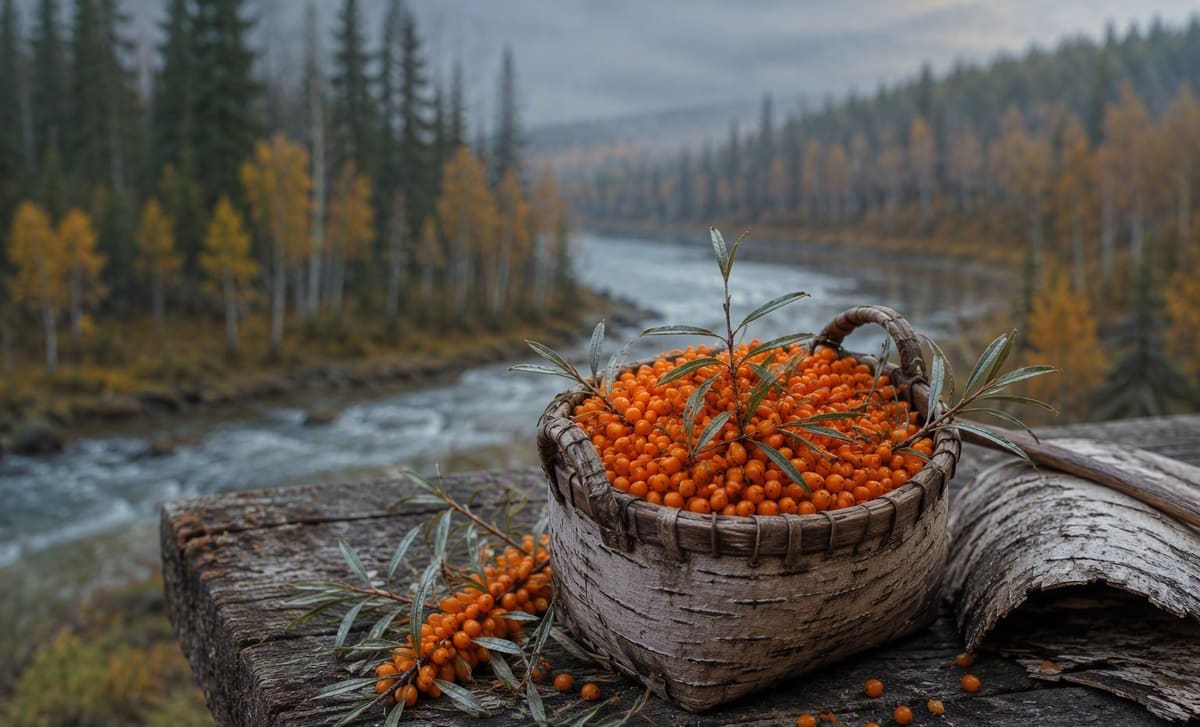
Russia is sea buckthorn’s breeding homeland. The wild shrub crowds river valleys across Siberia and the Altai, Soviet-era programs turned it into the sweet, large-berry crop grown worldwide today, and the berry holds a place in Russian kitchens and folk use that few countries match.
The Altai homeland
Wild sea buckthorn grows thick along the rivers of the Altai and across Siberia, and Russians have gathered it for centuries: for preserves, for oil, for winter vitamins. The tradition never really broke, which is why sea buckthorn products in Russian shops range from home-style jams to pharmacy oils. The same mountain system continues into Mongolia, where the harvest stayed wild.
Breeding changed the berry
Starting in the Soviet period, breeders in Siberia selected the traits that made sea buckthorn a real crop: larger berries, more sweetness, fewer thorns, easier harvest. Those varieties spread to Europe and later to North America, where Canadian orchards grow them today. The varieties page explains what the breeding achieved, and the cosmonaut story covers the space-program chapter that made the berry famous at home.
Buying notes
“Siberian” is one of the most common words in sea buckthorn marketing, so ask what it means on each label: berries actually grown in Siberia, a Siberian-bred variety grown elsewhere, or just a brand story. All three exist. After that, the usual checks apply: named producer, plant part, and a realistic price for a genuine oil, the same test we put the premium bottles through.
The regions hub places Russia on the full map, and China shows where planted volume eventually went.
The Altai terroir
The Altai valleys give the shrub its reference habitat: cold continental winters, bright summers with long days, and river corridors of stony, well-drained soil. Wild thickets there fruit heavily enough to have fed gathering traditions for centuries. When breeders later wanted starting material, this is where they came, because the wild population was both huge and varied.
What the breeders actually changed
The wild berry is small, ferociously sour, thorn-guarded, and glued to the branch. Soviet breeding programs attacked all four: larger fruit, higher sugar, fewer thorns, and stems that release at harvest, with oil content selected alongside. The cultivation history page traces how a riverbank wildling became an orchard crop inside a few decades, and the modern industry page follows what happened when those varieties met world markets.
The kitchen tradition
Inside Russia the berry never needed marketing: home preserves, juices, and pharmacy oils are ordinary goods, and dacha plots grow the bred varieties as standard fruit shrubs. That domestic normality is the deepest proof of the breeding work, because a fruit that holds a place in everyday kitchens has passed the only test that lasts.
Reading the Siberian label, precisely
Three products hide behind the word. Berries genuinely grown and gathered in Siberia. Siberian-bred varieties farmed in Canada or Europe. And a brand story with no address behind it. The first two are legitimate and different, the third is decoration, and the label that names a producer and a region is the only one that lets you tell them apart.
For the cold-climate grower
The bred varieties are the practical choice wherever winters bite: they berry earlier, bigger, and sweeter than wild stock, and the nursery trade has spread them across the northern hemisphere. The growing hub covers what any of them need in the ground. The Altai’s other gift is proof of concept: if a variety fruits there, your winter will not frighten it. That is the quiet promise behind every Siberian-bred name on a nursery tag, from Helsinki to Saskatoon. Few breeding programs anywhere have traveled so far, or fed so many.
Frequently asked questions
Why is Siberian sea buckthorn famous?
Because Siberia and the Altai are where modern sea buckthorn breeding happened. Soviet-era programs selected sweet, large-fruited, easier-to-pick varieties that spread to orchards worldwide, so Siberian on a label signals that breeding heritage.
Does Siberian on a label mean grown in Siberia?
Not necessarily. It can mean berries grown in Siberia, a Siberian-bred variety farmed elsewhere, or simply a brand story. The first two are legitimate but different, so ask which one the label means, and look for a named producer and region before paying a premium.