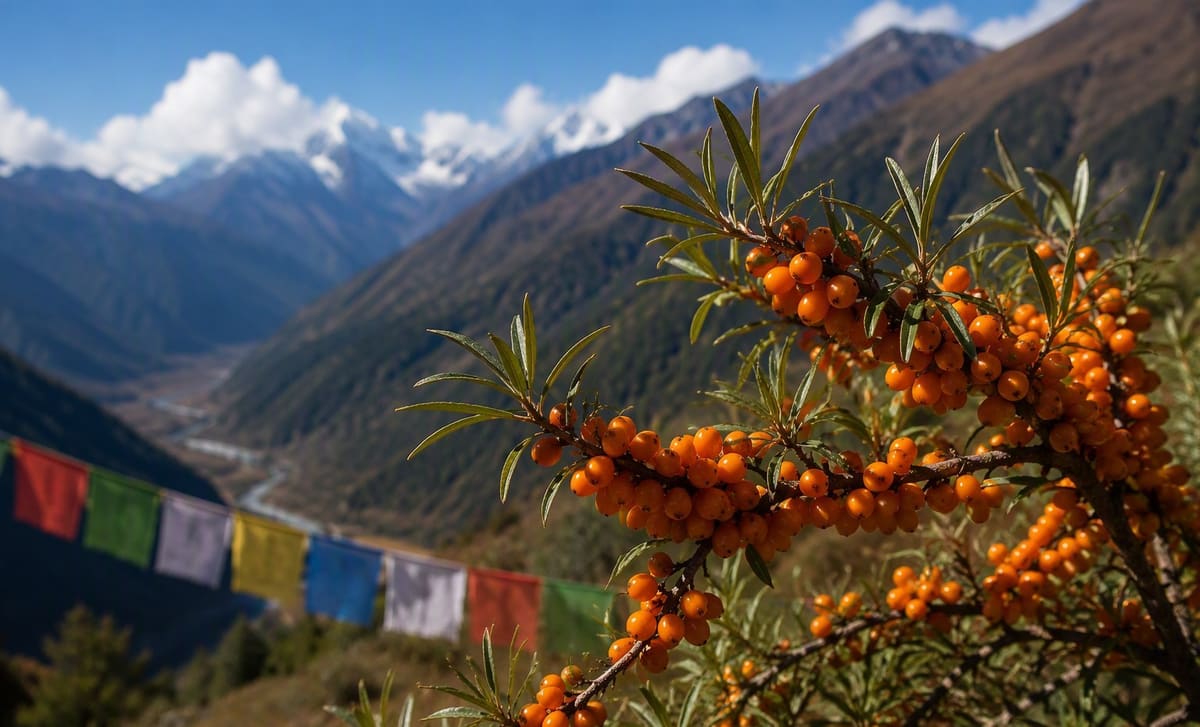
Bhutan’s sea buckthorn grows exactly where you would expect: wild, high, and scattered, along the cold river valleys of the eastern Himalayas. The country has no orchard industry for it. What exists is a gathering tradition and small local processing, which makes Bhutanese berries a niche inside a niche.
Wild stands, high valleys
The shrub is native across the Himalayan belt, and Bhutan’s higher valleys give it the cold winters and thin soils it prefers. Local people have gathered the berries alongside the wider mountain tradition, and the where it grows page shows how the same belt continues west into Nepal and India.
A small modern sector
Interest in value-added mountain products has put sea buckthorn juices and oils into Bhutan’s domestic market in small volumes, mostly framed as highland produce rather than supplements. Details are thin because the sector is thin: a handful of processors, a wild raw material, and seasonal supply. That honesty about scale is worth keeping in mind when Bhutanese origin appears on premium labels abroad.
Buying notes
If a label claims Bhutanese sea buckthorn, expect a small wild-gathered supply chain and ask who is behind it. Named producers matter more here than anywhere, because volumes are tiny and genuine product is the exception rather than the rule. After that, the standard checks apply, the same ones from our guide to choosing any sea buckthorn product: plant part, freshness, and a price that reflects real mountain logistics.
The belt continues in Himachal Pradesh, and the regions hub maps every origin we cover.
The terrain that shapes the berry
The eastern Himalayan valleys where the shrub grows are high, cold, and dry, with thin stony soils and sun that arrives at altitude strength. Plants stressed this way grow slowly and concentrate what they make, which is the honest mechanism behind the Himalayan potency story. The berries are small, the season is short, and every kilogram starts on a slope somebody climbed.
If you visit
Autumn is the window. Local markets in the mountain districts sell fresh berries in season, and small processors offer juices and oils framed as highland food rather than medicine. The wild stands grow along riverbanks and slopes, often far from roads. Altitude is the real gatekeeper: the valleys where the berries grow demand acclimatized legs and unhurried plans, and the thorns demand gloves regardless.
The etiquette of gathering
Wild stands in the Himalayan belt are effectively community resources, used by the villages nearest them. Visitors should treat them that way: ask locally before picking anywhere, take a handful rather than a bag, and leave the heavy harvest to the people whose economy depends on it. The foraging page covers the technique, thorns and all, that applies on any continent.
Reading a Bhutanese label
The country’s output is small enough that genuine product almost always carries a story: a named producer, a named valley, a small batch. Treat those details as the product. A label that borrows the mystique without naming anyone behind it has told you what it is. The deeper tradition the berries grow out of is covered on the Tibetan medicine page, which explains why this belt valued the shrub centuries before export markets did.
Why it stays small
Geography caps everything here. Steep valleys do not mechanize, wild stands do not scale, and mountain roads keep freight slow and costly. That is not a flaw in the Bhutanese model. It is the model: a small, wild, hand-gathered supply whose honesty is easier to verify than its volume. Small and honest beats large and mysterious in every aisle of this trade, and for a buyer willing to read labels, that is the whole point of the origin.
Frequently asked questions
Does sea buckthorn grow in Bhutan?
Yes. It grows wild in Bhutan's high river valleys, part of the same Himalayan belt that runs through Nepal and northern India. There is no orchard industry; the berries are gathered from wild stands on a small scale.
Can tourists pick sea buckthorn in Bhutan?
Only with local permission, and a tasting handful at most. The wild stands are gathered by nearby communities and count as local income, not public fruit. Visitors do better buying juice and oils from local processors, which supports the same mountain economy without touching the harvest.