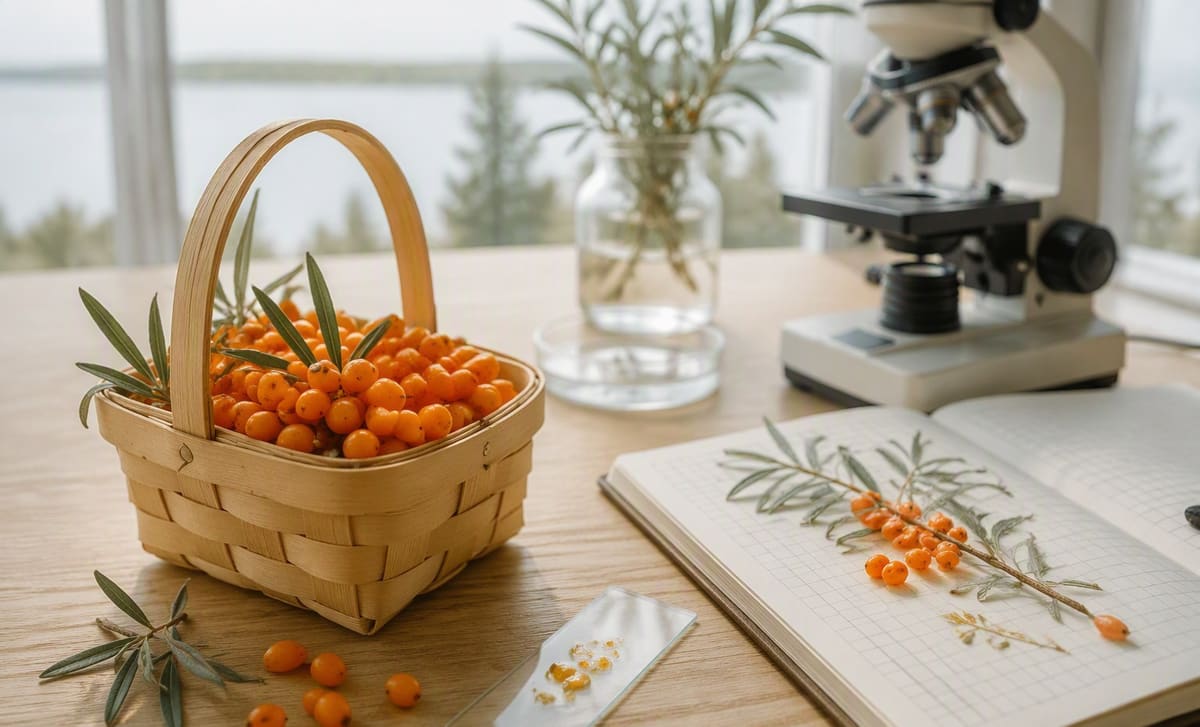
Finland punches far above its weight in sea buckthorn. The shrub is native to the Finnish coast, the country produced a remarkable share of the modern clinical research on the berry, and Finnish growers work with bred varieties under some of the most northerly farming conditions on earth.
Native berry, research country
Finns know the shrub as tyrni, growing wild along the southwestern coast and archipelago. Wild-berry gathering is part of Finnish culture generally, and sea buckthorn joined that tradition despite its thorns. The regions hub compares Finland with the other origins.
Then Finnish researchers gave the berry modern credibility. The flagship is the dry-eye trial: about a hundred adults, 2 grams of oil daily, measured across a full winter, with results the dry-eye trial page walks through. The winter mattered, because the condition is hardest in the cold months and a real effect has to survive them. A small country produced the study every sea buckthorn page cites. That’s what “research star” means in practice.
The archipelago terroir
The southwestern coast gives the shrub a mild maritime version of the north: cool summers, long light, and winters that freeze without prairie brutality. What the latitude removes in heat it returns in day length, and Finnish berries ripen under some of the longest summer days on earth. The crop stays small because the coastline that suits it is finite, and much of it is protected.
Bred for the north
Finnish breeding programs selected varieties for short, cool summers and reliable ripening at high latitude, work the varieties page puts in context. Small orchards grow them commercially, and the sector leans organic, with careful labeling that reflects the country’s food culture.
Those bred varieties matter beyond Finland too. They ripen where others fail, so they suit any cold-temperate garden. The climate page maps what the shrub tolerates, and northern gardeners should know the only real enemies are shade and wet feet. Not cold.
Germany is the other European research center, with a bigger processing industry, and Russia next door supplied much of the breeding material Europeans started from.
The tyrni shelf
Inside Finland, tyrni products are ordinary rather than exotic: juices, jams, and oils in normal shops, priced as food. That domestic normality is itself a quality signal. A product that survives on a skeptical home shelf has less to prove abroad, and Finnish products travel well for the same reason: they were built for buyers who already know the berry and priced for people who buy it weekly.
Visitors should shop like Finns. Juice for the table, oil for the shelf, no ceremony about any of it.
For the visitor
Finland’s roaming tradition is famously generous toward wild-berry pickers, but sea buckthorn plays by stricter local rules where it grows in protected archipelago and dune areas. Check before picking. The easier route is the autumn market season, when berries and juices appear alongside the rest of the wild harvest and farm shops sell the bred-variety crop.
Buying notes
Finnish products usually cost more than bulk imports, and the reasons are structural: small northern harvests, domestic processing, organic certification. If a Finnish label matters to you, check that the berries are Finnish-grown rather than only Finnish-packed, then check which oil is in the bottle, berry or seed.
For the continental picture, the Europe page sets Finland in its neighborhood.
Frequently asked questions
Is sea buckthorn native to Finland?
Yes. It grows wild along Finland's southwestern coast and archipelago, where it is known as tyrni. Finland also grows bred varieties in small orchards and has produced a notable share of the modern research on the berry.
What is tyrni?
Tyrni is simply the Finnish name for sea buckthorn, the same shrub and berry. On Finnish labels it signals a domestic product, usually from bred northern varieties or coastal wild stands, with the careful labeling Finnish food culture is known for.