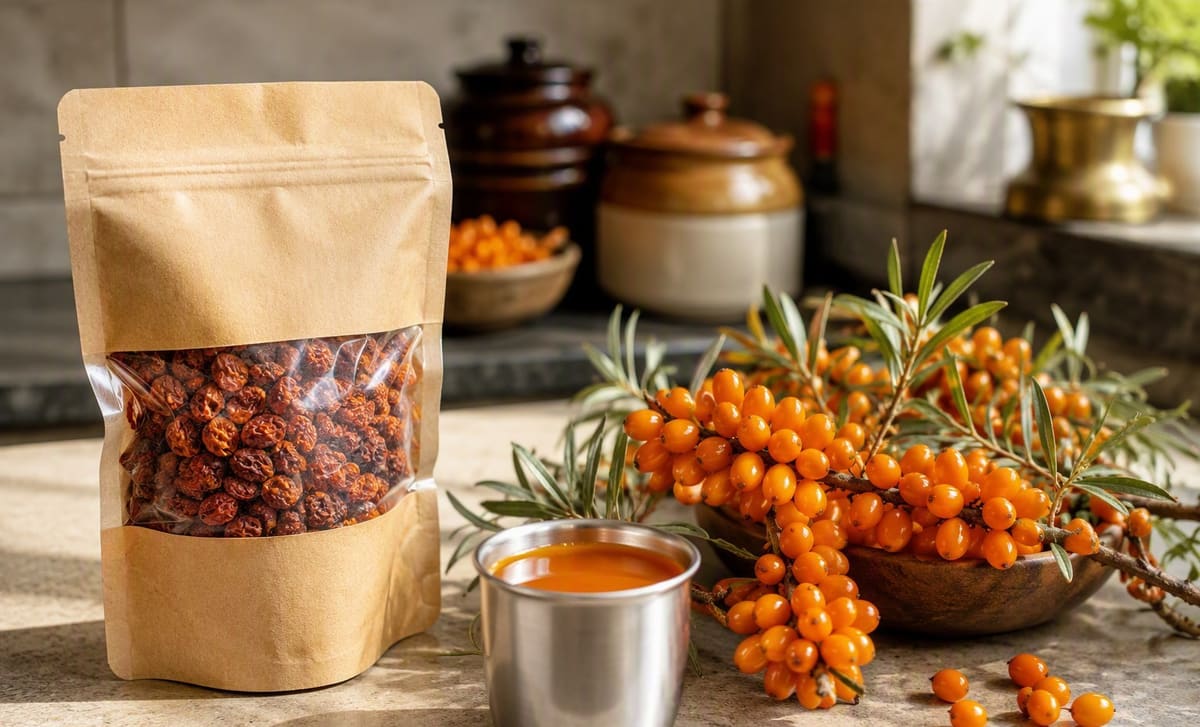
In India, sea buckthorn is the Leh berry, and you can buy it as juice, oil, capsules, and dried berries from Ladakh cooperatives, domestic brands, Ayurveda stores, and marketplaces like Amazon India and Flipkart. Most people search Leh berry because the fruit is named after Leh in Ladakh, where it grows. On any juice or supplement, look for the FSSAI logo and its 14-digit licence number, the mark that says the food business behind it is licensed.
Why Indians search “Leh berry”, not sea buckthorn
The name is the whole story. The berry grows across the cold desert around Leh in Ladakh, and a Leh-made juice put the term into shops and search bars, so Leh berry became the everyday Indian name. The Ladakhi name for the plant is tsermang, and the fruit is tsestalulu, but those stay local. There is no old Hindi word for the plant either, because it never grew in the Hindi-speaking plains, and the sea buckthorn in Hindi page walks through every name Indians actually use. If you want to find products online in India, Leh berry is the phrase that works, with sea buckthorn as the botanical backup. The regions hub maps where those berries are grown.
That popular juice has a real origin. The Leh Berry brand grew out of technology developed by the DRDO’s high-altitude research laboratory in Leh, which formulated a sea buckthorn drink that would not freeze in the sub-zero cold of Siachen and then passed the method to local groups and entrepreneurs. The Leh berry brand review digs into what that lineage means for a shopper today.
Ladakh sourcing and the domestic brands
Ladakh is the heartland, and the neighbouring high valleys of Himachal’s Lahaul-Spiti work the same way. Much of the harvest, wild-gathered and increasingly cultivated, moves through local cooperatives and self-help groups that press it into juice, oil, jam, and dried berries. A cooperative label matters to a buyer twice over: it usually means traceable origin, and it means the picking communities share the margin. Domestic brands then sell nationally through their own sites and the big marketplaces. The India region page maps the sourcing, and the Himachal Pradesh page covers the valleys next door.
The label mark that matters: FSSAI
Here is the single most useful thing to check in India. Food, juice, and health supplements are regulated by the FSSAI, and a compliant product carries the FSSAI logo alongside a 14-digit licence number. That number means the manufacturer or importer holds a valid licence under the Food Safety and Standards Act. A juice or supplement with no FSSAI logo and number is one you should put back on the shelf.
Products sold specifically as health supplements or nutraceuticals carry more: the category word, Health Supplement or Nutraceutical, printed on the pack, and the mandatory line that the product is not intended to diagnose, treat, cure, or prevent any disease. India’s green dot for vegetarian and brown dot for non-vegetarian also apply to these foods.
One honest nuance. If a sea buckthorn product is sold as an Ayurvedic medicine rather than a food or supplement, it is licensed under the AYUSH framework and the Drugs and Cosmetics Act, so it carries an Ayurvedic licence number instead of an FSSAI food category. The mark to look for depends on how the product is sold, but for juices and supplements, FSSAI is the one.
| Label line | What good looks like | Why it matters |
|---|---|---|
| Regulator mark | FSSAI logo plus a 14-digit licence number, or an AYUSH Ayurvedic licence | It shows the business behind the product is licensed |
| Category | Health Supplement or Nutraceutical printed on the pack | FSSAI requires the category to be stated for supplements |
| Veg or non-veg mark | Green dot for veg, brown dot for non-veg | It is a mandatory Indian food-label symbol |
| Plant part | Berry, seed, or blend, named | It decides which fatty acids you are buying |
| Origin | Ladakh or a named Himalayan source, ideally a cooperative | Source at the origin is the freshest and most traceable |
Sea buckthorn juice price in India
What should a bottle cost? Juice is where most Indian buyers start, so here is a real snapshot of the sea buckthorn juice price across the mainstream brands, read off their online listings in August 2026. Treat it as a range, not a fixed rate. Discounts swing week to week, and the printed MRP sits well above the street price on most days.
| Brand and product | Size | Listed price, Aug 2026 | MRP |
|---|---|---|---|
| Kapiva Sea Buckthorn Juice | 500 ml | around ₹540 to ₹600 | ₹699 |
| Nutrabud Sea Buckthorn Juice | 500 ml | around ₹390 | ₹749 |
| Leh Berry Seabuckthorn | 300 ml and 1 L packs | from around ₹249 a bottle | varies by pack |
| Ayuzera WellWith Sea Buckthorn pulp | 300 ml | around ₹765 | ₹849 |
Two honest notes on that table. First, compare per 100 ml, not per bottle, because a 300 ml concentrate and a 500 ml ready drink are not the same buy. Second, the famous Patanjali sea buckthorn product is a capsule, not a juice, so searches for a Patanjali juice mostly land on third-party combos rather than a Patanjali-made bottle. The WellWith and Ayuzera review and the Patanjali review go through what each label actually says. And remember the recurring point from the juice explainer: juice is a tart vitamin C food, not the concentrated oil the trials dosed, so buy it for the taste and the vitamin C, not for the studied benefits.
Two terms trip up the search. Sea buckthorn pulp is the thicker, less-diluted press some brands bottle, like the Ayuzera pulp above, and it costs more per 100 ml because there is simply more fruit in it. And the sea buckthorn fruit price is a different question from the juice price. Loose or frozen berries, sold by the kilo near the source in autumn, run cheaper than any bottled drink, though they are hard to find outside Ladakh and the hill markets. For the ranked bottles behind a search for the best sea buckthorn juice in india, the juice buying guide scores them one by one.
Does it grow in India?
Yes, and India is a genuine producer. Sea buckthorn grows across the high trans-Himalayan belt, with Ladakh as the famous heartland, plus Himachal Pradesh, Sikkim, and Arunachal. The shrub thrives at altitude in poor soil and brutal winters, conditions the lowland climate cannot offer, which is why production stays in the mountains. For Indian buyers that means domestic, near-source fruit is a real and often excellent choice. The India region page tells the growing story in full.
Before you buy
Decide plant part and dose first. Berry oil leans toward omega-7, seed oil toward omega-3 and 6, and the seed versus berry page is the decoder. Locally pressed juice is a tart food, not a studied supplement, so enjoy it as one and mind the acidity notes on the safety page. For the full quality check, use the how to choose guide, and compare scored products in the juice and oil guides.
Comparing markets abroad? The UK, Canada, and Australia buying pages cover each country’s rules.
Frequently asked questions
Why is sea buckthorn called Leh berry in India?
Because it grows around Leh in Ladakh, and a Leh-made juice popularised the name. The Ladakhi name for the plant is tsermang, with the fruit called tsestalulu, but most Indian buyers and sellers use Leh berry, which is why it is the term people search.
What should be on the label of Leh berry juice in India?
The FSSAI logo with its 14-digit licence number, the ingredient list, the veg or non-veg mark, and manufacturer details. A product sold as a health supplement also shows its category and the line that it is not intended to diagnose, treat, cure, or prevent any disease.
Where can I buy real Ladakh sea buckthorn?
From Ladakh cooperatives and self-help groups near the source, from domestic brands online, and through marketplaces like Amazon India and Flipkart. Buying near Leh in autumn gets you the freshest fruit, and a named cooperative label points to traceable origin.
Is Leh berry the same as sea buckthorn?
Yes. Leh berry is the popular Indian name for sea buckthorn, the shrub Hippophae rhamnoides. The same fruit is sold worldwide as sea buckthorn or seaberry, so a Leh berry juice and a sea buckthorn juice are the same thing under two names.